
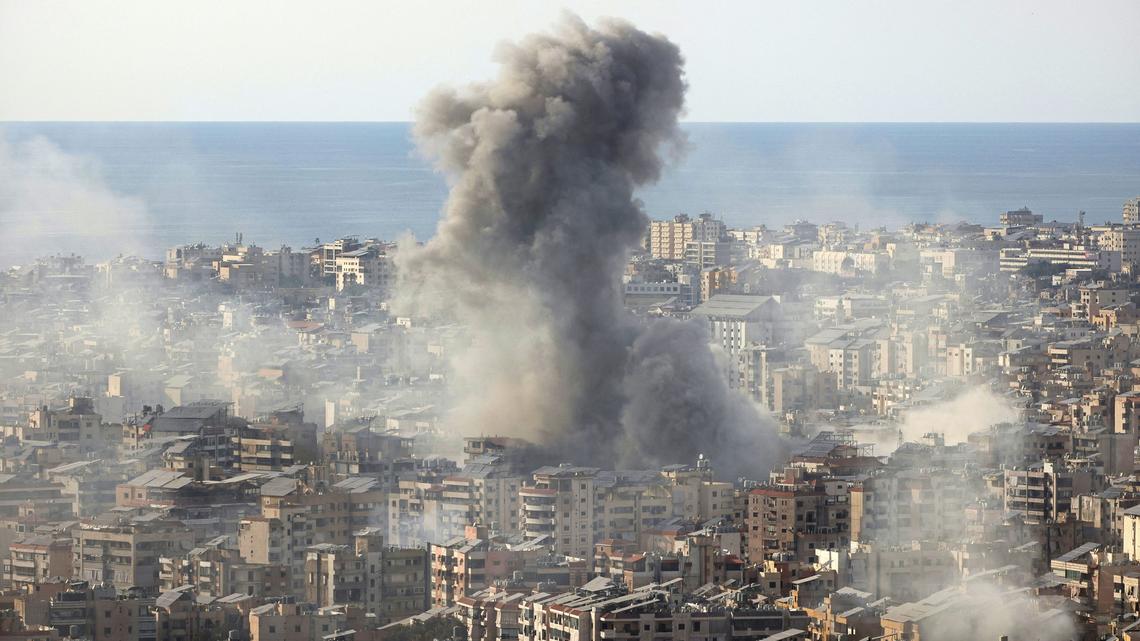
Smoke rises from the site of an Israeli airstrike in Beirut’s southern suburbs on March 6, 2026. Each of us can support humanitarian aid for victims of the U.S.-Israeli war with Iran as we encourage an end to the conflict.
Ibrahim Amro/AFP
TNS
Each of us can support humanitarian aid for victims of the U.S.-Israeli war with Iran as we encourage an end to the conflict. One of the dangers of the war is the creation of another humanitarian crisis in the Middle East. More than 1,000 civilians have been killed in the attacks. Displacement and hunger are inevitable, as the conflict has spread to numerous countries across the region.
It’s critical to prepare for what could be a broader humanitarian disaster, which means establishing sufficient funding. In Lebanon, where Iran-backed militants are fighting Israel, the UN World Food Program and Catholic Relief Services are helping those in need.
According to World Food Program USA, Samer AbdelJaber, UN World Food Program regional director, said that “within hours of shelters opening in Lebanon, WFP was on the ground — providing hot meals, ready-to-eat rations and bread to families who had nowhere else to turn.” The World Food Program says 30,000 individuals have already been displaced by the recent fighting. This number is likely to climb.
But providing aid will continue to get more difficult if the war continues. This is critical because there are numerous hunger emergencies in the Middle East, including in Yemen, Gaza and Syria. “Across the region, the humanitarian supply lines are under growing strain,” AbdelJaber said. “The rising security risks in the region are choking shipping routes and disrupting aid delivery.” One of the silent but severe consequences of war is its impact on children. Hunger, fear and disease all strike at once in a war zone, with lasting consequences for children.
The United Nations Children’s Fund is calling for a cessation of hostilities, stating the “military escalation in the Middle East marks a dangerous moment for millions of children in the region.” With numerous conflicts and food shortages worldwide, humanitarian agencies are facing major funding shortfalls. These shortages come at the worst time when people need help the most. There is famine in war-torn Sudan, which has become the largest hunger crisis impacting neighboring countries too. There is hunger in Gaza, Congo, Syria, Yemen and the Sahel region. With so many large relief missions in war zones, funding needs are increasing. But donations have not kept pace with escalating hunger.
Sadly, relief agencies have been forced to reduce rations or even cancel programs as a result. The war with Iran is going to add another humanitarian emergency on top of many others. Humanitarian aid funding needs to increase to meet this challenge. Sadly, the Trump administration has drastically reduced humanitarian funding and canceled many programs.
Consider financially supporting a humanitarian agency or asking your elected officials to support funding for humanitarian aid and to encourage peace in the Middle East. With so many wars, there is going to be extreme hunger and poverty for years to come. Such misery and instability is no recipe for peace.
William Lambers is the author of “The Road to Peace: From the Disarming of the Great Lakes to the Nuclear Test Ban Treaty.” He also partnered with the UN World Food Program on the book “Ending World Hunger.”
Related Stories from Sacramento Bee