
From cancelling a federal student loan repayment program to attempting to cut diversity programs, the Trump administration’s attacks against higher education have thrown universities into uncertainty.
Workers at the University of California have found what they think might be a solution: unionize.
On Wednesday, workers in communications, marketing and sales at the University of California, representing 2,000 people statewide and 200 in San Francisco, voted at an 82 percent clip to form a new union with United Auto Workers.
It marked the third time in recent months that U.C. workers formed a new union with UAW. Student services and advising professionals unionized in April, and research professionals followed suit in September.
In total, that represents 12,000 new union members working for the University of California system.
“There’s a lot of exciting energy in the labor movement right now, and especially at U.C.,” said Rebecca Griffin, a member of the new communication workers union’s organizing committee and communications director at UCSF’s Bixby Center for Global Reproductive Health.
The creation of the Communications, Marketing, and Sales Professionals Union (CoMaS) brings the total number of U.C. workers represented by UAW to over 60,000.
At UCSF, which at 28,000 employees is the second largest employer in the city, that means about 1,600 people have, in the past 12 months, joined one of the three new unions, according to union estimates.
The three unions have similar demands: higher wages, increased job security, protections for international workers and more flexible work arrangements.
More than that, union leaders say this is also a way to defend their workers as attacks coming from the federal government have meant budget cuts, layoffs and hiring freezes.
“We’re realizing that, by forming a union like this, we now have a platform to protect the important work that we do that we care so much about,” said Eve Perry, a data scientist at UCSF and member of the Research and Public Service Professionals bargaining team.
In March last year, faced with financial uncertainty due to proposed federal budget cuts, U.C. implemented a system-wide hiring freeze.
In July, the Trump administration attempted to pull $584 million in federal funds to UCLA over the university’s supposed failure to fight antisemitism on campus. In exchange for releasing those funds, the federal government later demanded a $1.2 billion settlement from the University.
Most recently, four public health programs within UCSF have faced cuts due to the government’s plans to undo $600 million in Centers for Disease Control and Prevention grants.
U.C.’s unions have been fighting back. In September, UAW successfully filed a lawsuit against the Trump administration over the $1.2 billion fine. The university system did not join the lawsuit.
UAW is also working with U.C. on a state bill that would put a $23 billion bond to fund scientific research across California on the November 2026 ballot.
Potential strike brewing
Two of the recently formed U.C. unions are currently in contract negotiations. Negotiations for Student Services and Advising Professionals started in July, and Research and Public Service Professionals commenced in October. But eight months in, negotiations are grinding to a halt.
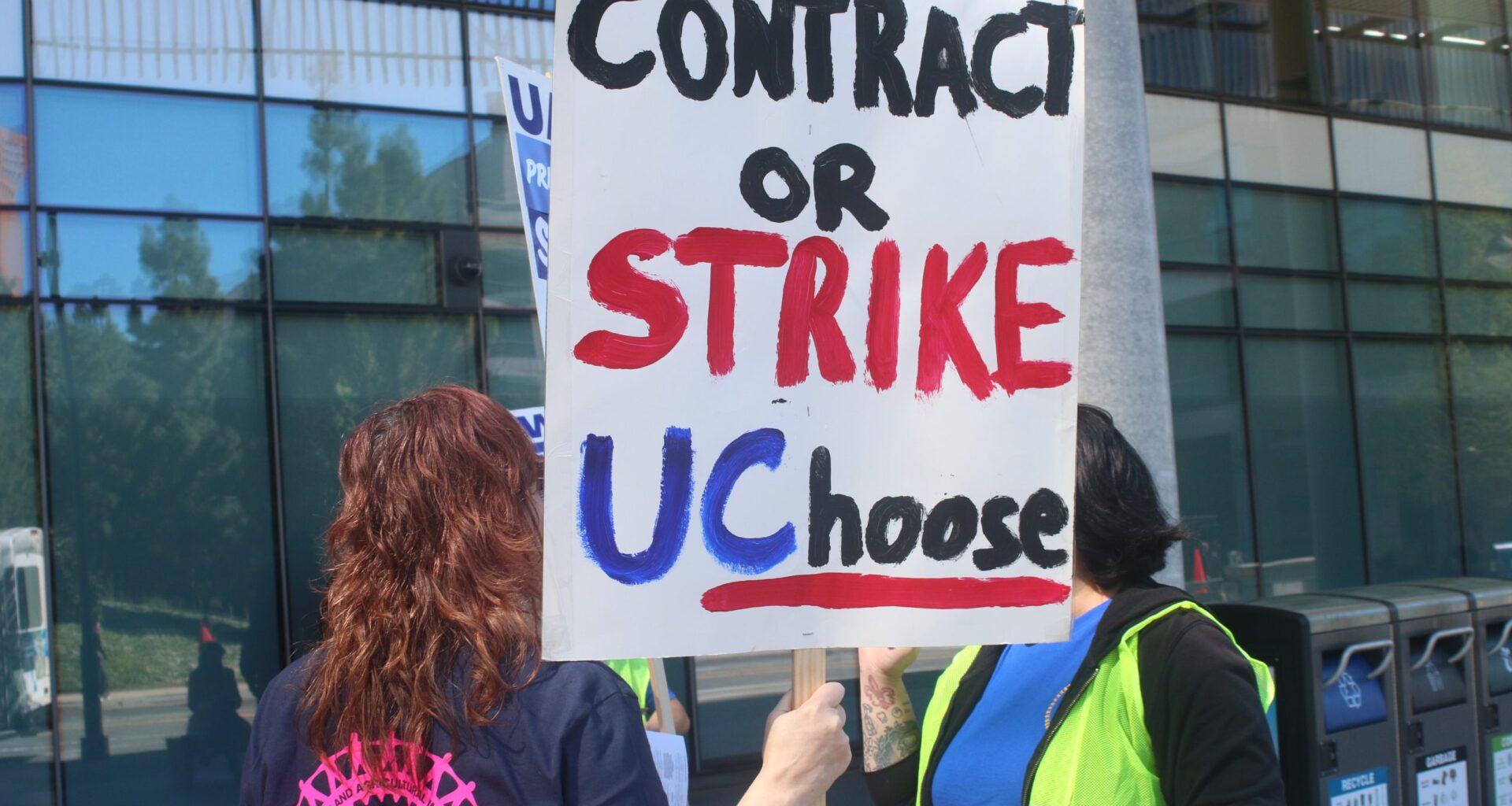
On Thursday, U.C. workers across the state walked picket lines as a “last chance” measure. In San Francisco, 100 employees held a demonstration before the Weill Neurosciences building in Mission Bay.
Three U.C. unions have already voted to authorize a strike, with 93 percent voting in favor out of 23,300 voting members.
Union leaders say the university has not been acting in good faith in the negotiations and engaging in unfair labor practices.
In an emailed statement to Mission Local, the University of California’s Office of the President said it “strongly disagree[s]” with the unions’ claims.
“These negotiations are complex because they encompass multiple bargaining units that cover academic student employees as well as newly represented staff employees transitioning from policy-covered roles into union-covered positions,” the statement read. “Our focus is on making real progress while ensuring any agreements are financially sustainable and workable across the entire UC system.”
Asked about the newly formed union, the Office of the President acknowledged its formation, and added that “UC respects our employees’ right to choose whether to organize” and “look[s] forward to working with them in good faith.”
The unions will decide whether or not to strike by Sunday. If a work stoppage occurs, it could come as early as next week, said Riley Stockard, graduate student researcher at UCSF.
Across the state, that would represent close to 40,000 people on strike. At UCSF, that would be about 2,000 people.
“I think it’s a really important time for people just to see the power of the labor movement and understand, how more full and strong we are when we are working in solidarity with one another,” Griffin said. “I’m very excited to see what we and other UAW unions at U.C. can get done.”