
A federal judge has dismissed a lawsuit challenging a longstanding San Diego law that has helped fund thousands of units of affordable housing, a decision advocates hope will deter future legal challenges.
The lawsuit, filed by the developers of a proposed 1,642-unit project in Kearny Mesa, sought to exempt the development from complying with San Diego’s inclusionary housing ordinance.
First enacted in 2002, that law requires developers of new residential housing either to include affordable units on-site or to pay a fee that helps fund affordable housing elsewhere in the city.
The project’s developer, G.H. Palmer Associates, argued the ordinance was unconstitutional, saying it amounted to an unlawful “taking” of private property by requiring a fee or on-site units.
U.S. District Judge Dana Sabraw disagreed. Developers can choose whether to build housing, he wrote in his ruling. If they do, they must comply with the city’s development rules.
Representatives of the company did not respond to a request for comment.
City officials praised the decision.
“This decision is an important victory for San Diego and reinforces the city’s ability to adopt and enforce policies that promote housing affordability and economic inclusion,” City Attorney Heather Ferbert said in a statement.
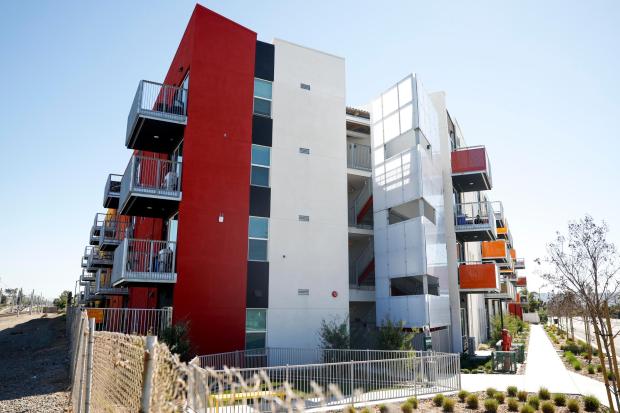 Iris at San Ysidro was received $2.3 million from inclusionary housing fees. (Meg McLaughlin / The San Diego Union-Tribune)
In his 26-page ruling, Sabraw noted that courts have long allowed governments to regulate housing, including through rent control and tenant protections, even when those rules affect property owners.
The deadline for the plaintiff to appeal Sabraw’s ruling expired Feb. 26, effectively ending the litigation.
San Diego’s ordinance currently requires new developments to set aside 10% of units for low-income households for at least 55 years. Developers can instead pay an “in-lieu” fee — currently $25 per square foot — into the city’s affordable housing fund.
The ordinance applies to projects with five or more units in coastal areas, and to those with 10 or more units elsewhere.
In 2025, the city committed roughly $12.5 million in fees to affordable housing programs. The money helped fund rental housing and accessory dwelling units and housing for people experiencing or at risk of homelessness.
The ordinance was first approved by the City Council on Aug. 6, 2002, as part of a daylong agenda dedicated solely to affordable housing, but it has faced challenges over the years.
The in-lieu fee started at $1 per square foot in 2003, gradually rising to $2.50 per square foot, making it more attractive for developers to pay the fee rather than include affordable units. The Building Industry Association sued over the ordinance that same year.
With the fee scheduled to nearly triple by July 2006, the BIA pushed for a compromise that preserved the program but changed when the fee was assessed and froze increases for several years, significantly reducing the amount of money flowing into the city’s affordable housing fund.
Inclusionary housing laws are common across California. As cities adopted the policies, developers challenged San Jose’s version of the ordinance in a case that ultimately reached the California Supreme Court, which upheld the law in 2015. The U.S. Supreme Court later declined to review the case, leaving the ruling intact.
In 2019, then-City Council President Georgette Gómez led an effort to strengthen San Diego’s ordinance, creating stricter affordable housing requirements and raising the in-lieu fee.
Then in 2023, G.H. Palmer — a firm led by Los Angeles developer Geoffrey Palmer, a prominent Republican donor who had previously challenged affordable housing regulations — took the challenge to federal court.
Sabraw initially dismissed the case as premature, saying the city had not yet made a final decision about whether the Kearny Mesa project would have to comply with the ordinance.
The developer sought an exemption. Even though the city never made a final determination on the project, Sabraw concluded in his January ruling that the dispute was concrete enough for the court to decide whether the ordinance violated the Constitution.
Stephen Russell, the executive director of the San Diego Housing Federation, said courts have repeatedly upheld inclusionary housing policies despite ongoing legal challenges.
“Does this mean the door is closed on challenges once and for all? One would think so,” Russell said. “But we thought that before.”
Russell said the lawsuit appeared to him to have relied on legal arguments that have repeatedly failed in court.
“My impression is that the developer tried to throw every previous failed legal theory at the wall, and nothing stuck,” he said.