

Recent court rulings on tiered water rates are creating confusion and uncertainty at water agencies across California — including in San Diego, where one of the rulings will mean rate hikes for most single-family homes.
The confusion stems from conflicting rulings by separate California appellate courts last year on tiered rates, which aim to reward conservation by charging heavy water users more per gallon than people who use less.
San Diego’s use of tiered rates was ruled unconstitutional last April by the Fourth District Court of Appeal, forcing the city to abandon tiers and then hike rates by roughly $6 a month for about 150,000 single-family homes.
But tiered rates in Los Angeles were vindicated in December by the Second District Court of Appeal, allowing L.A. to continue using tiers and leaving other water agencies confused about what’s legal and what isn’t.
“A lot of agencies are scratching their heads,” said Lutfi Kharuf, an attorney who represents water agencies for the firm Best, Best & Krieger. “The uncertainty is bad for everyone.”
Some optimism emerged this week when the state Supreme Court, which declined in October to consider hearing San Diego’s appeal of its case, announced it will hear an appeal by the plaintiffs in the L.A. case.
But until the California Supreme Court issues a ruling — likely not until 2027 or even 2028 — the uncertainty will remain, and San Diego must abide by the appeals court ruling in its case.
That ruling says San Diego must replace its tiered rates with uniform rates within each of its customer classes — single-family homes, businesses, industrial users and apartments and condos.
Early analysis by city officials indicates that change will have the biggest impact by far on single-family users, with a $1 monthly reduction likely in bills for heavy water users and a $6 hike likely in bills for light users.
The changes to the rates are somewhat skewed by the need for the city to reward the heavy users for winning the case by paying them damages in the form of lower rates — amounting to nearly $120 million.
Heavy users are typically homes with large lawns, a pool or both, city officials said.
The rate hike for most single-family homes is not included in previously announced city rate hikes — some of which are already approved while others are expected in coming years.
 Fishing boats and kayakers take advantage of being out on the water at San Vicente Reservoir on Monday, Jan. 19, 2026, in Lakeside. (Nelvin C. Cepeda / The San Diego Union-Tribune)
In January, the city released an analysis saying water rates must go up 44.2% between 2028 and 2031 even though the City Council agreed in October to raise them a cumulative 31.3% this year and next.
If the council ends up approving additional hikes that steep when they come to a vote next year, the cumulative six-year rate increase would amount to more than 90%.
And this new $6 monthly fee hike will boost that percentage jump even higher for about two-thirds of the city’s roughly 225,000 single-family-home customers, city officials said.
“This ruling forces an unfair outcome for San Diego ratepayers,” Mayor Todd Gloria said Thursday. “It shifts more costs onto customers who use the least water and rewards those who use the most. That is exactly backwards.”
Gloria defended the city’s rates and methodology for determining them.
“San Diego followed a rate-setting methodology widely used by water agencies across California to comply with Proposition 218 while keeping rates equitable, and this decision creates negative consequences for our city and real uncertainty for water providers statewide,” he said.
Proposition 2018 prohibits government agencies from charging more for a service than it costs to provide, which can make things complicated for incentives that reward conservation or other behavior.
To defend its tiered rate structure in court, the city argued that higher rates were justified by the differential between local and non-local water supply costs.
The city said water supplied to low-volume users came mostly from cheaper local water stored in reservoirs, while water supplied to high-volume users was mostly more expensive, imported water.
Another rationale for tiers was that the city could have a smaller overall water system — fewer pump stations and pipes — if it had fewer heavy users.
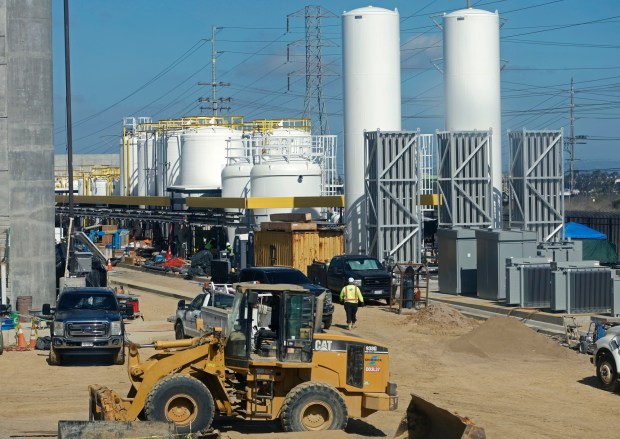 Construction continues at the North City Pure Water Facility chemical tank farm on Oct. 22, 2025, in San Diego. (K.C. Alfred / The San Diego Union-Tribune)
In 2021, a Superior Court judge rejected those arguments, ruling in favor of the plaintiffs, declaring the city’s tiers unconstitutional and ordering the city to pay nearly $80 million in damages.
The city appealed that ruling and made the case to the Fourth District Court of Appeal that the city should only have to show that its rates reasonably reflect its costs for service.
In a 2-1 ruling last April, an appeals court panel said “reasonable” is not the litmus test, and that the city must show, “with substantial evidence withstanding independent review, that the agency’s water rates are proportional to the ascertainable costs of service that can be attributed to specific parcels.”
The ruling said the city must employ time-of-use metering to show it was using one water supply for low-volume users and another water supply for high-volume users.
City officials asked the state Supreme Court last summer to review — and possibly overturn — the ruling in the case. They said this week there had been optimism for a review based partly on the opinion from the dissenting appeals court judge.
“The defendant used the only known methodology for constructing a tiered cost calculation and allocation and setting tiered rates, and it applied that methodology to all of the appropriate data and the only data that defendant had, which is the only data that anyone has (with the possible exception of any utilities that use smart meters),” said Judge Frank Menetrez. “Holding the defendant liable for that is like holding an accountant liable for using generally accepted accounting principles.”
But the Supreme Court informed city officials in October that it won’t review the appellate court ruling.
So the City Council will be asked in June to schedule a September public hearing where a new rate structure lacking tiers will be voted on. It would take effect in January.
The estimated $6 monthly hike for most single-family customers comes from a cost-of-service study that hasn’t been finalized, city officials said.
That study could be affected by ongoing negotiations over the damages in the case between attorneys for the city, the Superior Court judge who issued the 2021 ruling and the plaintiffs — a class led by Daniel Patz.
With interest, the damages have risen to nearly $120 million.
City Attorney Heather Ferbert declined any comment, citing the litigation.
Council President Joe LaCava called the ruling a bad decision.
“By rejecting the widely accepted and Proposition 218-compliant methodology, this ruling creates significant uncertainty,” he said. “While the city of San Diego will comply with the order, we acknowledge that it creates confusion for other water agencies across California and will be financially challenging for many of our city’s customers.”
In addition to ratepayers in the city of San Diego, the projected water rate changes would affect customers in Coronado, Imperial Beach and Del Mar who are part of San Diego’s water system.