
A few weeks ago, The Oaklandside reported on what many saw as an exciting environmental development in West Oakland: a new barrier, made up of trees and shrubs, along Frontage Road, designed to block some of the particulate pollution generated by gas-burning vehicles. The Prescott Greening Project, as it’s called, is managed by an Oakland-based environmental group called Hyphae Design.
In recent years, research has found that high rates of vehicle exhaust in the area have led to “elevated rates of asthma, heart disease, and pollution-sensitive illnesses,” and that West Oakland residents have twice as many asthma-related hospital visits as the county average.
Community organizers, such as Margaret Gordon of the West Oakland Indicators Project, spent years looking for a solution to pollution for a community that has faced decades of underinvestment. A new report by the National Institutes of Health shows exactly how WOIP, with partners, managed to gather this data — and how trees have played a big role in pollution reduction.
After our story appeared, we heard from readers excited about the tree planting project. But we also heard from readers with deep ties to arbory who were a little skeptical of the effort. They celebrated the fact that the plantings were going in, but they were worried about the choices the project’s designers made for that green barrier.
One reader expressed frustration at the failure to emphasize native plants. Others noted that certain plants on the list, especially bottlebrushes, produced large amounts of “highly allergenic” pollen.
Bottlebushes, they said, had a score of 9 out of 10 on the Ogren Plant Allergy Scale, or OPALS, a system created by arborist Tom Ogren 26 years ago and outlined in his best-selling book “Allergy-Free Gardening” as a way to measure pollen’s effect on people.
“It would be a shame to spend all that time and money to replace one form of pollution (freeway particulates) with another (allergenic pollen),” the reader wrote, “I recommend that the folks in charge of choosing the plants for this project consult the OPALS rating for these plants before they plant.”
The claim piqued our interest, as Ogren’s OPALS system has gained acceptance in many parts of the world in recent years. In Canada, the OPALS scale was used for a nationwide allergy audit, and in the U.S., its use has been promoted by the American Association of Medical Colleges and the California Public Health Department, particularly for asthma prevention.
Another reader expressed concern that some of the trees chosen by the contractor, Hyphae Design, were non-native plants that are not adapted to the region’s clay soils and “don’t support pollinators.”
So we took these concerns back to the Prescott Greening Project designers and asked them to explain their tree and shrub choices, which may not be final, since they have not yet begun planting the barrier, which abuts several apartment buildings. We also reached out to the inventor of the OPALS scale himself to ask him what he thought about Oakland’s plans — and whether the choices in West Oakland were really that problematic.
An explanation of the tree and shrub choices
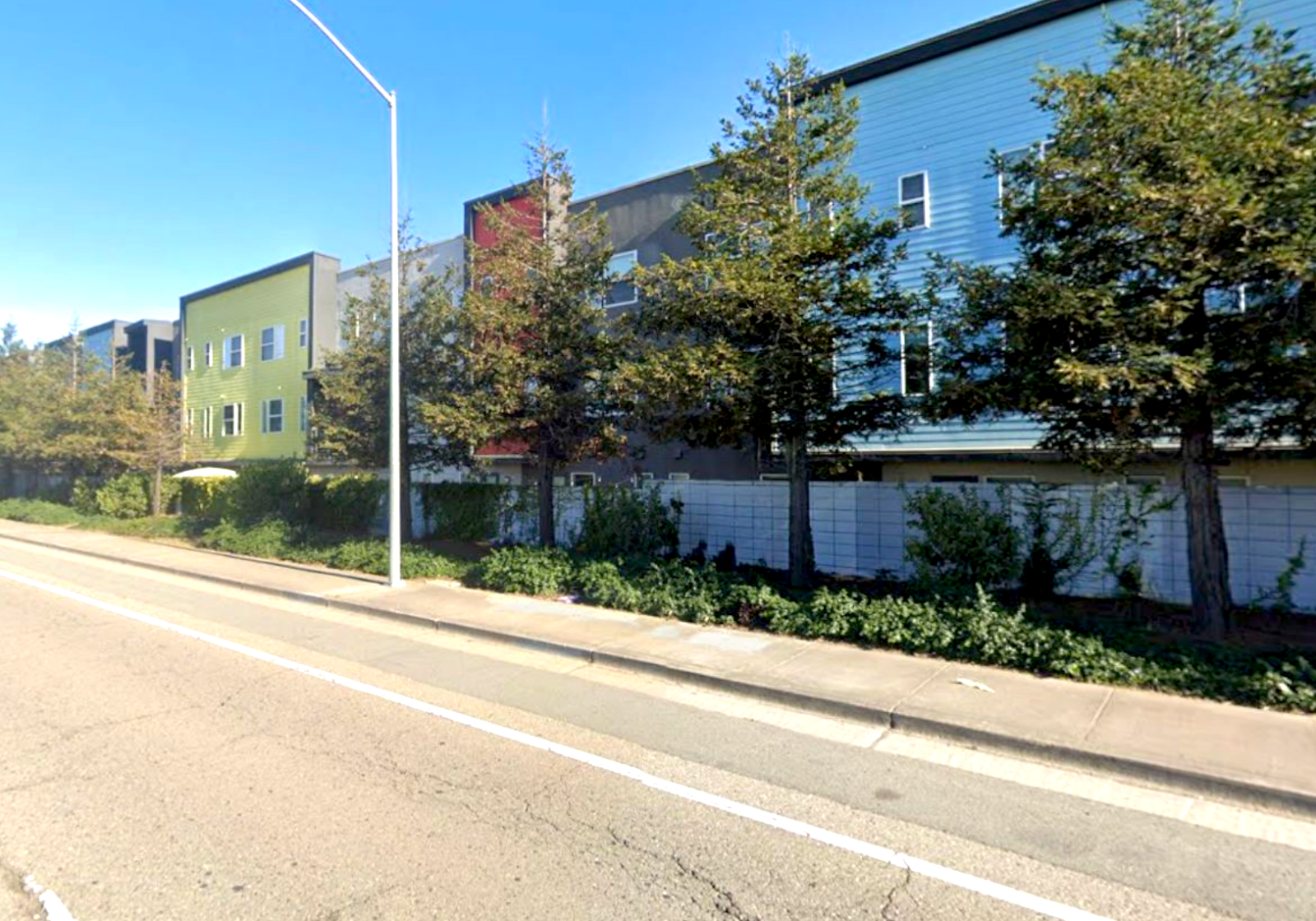 New trees and shrubs, including pines and California lilacs, will be planted along Frontage Road in March to reduce pollution in West Oakland’s Prescott neighborhood. The road currently has less dense plantings, pictured. Credit: Hyphae Design Credit: Hyphae Design
Mei Visco, the Hyphae designer on the project, used computer models to run through potential impacts for different plant selections for the project. She said the team did, in fact, look at plants’ OPALS scores — and found that the amount of pollen they generate likely won’t be a big issue.
Visco said that the bottlebrush variety they are using, Better John Bottlebrush, is small, at three to five feet tall, compared to other varieties that can reach 20 feet. They also decided to use only 15 bottlebrush plants as part of a 200-plant selection.
“While I can’t say for sure whether this would reduce the impact for people who have allergen issues with this particular plant, it is a small part of the overall buffer,” Visco said, adding that she has asthma and seasonal allergies and understood why other Oaklanders were wary of such a pollen-producing species.
The designer noted that the region’s most famous plant species, which gave the city its name, is Quercus agrifolia, the coast live oak, also has a high OPALS score.
“We don’t want to have an Oakland without oaks,” she said. “I think this highlights the difficulty of creating a plant palette in the city context.”
According to Hyphae Design, the complete species list for Frontage Road was reviewed and approved by city arborists at the trees department and by Matt Ritter, a biology professor at Cal Poly, San Luis Obispo, and the author of “A Californian’s Guide to the Trees Among Us” and “California Plants: A Guide to our Iconic Flora.”
Visco said the plant list includes a number of California native plants, including manzanitas, ceanothus, California coffeeberry, huckleberries, yarrow, and sticky monkey flower, which will fill out the barrier and allow birds and pollinator species to thrive.
Regarding the decision to incorporate some non-native species, Visco said the project’s pollution-reduction requirements narrowed their options.
“While we do have native trees on our tree list” — Visco mentioned Cupressus forbessi, or Tecate cyprus; Heteromeles arbutifolia, or toyon; Myrica californica, the Pacific wax myrtle; and Pinus torreyana, the island Torrey pine — “we couldn’t just plant those to the exclusion of all others,” Visco said. “You can see many of the other trees on this list planted all over Oakland, and doing fine in our clay soils.”
To create a true barrier that would maximize particulate blocking, the trees had to be evergreen species with long branches near the ground, be able to survive a warming climate, and be available in large quantities at nurseries for sourcing.
The tree plan also had to be biodiverse, or an invasion of pests or disease would risk destroying the whole project.
The guy who wrote the book on pollen allergies weighs in
Tom Ogren has studied thousands of plants for more than 35 years, from trees to flowers and everything in between, to better understand their effect on the environment and the people who live near them. His pollen rating system is respected, and so is his voice on pollen strategies and projects. He told us a green barrier in that part of Oakland “makes perfect sense” to block pollutants from reaching people living next to the freeway.
“It ought to be illegal to be building residential houses right next to the freeway because they’re known for what they call ‘a death zone,’ where people die 10, 20 years sooner than others,” he said.
Among the trees Hyphae Design mentioned for the project, the humble pine tree was a “perfect” choice to absorb pollutants, with its big, overarching branches, because it is drought-tolerant, evergreen, easy to plant in most soils, grows quickly, and has a long life. The arboriculturist said that he’d just come back from Hawaii, where he saw large pine trees next to freeways to protect surrounding communities from pollution.
But he said that the Oakland team needed to ensure that the pines they buy and plant are female. That’s because male pine trees produce a “prodigious amount” of airborne pollen.
“When they bloom, the males look like they’re on fire, so much that it looks like smoke coming out of them,” he said. “It’s pretty much a foolproof tree if you have the females. But if you plant a lot of them, and you don’t have females, whoever lives closest to the males is going to get swamped with the worst sort of pollen.”
Ogren said it was important to keep an eye on pollen counts of trees that are next to highways because when pollens combine with chemical air pollutants, they can break down into smaller particles and become even more allergenic, causing more breathing problems.
Ogen pointed to a picture of a microscope slide containing pine tree pollen behind a piece of window screen, showing how tiny the particles are — and how easily they can get through into people’s homes.
Regarding the bottlebrush that one reader most worried about, Ogren said the species’ pollen is very sticky and looks like little ninja stars. But he said they’re only liable to cause problems if you are very close to them.
He told the story of resident of San Luis Obispo, where he lives, who gave up the family dog thinking he was causing them serious allergies but later realized the problem was he’d been sleeping under a large bottlebrush plant and was routinely bringing the pollen inside.
“She realized after hearing me talk that what they needed to do was cut down the bottle brush and put in something different,“ Ogren said.
Looking at the Prescott Greening Project from an environmental impact point of view, Ogren said that almost any plant added next to the highway would be better than nothing — as long as it’s not a male.
“Blueberry trees, which they’re also adding in this project, don’t produce much pollen and they’d be alright, but they’re not particularly fast-growing,” he said. “But you could not come up with a better project to affect the health of more people in California than this particular project for the effort and the time and the money involved.”
.
“*” indicates required fields