
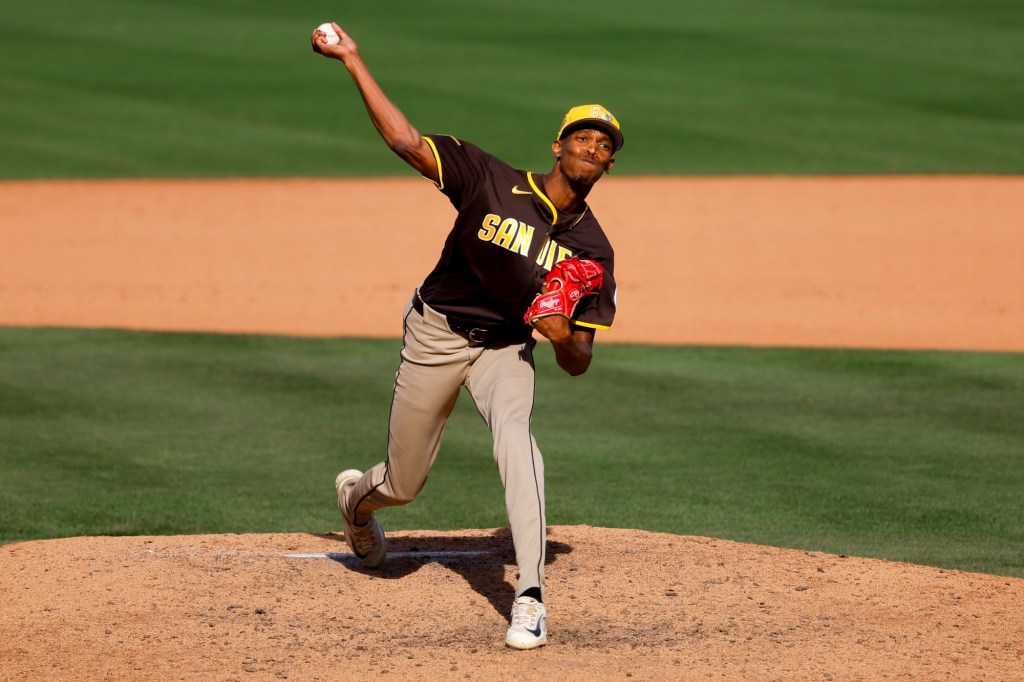
PEORIA, Ariz. — Triston McKenzie gained a little weight over the offseason. He pitched in winter ball for the first time. He is trying to make a team.
Other than that …
“I have no idea,” he said one recent morning.
The topic of interest was the velocity of his four-seam fastball and how it has increased immensely — up, on average, more than any other major league pitcher year over year.
McKenzie’s first three pitches this spring were clocked at 97.6, 98.7 and 97.8 mph. On March 5, in his most recent spring appearance, he hit 98.8 mph with one pitch and topped 97 six other times.
Those are the 10 fastest pitches he has thrown as a professional.
He had never before reached 97 mph in 442 career innings in the major leagues. And the seven pitches he has thrown between 96 and 96.9 mph were all in his major league debut in 2020.
He threw seven other pitches at least 95 mph that day and has done so just 52 other times in 3,976 pitches since.
Of his 72 fastballs this spring, 58 have been 95 mph or faster. His average fastball velocity this spring is 95.7 mph, up from 93.7 mph last season, which was the highest of his career.
The radar guns in Arizona this spring are not “juiced” to give pitchers a few extra ticks, though teammates have teased McKenzie about that.
The best explanation by scouts, coaches and McKenzie is that velocity gains show up at different times and that it does not hurt that he is motivated by the desire to earn a spot in the starting rotation.
“Everybody has been like, ‘Am I seeing this? Is this true?’ And I’m like, ‘I have no clue,’” McKenzie said. “I’m not doing anything different. Nothing has changed in my routine or anything like that. It’s just like I got out there in front of fans, a little bit more adrenaline, and I saw numbers that I hadn’t seen before.”
The 28-year-old McKenzie, who signed a minor-league contract with the Padres in December, is not some kid who has never succeeded in the major leagues. He was at one time excellent. The Cleveland Guardians were trying to lock him up long-term.
All of his 80 big-league starts were made in a Guardians uniform. That includes the 30 starts he made in 2022 while posting a 2.96 ERA over 191⅓ innings. He struck out a quarter of the batters he faced and had a 5.9% walk rate that season.
Dogged by elbow and shoulder injuries, McKenzie has appeared in just 24 games (20 starts) and has a 5.46 ERA over 97⅓ innings in the three seasons since. His walk rate ballooned to 15.6% and his strikeout rate shrank to 21.2% over that span.
He appeared in just four games (three starts) last season before being designated for assignment and then sent to the Arizona Complex League to work on his mechanics and tempo. He threw just seven innings over eight games in Triple-A at the end of the year before becoming a free agent.
McKenzie saw in the Padres a thin rotation and the chance to reunite with Ruben Niebla, who he worked with in the Guardians minor-league system and on the big-league club. He can be sent to the minors out of spring, but has a clause in his contract that allows him to opt out in June if he has not been called up by then.
“I’m not thinking about (June),” McKenzie said. “I’m thinking about today.”
The reality is, time is running short for him to make the opening-day roster.
The Padres might have two spots open — the fifth starter job and a fill-in role should Joe Musgrove not be able to go at the beginning of the season. Most inside the organization believe Walker Buehler and Germán Márquez are the leading candidates to fill those roles. But a team needs more than five starting pitchers to make it through 162 games.
McKenzie’s next chance to impress comes Friday in a Cactus League game against the Athletics.
“He’s here to compete for a major league job,” Niebla said when it was suggested that McKenzie was something of a project. “He’s gonna get another opportunity and another opportunity. He’s here to see how he’s gonna fit in this whole puzzle of making it through the season, whether it’s starting with the major league team or starting with Triple-A to help us later.”
The long-armed McKenzie’s success in the past has been more predicated on the deception of his fastball, which appears to rise as it approaches the plate, and a “plus” curveball, than high velocity.
“He’s got good stuff without the velo (bump),” manager Craig Stammen said. “The velo is an added (bonus). He has opened some eyes.”
The reality, however, is no matter how hard he is throwing, McKenzie needs to find the strike zone more if he wants a big-league job out of spring.
Just 57 of his 108 pitches (52.7%) have been strikes through his two Cactus League appearances (4⅓ innings). Seven hits and seven walks have led to his being charged with six runs.
“I know what the talent looks like up close,” Niebla said. “It’s been that (lack of command) the last few years of his career. It’s our responsibility, along with him, to be able to figure it out.”
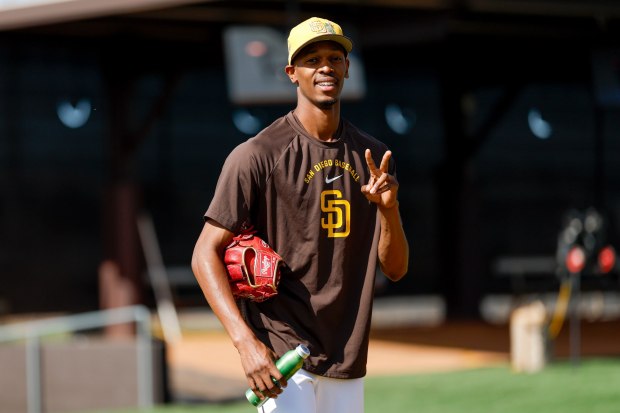 Triston McKenzie #25 of the San Diego Padres poses for a photo during their spring training workout at Peoria Sports Complex on Wednesday, March 4, 2026 in Peoria, Ariz. (Meg McLaughlin / The San Diego Union-Tribune)
McKenzie continues to work on his tempo during games. He likes the shape and location of his offspeed pitches in the bullpen, and then he misses in the game.
In addition to sometimes moving too fast, he said he needs to make better pitch selections at times.
“It’s not about trying to change the mechanics or trying to change the stuff,” he said. “It’s more just like figuring out what our plan of attack is — not necessarily going for strikeouts, more just pitching to contact and getting outs however we can in the shortest amount of time possible.”
McKenzie’s first walk and first hit in his March 5 outing came after he got up 1-2. The wind-aided home run he allowed came on a 96 mph fastball he sent to essentially the same place as the 96 mph fastball he had gotten a swing and miss on the previous pitch.
He followed that homer by getting two outs before a walk, a single and another walk ended his outing.
“Triston (came in) showing his elite stuff,” Stammen said. “Just got to get him in the zone a little bit more. He’s got a big future ahead of him. We’ve just got to take our time with him and get him working. … It’s a slow drip. Things aren’t gonna just change immediately. He has battled this for a little while now. So while the stuff is probably even better than what it was before and it’s really encouraging to see, you’ve got to be patient with guys like that. Because we can see how that stuff will play at the big-league level. It’s whether we can get him in the zone or not. I think we can. I think he’s willing to work with us and be patient. We’ll see how good of coaches we are.”