
For the third consecutive year, The Hollywood Reporter has handed Hollywood’s most coveted trophy to a group of revered Los Angeles artists and asked them to reinvent it. As happens every year, the resulting statuary would have Cedric Gibbons — the original Oscar artist who first whipped up the figurine in 1928 — spinning in his grave.
Previous Oscar art portfolios gave us Kenny Scharf launching the little gold man into deep space, Karon Davis recasting him as an ancient Egyptian deity and Austyn Weiner turning him into a mischievous mail-art project. This year’s class is no less unruly. Among the highlights: a glazed earthenware candelabra evoking a biblical oil lamp, a mirrored cupid doll titled This Is Spinal Tap, an Oscar in a wheelchair and one gold statuette sharing a still life with a loaded revolver. Idol worship this is not.
Because these works deserve more than just some spreads in a magazine, we’re bringing the portfolio off the page for the third time — following previous outings at Deitch and AF Projects — with an exhibition at West Hollywood’s Megan Mulrooney Gallery, March 12 through 21.
See you at the show.
Eddie Ruscha and Francesca Gabbiani

Eddie Ruscha and Francesca Gabbiani
Photographed by Roger Kisby
One of L.A.’s art-world power couples, Ruscha (son of Ed) and Gabbiani usually do their own thing: He makes trippy airbrush paintings and performs psychedelic techno under the name Secret Circuit; she crafts precise collages examining the SoCal landscape. But they’ve lately found a groove working together, most recently with The Messengers, which inaugurated Wilding Cran Gallery’s new Melrose Hill space. For this portfolio, they turned that collaborative energy on the Oscar statuette (see previous page), pairing its silhouette with agave plants — those spiky SoCal roadside fixtures that spend years building toward one spectacular, towering bloom. “The agave’s final act feels more like a culmination than an ending,” says Gabbiani. “The Oscars always give this feeling, too — an annual flowering in our creative community before we begin again.”
Eddie Ruscha and Francesca Gabbiani turn the Oscar into an agave plant in full bloom for THR’s third annual Art of Oscar portfolio.
Photographed by Roger Kisby
Nicki Green
Nicki Green
Courtesy
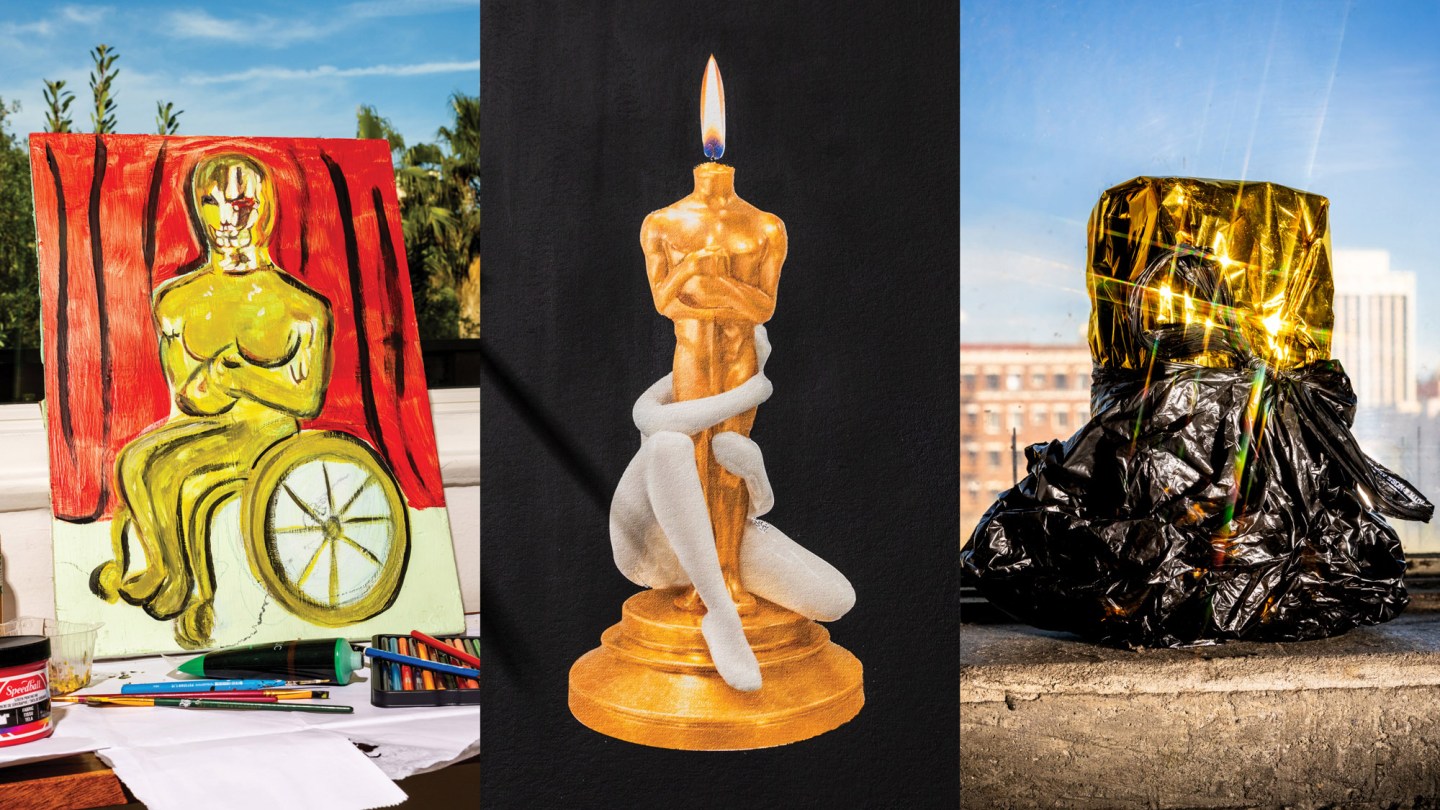
Green’s cerebral ceramics have landed at the New Museum, the Musée d’Art Moderne de Paris and the Museu de Arte de São Paulo, with pieces in the permanent collections of London’s Victoria and Albert Museum and LACMA. It’s not a leap to expect her reimagining of the Oscar to be multi-layered. Her contribution is a miniature candelabra that scrambles the original statuette’s anatomy — Oscar here is a bi-gendered androgyne cradling twin fermentation crocks instead of a sword, ringed in esoteric symbolism. “I was thinking about beeswax as gold, a biblical material — oil lamps in the tabernacle,” says Green. “As a lamp with candles, this form will ideally accumulate more and more beeswax, becoming more and more gold over time.”
Greta Waller
Greta Waller
Photographed by Michael Buckner
Before Waller was landing prime solo booths at Frieze Los Angeles with her luscious paintings of melting ice, glistening cherries and glittering cityscapes, she spent a decade working as an EMT while raising three sons. Multitasker is an understatement. For this portfolio, she started by thinking about all the Oscars that have been lost or damaged or have gone missing over the years — including Whoopi Goldberg’s, which was lifted in 2002 while being shipped for cleaning and turned up in an airport dumpster. “I was positioning these two faux statues I had — one of which I broke — on top of one another in an ice bath surrounded with oysters,” she says. In a nod to Titanic, she calls it Hold On Jack.
Aryo Toh Djojo
Aryo Toh Djojo
Photographed by Michael Buckner
Toh Djojo makes noirish, airbrushed paintings that run L.A. iconography, UFO culture and art history through a cinematic haze. His contribution here is a canvas called The World’s a Stage: a Hollywood Sign hovering beneath a glammed-up, watchful eye. “I have been exploring the visual language of comics and graphic design,” he says, using them to take on “Hollywood as a constructed spectacle, addressing the illusion it presents alongside the pressures and suffering tied to awards culture, while hinting at the darker forces and hidden narratives that exist beneath its glamorous facade.”
E. Barker
E. Barker
Photographed by Roger Kisby
“I’m inspired by cursed objects,” says Barker, “so I made this cursed painting of an Oscar award in a wheelchair.” Barker, a 2025 Guggenheim Fellow, has used a wheelchair since being diagnosed with paraplegia following an accident at 19 — and has been exploring exclusion in artworks ever since: flags that sag and buckle, vacuum-formed sculptures referencing spaces built to shut disabled people out, performances that recast the body as a site of resistance. The wheelchair-bound Oscar zeroes in on what Barker calls “the frightening lack of wheelchair users in Hollywood.”
E. Barker
Photographed by Roger Kisby
Salomón Huerta
Salomón Huerta
Photographed by Roger Kisby
Salomón Huerta grew up in the Boyle Heights projects, and his paintings — L.A. pools, modernist houses, gang members from his childhood — have landed at the Whitney Biennial, LACMA and Gagosian. But his most personal work may be his Daily Ritual series: spare, quietly unsettling canvases pairing his father’s revolver with everyday objects — a Tecate, a pan dulce, a pair of peaches — each one a memory of the gun that sat on the bedroom table like it was just another piece of furniture. For his Oscar piece, Hollywood’s coveted trophy gets the same treatment. “It’s possible people would find the collision of an Oscar paired with my father’s gun as shocking or in poor taste,” he says. “But I’m asking people to think about what is truly more shocking or dangerous: the potential violence implied by the elements in this painting or the number of this year’s nominated films that are centered around gun violence?”
Kelly Lamb
Kelly Lamb
Courtesy
Lamb’s contribution to this portfolio is a blown-glass, mirrored cupid/baby doll she’s titled This Is Spinal Tap — a nod to Rob Reiner’s classic mockumentary about artists who believe their own hype a little too completely. Stare at it long enough and you’ll see yourself staring back. “The absurdity and spectacle of the art world,” is how Lamb describes what she was trying to capture. She knows that world well; her multidisciplinary practice spans sculpture, photography, video, ceramics, furniture and product design, with shows at MOCA, the New Museum, Art Basel and the Armory Show.
Daniel T. Gaitor-Lomack
Daniel T. Gaitor-Lomack
Photographed by Roger Kisby
Gaitor-Lomack’s multimedia practice runs from action paintings made with paint-soaked dodgeballs to durational performances, and his recent solo show at Night Gallery, “You Can Hate Me Now,” crammed the American psyche into a room full of star-spangled cowboy hats, golden ashtrays, helium balloons and plastic car bumpers hanging from the rafters. For this portfolio, the NXTHVN Fellow, whose work sits in the Hammer Museum’s permanent collection, stripped things down: a brick wrapped in gold, cinched in a black plastic bodega bag. It’s a sharp little commentary on a moment when films of uprising are all over the nominations. “Sometimes you catch a brick,” says Gaitor-Lomack. “Sometimes you catch a gold brick.”
Daniel T. Gaitor-Lomack
Photographed by Roger Kisby
Erick Medel
Erick Medel
Photographed by Michael Buckner
Medel makes needlepoint paintings on denim with an industrial sewing machine, and his subjects aren’t generally movie-related — they’re the laborers keeping L.A.’s film industry, and the city itself, running. For this portfolio, he stitched a workman hammering away as an Oscar helps keep a window open for him. “I wanted to pay homage to the people working behind the scenes, whether in the industry or simply keeping this city going,” he says.
Frances Stark
Frances Stark
Photographed by Roger Kisby
L.A. legend Stark is the kind of artist who turns her sex life into paintings, her online affairs into animated films and a pop-up shop into a full lifestyle moment — complete with a Conspiracy Theory poncho and her own Panpharmacon perfume. Provocateur is basically her job title. So when asked to reimagine the Oscar statuette, she reached back to a previous, considerably less glamorous life. “Believe it or not, I once worked as a photo editor at an agency that supplied paparazzi images to tabloids,” she says, “and I was perplexed to discover that my boss — a real brute — was a voting member of the Academy.” The result: a fragrance bottle fused with an Oscar-shaped candle, its gold head slowly melting. Magritte with a Hollywood hangover.
Frances Stark
Photographed by Roger Kisby
Charles Arnoldi
Charles Arnoldi
Courtesy
Charles “Chuck” Arnoldi won the LACMA Young Talent Award in 1969 and has been reinventing abstract painting and sculpture ever since — with work in MOMA, the Met and LACMA, as well as a slot in the legendary “Documenta V” in 1972. He also had a cameo in pop culture history when Dennis Hopper cast Bob Dylan to play a version of him in the 1990 film Catchfire. More recently, he’s been bending rebar into sculpture and collaborating with British fashion house Alexander McQueen. For this portfolio, he did something he almost never does: “I don’t really think about the Oscars, and I don’t make figurative work,” he says. “But there’s a human quality to this particular sculpture because it has legs and these morphing human forms. I guess you could say that’s a commentary on the chaos that accompanies the Oscars race every year.”
Jessie Homer French
Jessie Homer French
Courtesy
Homer French, now 86, came to this portfolio the old-fashioned way: through her late husband’s subscription. Robin French — the mega-agent who represented everyone from Elizabeth Taylor to Marlon Brando before becoming head of production at Paramount — left behind, among other things, his THR account. Leafing through last year’s Oscar issue, Homer French was inspired enough to paint an Oscar lying among the King Clone creosote, an 11,700-year-old plant considered one of the oldest living organisms on Earth. “It’s ancient, so I thought about what’s old and what lasts,” she says. “Gold lasts, but do Oscars last?” At her stage in life — and with her landscapes exhibiting at the Venice Biennale, the Hammer’s “Made in L.A.” biennial and now, in the pages of her late husband’s favorite magazine — she’s earned the right to ask.
Alex Becerra
Alex Becerra
Courtesy
Becerra barely had his diploma from Otis College of Art & Design before landing on the cover of Modern Painters and in Cultured’s Young Artists portfolio. Since then, he’s been considered a painter’s painter — capturing jazz icons, heroes from his Mexican heritage, his wife and his own recognizable bearded face — while also staging gonzo solo shows featuring live music, DJing and a faux Mercedes that’s half instrument, half sculpture. His Oscar contribution is the “Ozcar”: a three-dimensional figure sculpted from clay and built up with the same thick impasto oil paint that distinguishes his canvases — a statue, in other words, fit for perching. Says Becerra, “The award goes to the idealized Mexican male form, forgotten only to be used as a loitering point for seagulls’ discharge.”
This story appeared in the March 11 issue of The Hollywood Reporter magazine. Click here to subscribe.