

 (Illustration by Joe Dworetzky/Bay City News)
This is an opinion piece. We value the diverse opinions of our readers and we welcome robust, wide-ranging thoughts and ideas on subjects relevant to Mendocino County. The following opinion is not representative of The Mendocino Voice, its publisher, editor or staff. Opinion pieces can be sent to info@mendovoice.com.
Don Perata is a former California state senator who served as president pro tempore of the state Senate from 2004 to 2008.
It doesn’t happen often in today’s politics, but sometimes bitter rivals from different parties arrive at the same conclusion at nearly the same moment because the facts leave little room for denial. That’s what happened this month on housing.
Governor Gavin Newsom recently put a spotlight on a problem Californians know all too well: large institutional investors and private equity firms are buying up Golden State homes at scale, crowding out working families and first-time buyers. Homes, he argued, should be places to live — not just financial assets for Wall Street portfolios. President Donald Trump followed suit by signing an Executive Order on the same subject.
Different parties, same diagnosis.
And they’re right: America’s housing crisis is being exacerbated by Wall Street money flooding into a market already constrained by limited supply. And unfortunately, California is ground zero for that reality.
One in five homes is a corporate asset
Roughly one in five homes in California is now owned by corporate investors, representing well over a million properties statewide. That matters enormously in a state that has underbuilt housing for decades and now faces a multi-million-unit shortage according to recent state data. As a result, median home prices are near historic highs, and less than one in five California households can afford the median-priced home.
Meanwhile, California’s rate of homeownership, which has historically lagged behind the rest of the country, has declined dramatically. In California, the average age of homeowners is 49 years old. By comparison, across most of the United States that average age is 35.
Only 43.5 percent of Californians aged 25–75 were homeowners in 2021, down from 49.8 percent in 2000. The decline was even more pronounced for Californians aged 35-45, where home ownership declined from 49.5 percent to 39.7 percent.
With cash offers and fast closings, private equity forces that do not need mortgages routinely outbid families that can’t match their high-priced offers. The homes and condos they buy are then often rented back into the market at rates that most state residents can just barely afford.
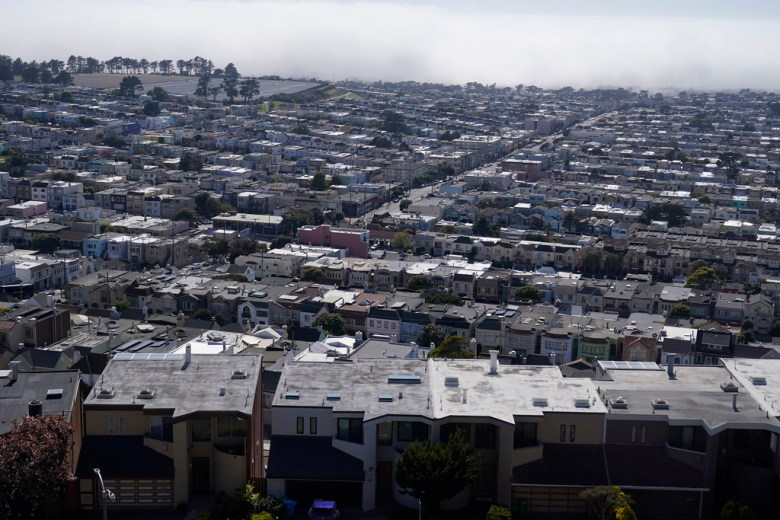 Fog hovers over properties in San Francisco, Wednesday, April 26, 2023. (AP Photo/Jeff Chiu)
It’s easy to see why both political parties are concerned about private equity gobbling up single family homes. If left unchecked, consolidation of housing stock by big investors will continue to put homeownership out of reach for many buyers.
In past housing debates, I’ve been sympathetic to concerns about policy overreach. For example, I opposed efforts to ban algorithmic software used to analyze housing prices. These tools don’t set prices; they only respond to supply and demand by signaling when rents should rise or fall. In fact, California itself relies on similar algorithmic models to manage toll pricing on state highways.
Institutional investors are different. They aren’t trying to better understand supply and demand; they are trying to manipulate the market by buying up as much housing as they can — because they know that the more properties they control, the more they can dictate their prices. That’s not capitalism, it’s crony capitalism.
Getting institutional investors out of the single-family housing market won’t solve everything, but it will address a major source of distortion and give families a fairer shot.
This housing crisis didn’t happen overnight, and it won’t be fixed overnight either. But meaningful reform always begins the same way — by finding clarity about what needs to change. And that clarity is finally emerging.
With leaders across the political spectrum acknowledging the same problem, California has a rare chance to make progress.
The window for reform is opening. It’s up to us to make sure it doesn’t slip away.
Related