
It all started with lemons.
When she was a college student, Alessandra Moctezuma had an epiphany while painting lemons for an art class. It was there, awash in brushes and yellow paint, that the 18-year-old realized a career in the arts could very well be in her future.
“I was taking this evening class at Santa Monica College, and I painted this still life of lemons, and my professor, Curtis Hoekzema, was critiquing our work,” she recalls. “He was saying all these wonderful things about my painting. I was just having fun doing it, but he had a way of nurturing us as students. He cared, and he made us see our potential.”
She adds: “That’s when I thought, ‘Maybe I can do this. Maybe I can become an artist or a teacher. … There was something about that class. All of us students, we were all excited about this new thing that we were learning — trying to capture something from life and imbue it with magic and spirit. … I always think that if it hadn’t been for that class, I might not have ended up going into the arts.”
Perhaps it was that art class, or perhaps it was preordained: Her father was an artist before settling into a career in TV journalism and film, first in Mexico and then in Los Angeles. Her mother worked for an anthropology museum.
“Growing up, my childhood was spent going to museums or spending time with my dad’s friends, going to their homes, their studios or their gallery exhibits,” Moctezuma remembers. “So I kind of grew up in the arts and museum world — and it was very much what I understood life to be.”
Decades after that aha moment in a classroom in Santa Monica, Moctezuma is very much on the front lines of the arts in San Diego — a visible and vocal champion for visual art with a deep passion for and commitment to the arts.
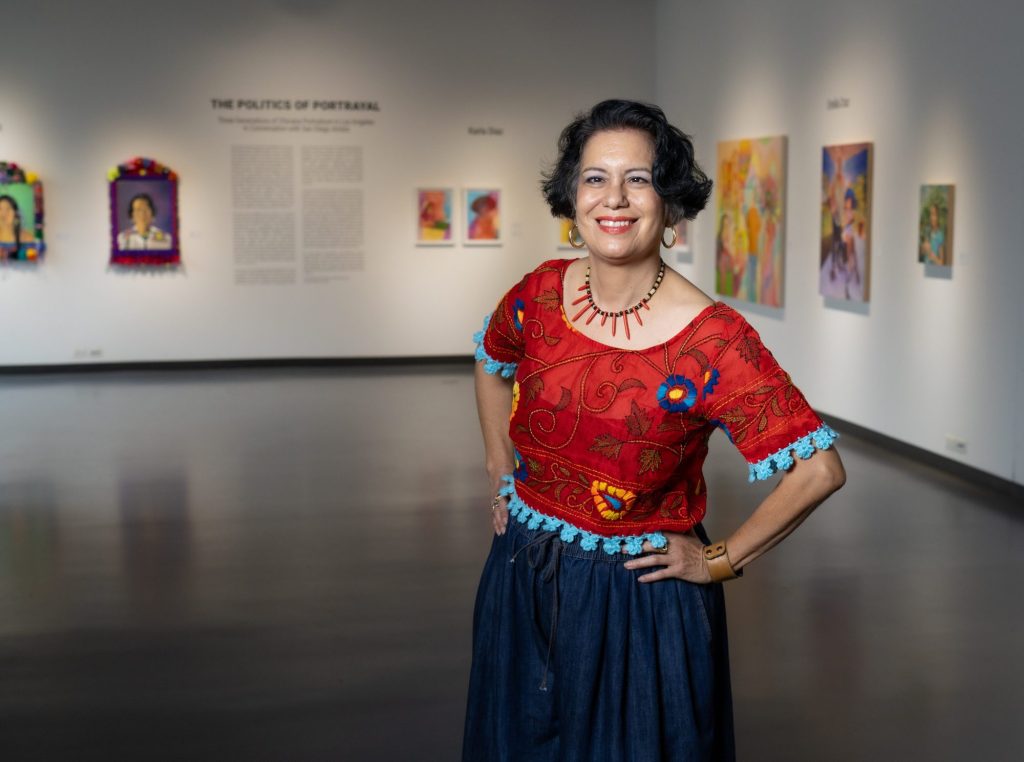
For 25 years, she has been a professor of fine art at San Diego Mesa College, where she teaches courses in Museum Studies and Chicano Art. At the same time, she oversees the San Diego Mesa College Art Gallery, a highly prolific campus art space known for showcasing local artists and culturally diverse installations — a remarkable feat for a college campus, let alone a community college.
She never really pursued art as a career, mainly because she didn’t much care for the often-solitary life of an artist. The classroom gave her a chance to be with like-minded people who loved the arts — and that was enough.
It was more than enough, really.
Before coming to San Diego, she’d worked in Los Angeles and New York, where her late husband — the American writer, historian and urban theorist Mike Davis (“City of Quartz”) — was teaching at Stony Brook University. In Los Angeles, she’d learned many life lessons from working closely with Chicana artist and activist Judith F. Baca, who taught her practical skills that she’s now trying to impart to a new generation of artists and art lovers in San Diego.
In the classroom — or any teaching environment, really — Moctezuma has the golden opportunity to effect change and affect lives.
“I understood that the work I do as a teacher is important — it’s a way of providing a pathway for students — a pathway to the arts,” she says.
It’s important, too, for artists, especially local ones. As part of her Museum Studies classes, Moctezuma’s students work on installing exhibitions, often connecting with local artists in ways that benefit both. The artists get more visibility, while the students get the experience of working with real-life working artists.
In a way, Moctezuma says, she sees her work as a conduit for connections.
“People always joke and say, ‘You’re everywhere — always out doing and seeing things in the arts.’ That’s true because art is my pastime. Art is not just my job. Art is what feeds my soul and my spirit. … I almost feel like I am a bridge between communities. I feel connected to educators and artists, especially Mexican American artists. I feel connected to their struggle — and want their voices to be heard.”
There’s also a sense of comfort and ease that puts Moctezuma in the perfect position to view the local art scene, but perhaps more importantly, to be a part of it in such a way that can connect communities that might not otherwise cross paths.
“I’m bilingual and feel comfortable navigating the art community,” she says. “I can go to Centro Cultural Tijuana and be there with artists who are from Tijuana or Tecate and have a connection and conversation with them in Spanish. I can go to a gallery or museum in La Jolla and talk about the Light and Space movement and then go to James Hubbell’s compound in Santa Ysabel.”
Indeed, when Moctezuma applied for her job at San Diego Mesa College, she was already familiar with the county’s artistic landscape.
“I already had a sense of the San Diego community because of its proximity to Los Angeles. I already knew about Chicano Park and the Border Art Workshop and Robert Irwin,” she says.
When she finally landed a second interview with then-San Diego Mesa College President Contstance Carroll, “I told her: ‘This would be my dream job. I would love this position, and I hope you hire me.”
“I can’t believe it’s been 25 years!”
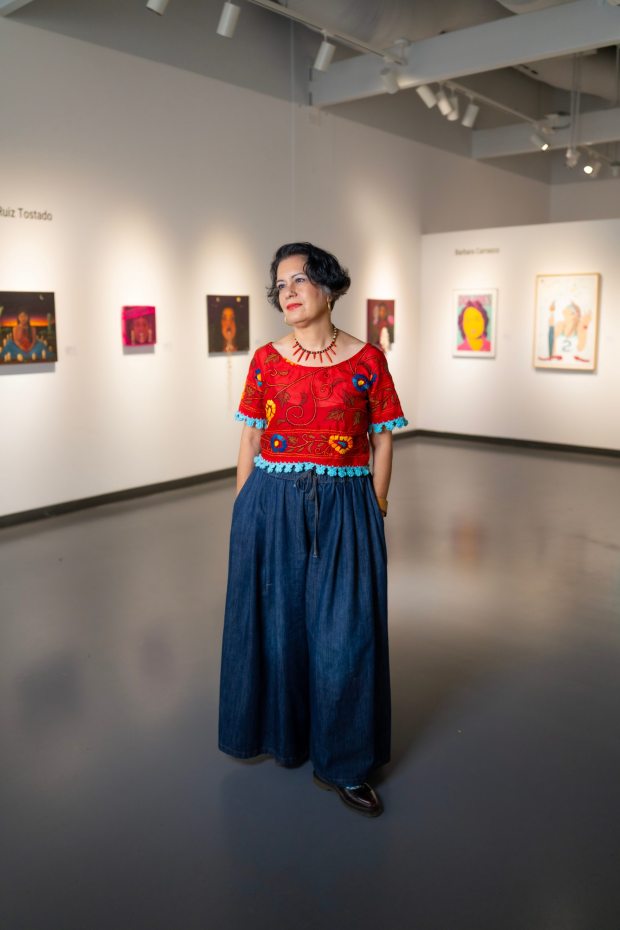 Standing in the campus Art Gallery at Mesa College, Alessandra Moctezuma is the gallery director and a professor of art at San Diego Mesa College, where she runs the Museum Studies program. Alessandra was born in Mexico City and immigrated to Los Angeles with her family in 1981. (Nelvin C. Cepeda / The San Diego Union-Tribune)
Her impact goes well beyond the walls of San Diego Mesa College, having curated exhibitions at regional art spaces. At the Oceanside Museum of Art, she was the curatorial driving force behind “Borderless Dreams” (2005), “Through a Lens Sharply: Photo Imaginings” (2006) and “Twenty Women Artists: NOW (2021). In 2017, also at the Oceanside Museum of Art, she curated “unDocumenta” as part of the Getty’s landmark regional art event Pacific Standard Time (PST ART).
She currently serves as the chair of the San Diego Arts Commission and on the advisory boards of the Oceanside Museum of Art and the San Diego Art Prize. She’s also served on the boards of the Museum of Contemporary Art San Diego, the Women’s Museum of California and the Friends of the Villa Montezuma, and in an advisory capacity, for the Institute of Contemporary Art San Diego, the San Diego Museum of Art’s Latin American Arts Council and the Centro Cultural de la Raza.
Her impact on San Diego’s artistic community hasn’t gone unnoticed.
“I’ve had the privilege of seeing firsthand how Alessandra brings both scholarship and heart to everything she does,” says Bob Lehman, executive director of San Diego ART Matters, the region’s leading arts advocacy and service organization. “Her exhibitions spark conversation, her students move into leadership roles across our region, and her advocacy for artists of color strengthens the entire arts community. She leads with purpose — and San Diego is better for it.”
Lehman, previously the executive director of the San Diego Museum Council, adds: “Alessandra understands that art is not separate from community — it is born from it. Her lifelong commitment to Chicano/a art, public art and social justice has expanded who is seen, who is heard and who belongs in our cultural spaces. San Diego’s visual arts community is stronger, more inclusive and more visionary because of her work.”
“Alessandra Moctezuma is a gift to the local arts community,” says Jennifer de Poyen, executive director of Space 4 Art. “She has taught thousands of students, many of whom are trained as skilled culture workers who form the backbone of institutions all over San Diego and beyond. …
“She is passionate and incredibly knowledgeable about art, and she’s laser-focused on community, inviting everyone into the experience of making, experiencing and enjoying art. Alessandra is a connector, someone who uses her position to create opportunities for others to enter the experience of art in San Diego. She is motivated by her passion for art and her commitment to principles of equity and inclusion. She believes in creating, sustaining and growing the arts community in San Diego, and she has dedicated her life to that admirable goal.”
Moctezuma, as an educator, finds herself at the intersection of art, community and cultural identity. It’s a responsibility she doesn’t take lightly.
“As much as possible, I want to immerse my students not just artistically but practically — the skills they’ll need to succeed in the arts,” she says. “But at the end of the day, I want them to experience the same joy I experience every day.”
Joy that, in many ways, started with lemons in a classroom in Santa Monica.