
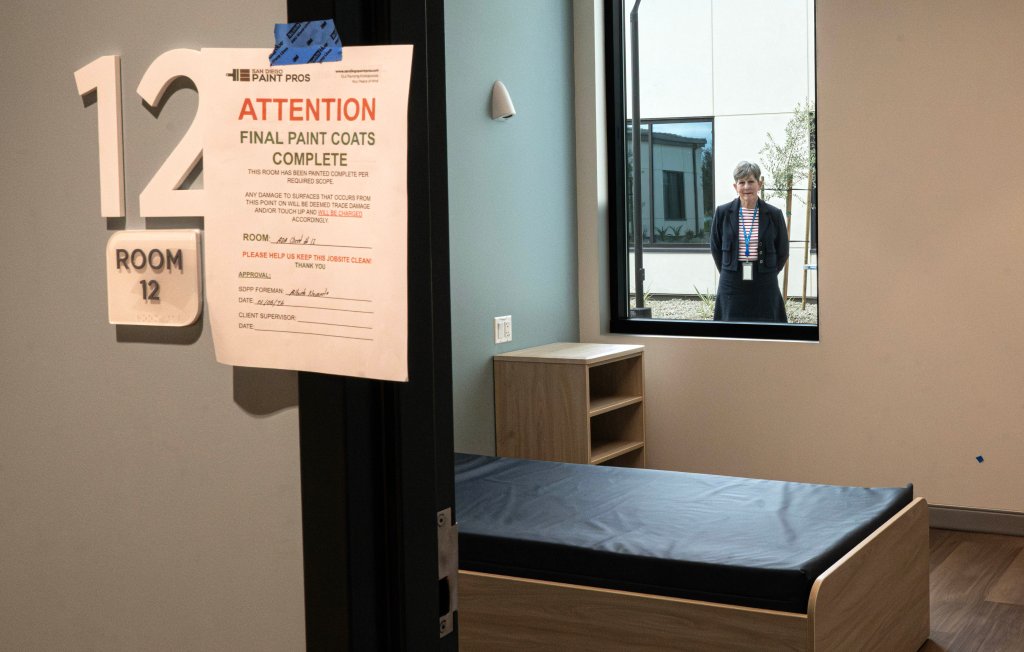
Walk through the structures at the newest Be Well OC mental health campus, on the south edge of the Great Park in Irvine, and you’ll get a blast of “new building smell.”
The paint is fresh and the walls unmarked. The mattresses, covered in crib-thick synthetics, are neatly arranged with even surfaces The windows are clean enough that birds might smack into them.
After two years of construction, the county’s second Be Well campus, complete with upbeat splashes of art and gleaming kitchen equipment and self-harm-resistant door handles, is ready to start helping people with severe mental illness or substance abuse disorders or both.
Yet opening day at Be Well Irvine isn’t on anybody’s calendar.
“We can’t say because we don’t know” when the campus will open, said Phil Franks, chief executive of Mind OC, the Irvine-based nonprofit that operates as Be Well OC and oversaw construction of the Great Park project and is managing a similar Be Well operation in Orange.
“We could be helping people today, right now. … But we can’t move forward without (approval from) the county. And we’re pretty sure the county is going to hit us with something.”
A day after Franks made that prediction, the county did, in fact, make public its latest lawsuit against Mind OC.
In the complaint, filed Tuesday in Orange County Superior Court, the county accuses its nonprofit partner of overcharging for rent, violating patient privacy rights and funneling money to the office of former county Supervisor Andrew Do, who is serving a 60-month sentence in federal prison for misusing public funds.
The county made similar allegations against Mind OC (minus the Do-related issues) nearly two years ago. At the time, the county wanted to remove Mind OC from having any role at the Be Well campus in Orange. Since late 2024, Franks and other Mind OC leaders have stayed on as the property managers in Orange only because of a court-issued temporary restraining order.
But the running legal squabble between the county and one of its nonprofit partners — as costly and as frustrating as it is for both parties — reflects a bigger problem.
Even if the $110 million Be Well campus in Irvine opened today, it would be a welcome but hardly world-changing addition to a mental health treatment ecosystem that, in Orange County, is woefully outgunned.
Like much of the country, in Orange County there aren’t nearly enough beds, or experts, to treat a fast-rising wave of mental illness.
“There’s such a huge, huge need for this. A lot of people need help and there aren’t a lot of places to get it,” Franks said.
On this, county officials agree with Mind OC.
“It’s true,” said Dr. Veronica Kelley, director of the county’s Health Care Agency.
“In terms of treating people with severe (mental health and substance abuse) issues, everybody is playing catch-up.”
40,000
The situation in Orange County reflects an unexpected twist that’s true in many of the nation’s biggest counties: If you suffer from severe mental illness, being poor isn’t necessarily a disadvantage.
The state estimates that about two-thirds of the 3.2 million people living in Orange County are covered by some type of private insurance. Though such coverage generally is viewed as effective at finding care for illnesses ranging from colds to cancers, most experts say — and federal studies have shown — that private insurers are often ill-equipped to help people with severe mental illnesses. If someone is diagnosed with a debilitating form of schizophrenia or bipolar disorder, for example, private insurance often can’t place them in a bed that would provide them with needed — indeed, potentially life-saving — full-time care.
Most of the million or so locals who aren’t covered by private insurance have public coverage, either Medicare, which is mostly for people age 65 and up, or Medi-Cal, known locally as Cal Optima, which is mostly for people who can’t afford any other insurance. Like the private insurance system, those public plans also don’t always have access to enough beds or experts as much as is needed for people with severe mental illnesses.
But the county — specifically, the Behavioral Health division of the Orange County Health Care Agency — comes closer.
Since the mid-1980s, when the nation (led by California) shut down public mental hospitals (a response to patient abuses and a tax-cutting move), that segment of the health care world has languished. In recent decades, as mental illness has become less stigmatized and as the gap in available coverage has become more acute, states and counties have used tax money to rebuild some of what is needed to care for the most severely mentally ill.
In Orange County, that means Behavioral Health now works with about 100 local treatment providers to help patients who are covered by CalOptima and have been medically diagnosed with “severe” forms of mental illness or substance abuse disorders. That county system, which is separate from CalOptima, has a budget north of $800 million and access to about 1,300 beds. That’s a more robust world of care for severe mental illness than typically can be accessed through private insurance, according to many.
And, according to Kelley and others, it’s not nearly enough.
Last year, Behavioral Health helped about 38,000 individuals, a population of indigent people with severe mental illness that’s roughly as big as the city of Stanton. That world was separate from the people covered by CalOptima, which probably treated a similar number of people with less severe forms of mental illness, or the world of private insurers who, based on size, probably treated three times as many locals with severe and less-severe mental illnesses.
Kelley and other experts, including Franks, said no version of health care — public or private — currently has capacity to match the need when it comes to a rising wave of mental illness.
“There’s a huge psychiatrist deficit in the state,” Kelley said. “We have, maybe, 50% of the psychiatrists we actually need to treat the actual demand. That’s true for both the public and the private sector.”
The subset of patients helped by the county includes people with a wide variety of illnesses. Last year, Behavioral Health treated about 10,000 people with severe substance abuse disorders, and about 14,000 children battling forms of mental illness that require constant care or hospitalization, as well as about 14,000 adults.
But funding for that treatment comes from a small slice of the county’s sales taxes and auto licensing fees. That means wages for county-employed medical experts — from psychiatrists and psychologists to clinical therapists, nurses and others — are much less than, perhaps half, what they would earn in the private sector.
“The people we hire are, obviously, mission-driven,” Kelley said. “And the people we serve are the most severe.”
And that local pool of potential patients — people with the most severe versions of mental illness who don’t have access to private insurance — is growing faster than the system can accommodate. So far this year, Kelley estimates, the patient load has already jumped to about 40,000.
When asked if that’s a result of mental illness actually becoming more common, or is instead a result of more people recognizing mental illness and feeling less stigma for admitting they need help, Kelley said, “Yes. It’s all of those.”
She also noted that, anecdotally, as many as a quarter of the people being treated by the county come from families who purposely dropped out of private health systems, a process that would require them to reduce their net worth to a level that would qualify for public health.
“So you’ll have older parents, like in their 80s, who have paid for commercial insurance for their adult child who has schizophrenia. And now, as they age, they’re worried that they’re gonna die, and their child’s gonna have nobody. So they’ll stop the insurance,” Kelley said.
“They’re doing that so they can fall into our system, and so we can then serve them,” she added. “But that’s a travesty that a parent even has to make such a decision because their health care doesn’t work.”
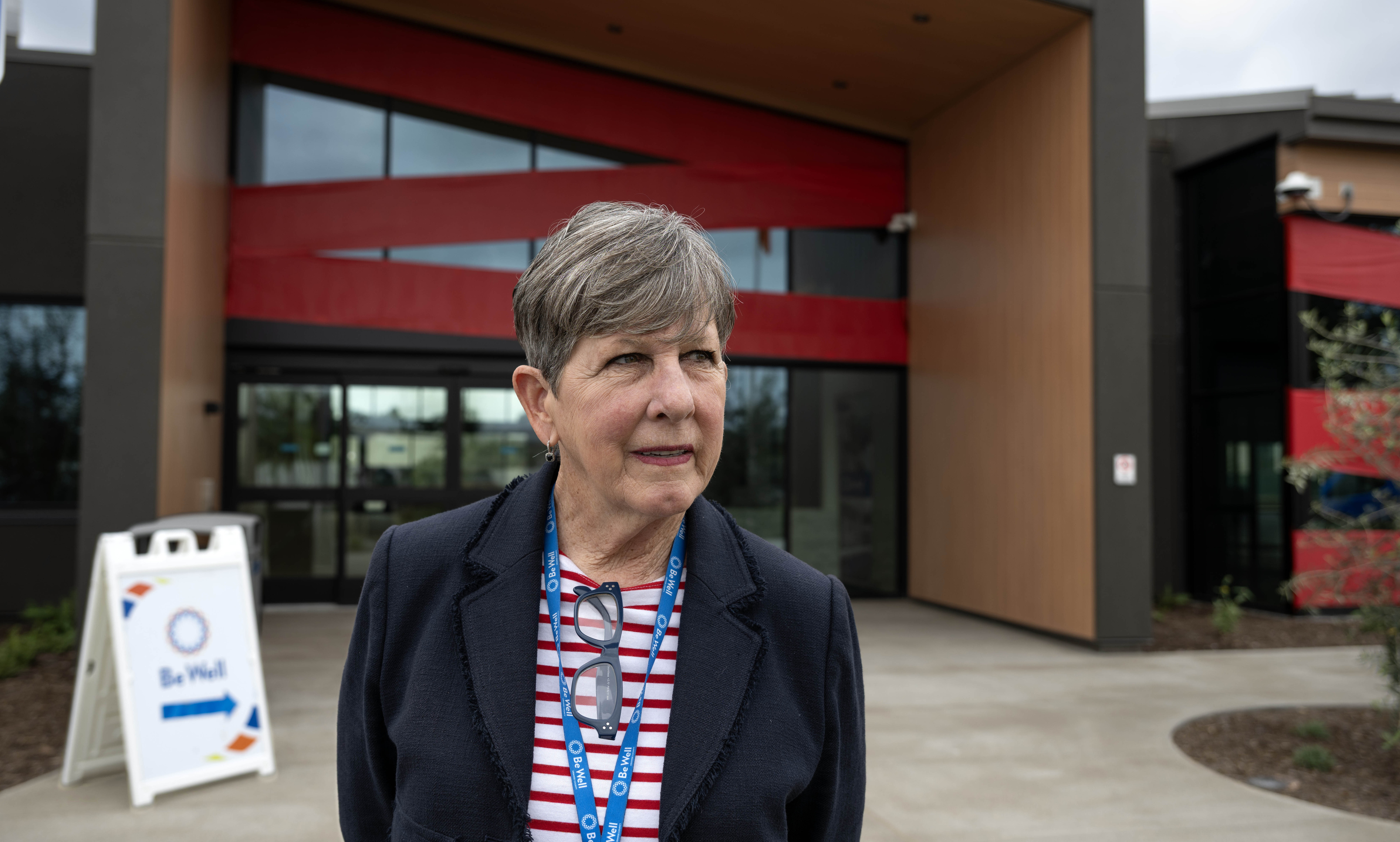
Be Well OC is wrapped in red ribbon, (and red tape), as the long-await mental health facility’s opening is stalled by legal disputes. Chief Strategy Officer Blair Contratto stands outside the main entrance at the Great Park in Irvine on Tuesday, March 10, 2026. (Photo by Mindy Schauer, Orange County Register/SCNG)

A Be Well OC mental health van sits in front of the new Irvine facility at the Great Park on Tuesday, March 10, 2026. The full-service, 16-acre mental health facility has been bogged down with legal disputes and the long-awaited opening is uncertain. (Photo by Mindy Schauer, Orange County Register/SCNG)

Drought-tolerant, colorful plants adorn the garden area of the new Be Well OC mental health facility at the Great Park in Irvine. The facility’s opening is in question because of disputes. (Photo by Mindy Schauer, Orange County Register/SCNG)

Local art, like this framed tapestry of reclaimed fabrics and threads by Irvine artist Mitzie Mires, adorns the Be Well OC facility at the Great Park in Irvine on Tuesday, March 10, 2026. (Photo by Mindy Schauer, Orange County Register/SCNG)
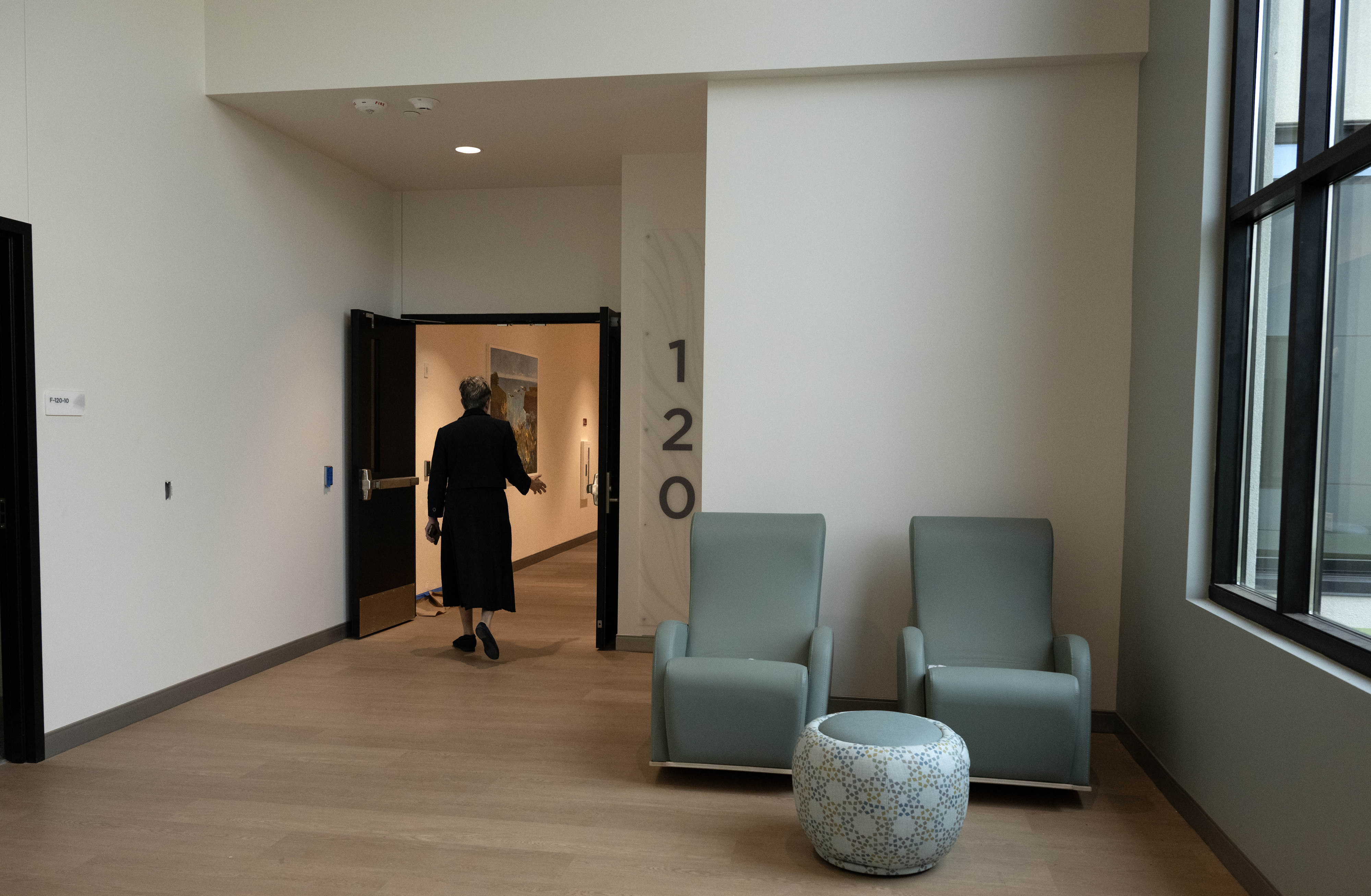
Blair Contratto, chief strategy officer for Be Well OC, walks through the mental health facility’s mother/child unit of the 16-acre property at the Great Park in Irvine on Tuesday, March 10, 2026. (Photo by Mindy Schauer, Orange County Register/SCNG)

Jack and Jill bathrooms connect teen units of the Be Well OC mental health facility at the Great Park in Irvine on Tuesday, March 10, 2026.. Everything on the 16-acre campus is “anti-ligature,” or designed to prevent self-harm. (Photo by Mindy Schauer, Orange County Register/SCNG)

The garden area of the new Be Well OC Irvine campus includes a pickleball court, drought-tolerant plants, and a soothing area to sit or walk. (Photo by Mindy Schauer, Orange County Register/SCNG)
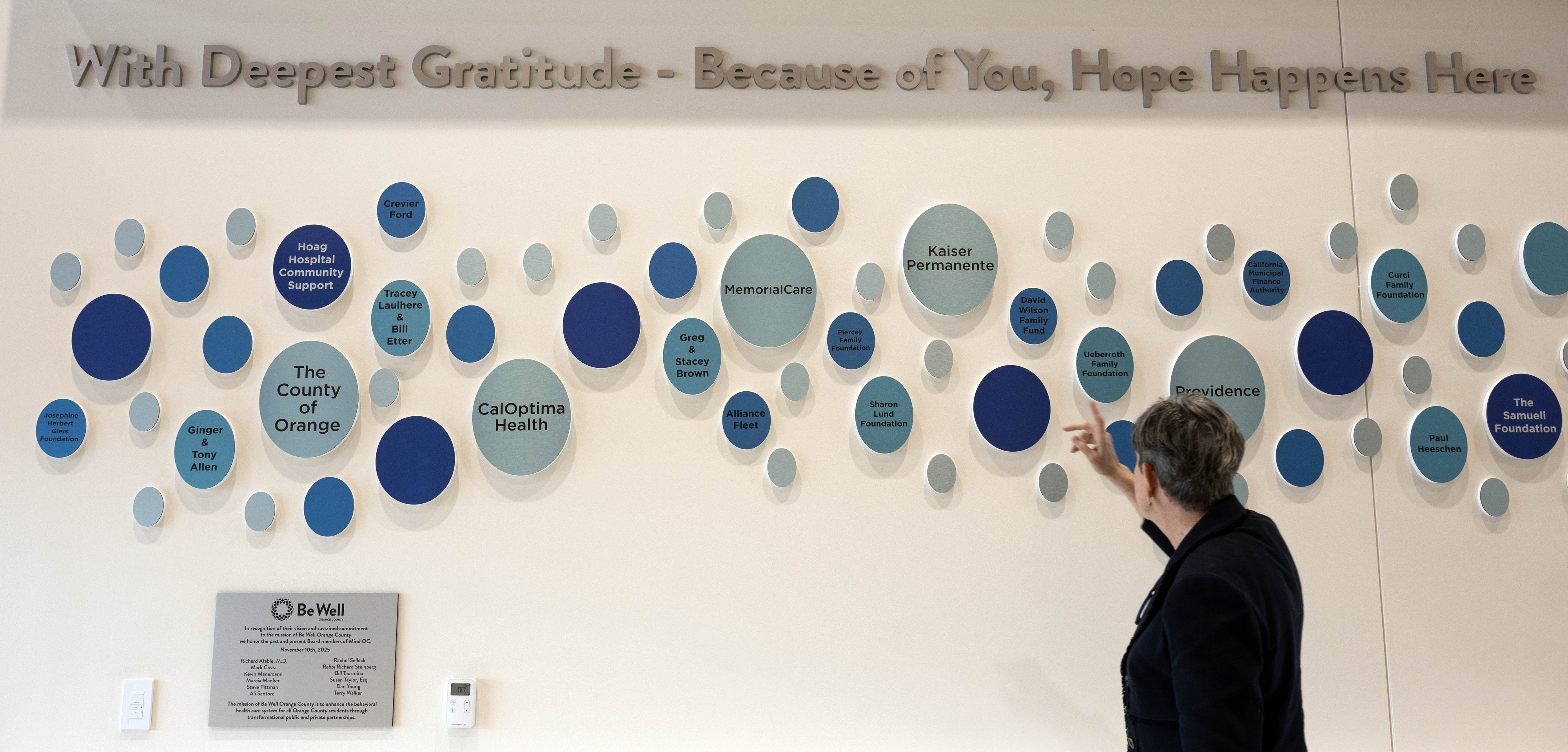
Blair Contratto, chief strategy officer for Be Well OC, points out the donor wall showcasing the mental health facility’s public and private partnership. “It’s an incredible promise to all of Orange County,” she said. (Photo by Mindy Schauer, Orange County Register/SCNG)

Be Well vans are parked outside the new Be Well mental health campus in Irvine on Tuesday, March 10, 2026. (Photo by Mindy Schauer, Orange County Register/SCNG)
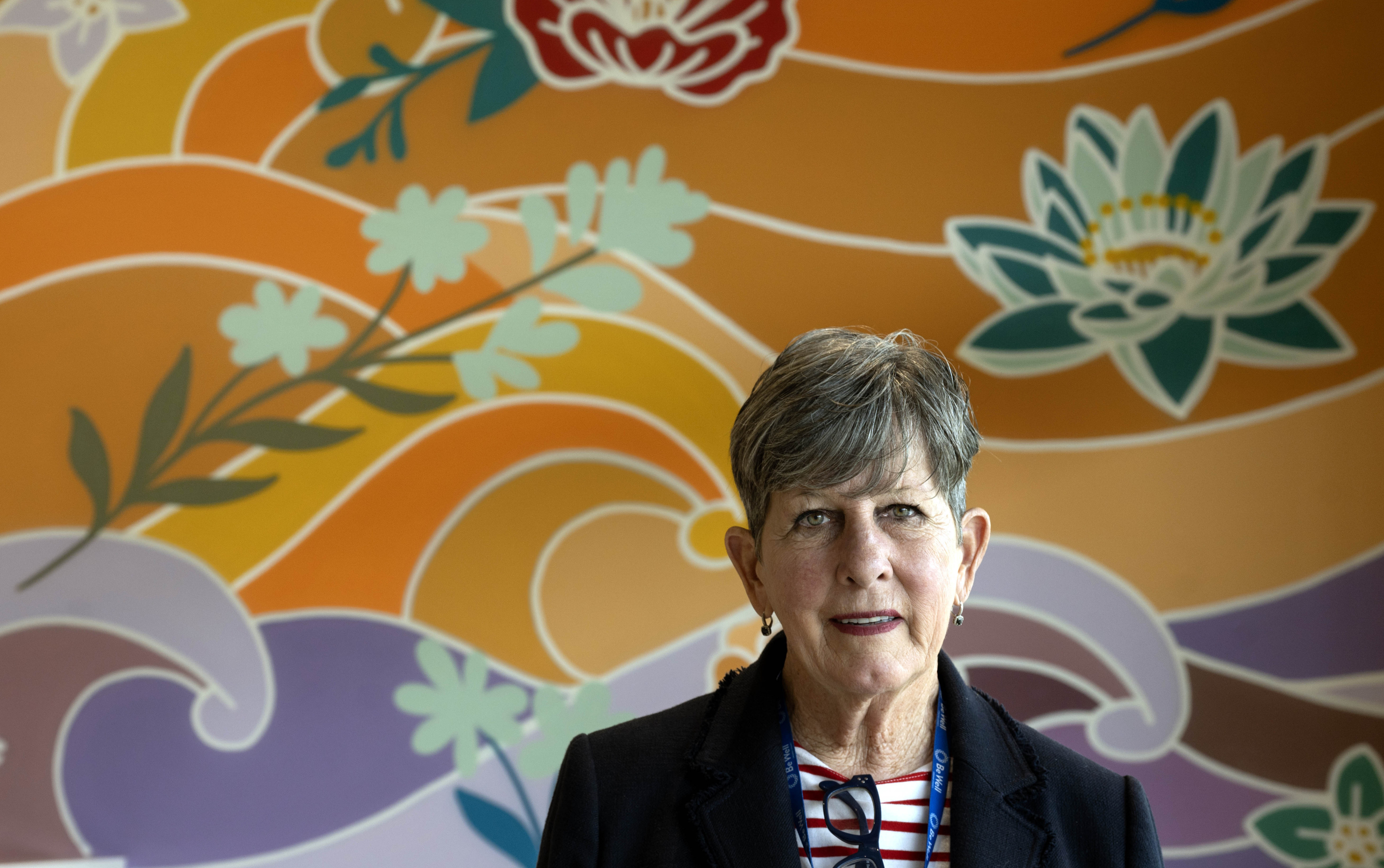
Chief Strategy Officer for Be Well OC, Blair Contratto, is backdropped by local artist Damin “zaoone” Lujan’s “Currents of Calm,” a mural at the Irvine facility on Tuesday, March 10, 2026. Through symbolism the work pays homage to community divirsity, peace and support. (Photo by Mindy Schauer, Orange County Register/SCNG)
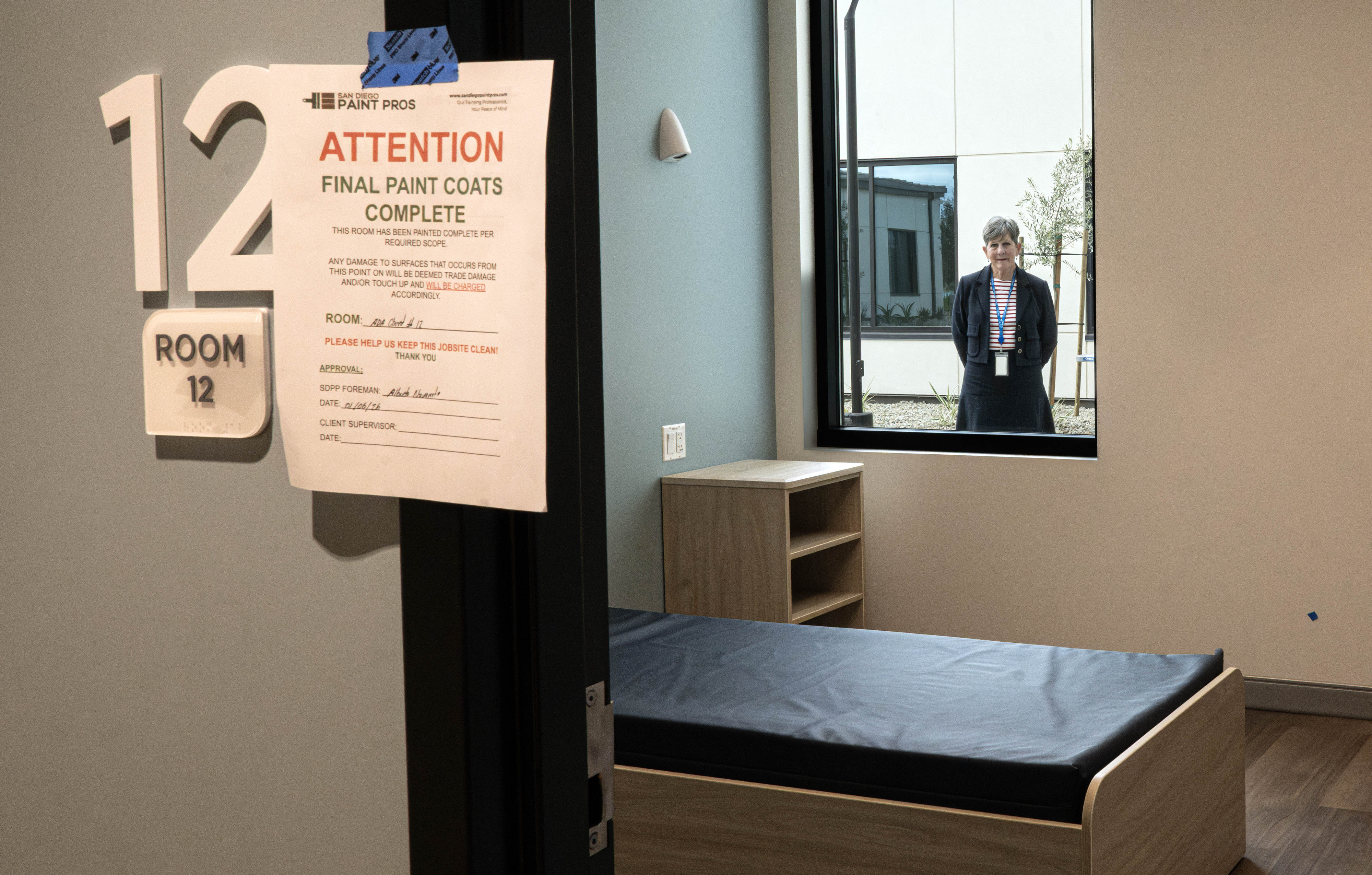
Blair Contratto, chief strategy officer for Be Well OC, stands outside an empty adolescent residential room at the newly built mental health facility in Irvine on Tuesday, March 10, 2026. (Photo by Mindy Schauer, Orange County Register/SCNG)
Show Caption
1 of 11
Be Well OC is wrapped in red ribbon, (and red tape), as the long-await mental health facility’s opening is stalled by legal disputes. Chief Strategy Officer Blair Contratto stands outside the main entrance at the Great Park in Irvine on Tuesday, March 10, 2026. (Photo by Mindy Schauer, Orange County Register/SCNG)
Expand
For all?
The legal battle between the county and Mind OC is about a lot of things.
Money is part of it. The county, which pays the rents set by Mind OC at the Be Well campus in Orange and possibly the future campus in Irvine, has described those rents as criminally high. The lawsuit alleges that Mind OC has fraudulently overbilled on rent by several million dollars.
Franks and other Mind OC officials strongly deny that allegation, saying they charge rents that reflect standard industry practices. They also note that it would be bad for everybody — patients and treatment providers alike — if the properties couldn’t be maintained well enough, for many decades, to attract high-quality health care providers.
Franks said he and his team were “blindsided” when the county initiated legal action against Mind OC in late 2024, saying they previously believed they were in good standing with the county. Now, he said, they’re less surprised.
“The county is looking to seize our assets and take these (mental health care campuses) over,” Franks said.
“Two years ago, we realized, too late, that the county was looking to build a narrative. And they’re still trying to do that, to build a narrative that we’re not the right people to run these facilities.
“But they’re wrong. We are.”
Beyond money, the lawsuit is also about boundaries and appropriate roles.
The county views Mind OC as a developer and property manager, not a provider of mental health care.
Mind OC — which, in several local cities, has hired mental health technicians to drive in “Be Well” vans to provide emergency response services for mental health-related police calls — described itself this way in its 2025 federal tax filings: “Be Well Orange County is working to make Orange County the happiest and healthiest community in the United States. And that starts with a world-class mental health care system. The mission is to make compassionate mental health care more accessible for all in our community.”
And that last phrase — “for all” — is key to the stakes in Mind OC’s legal battle with the county.
When Mind OC was formed as a nonprofit in 2019, it was responding to a county plan to create a chain of local health care campuses that would provide mental health treatment for anyone, including people with county insurance or no insurance, and people with private insurance who couldn’t find adequate mental health treatment in their health systems.
The first of those campuses, in Orange, opened in 2021. At the time, the pandemic was still raging and a mental health crisis — nationally and locally — was at a flashpoint. Soon, the county limited access at the Be Well campus in Orange to patients served by public health care, a condition it also wants for the Irvine Be Well campus.
The long-term isolation many people experienced during the pandemic, Kelley said, drove the need for mental health care so dramatically that the county had no choice but to become more focused.
“The pandemic did some really good things for mental health. It increased our awareness of the importance of it,” Kelley said.
“But it also disrupted our ability to have that (human to human) connection, and we have not recovered from it,” she added. “It also disrupted our health care systems in total, which included behavioral health clinicians, and many people left the health care system.”
Kelley suggested that, in a perfect world, the Be Well campuses would serve everybody, but that such a goal isn’t yet feasible.
“Until private insurance companies can bring themselves on par with our public behavioral health system, we will all be at a disadvantage … Standing up systems on the private side that resemble those that we have established on the public side would be a benefit to everyone.”
Next up: More need
Regardless of how the lawsuit with Mind OC plays out, Kelley said the county is pushing forward on several programs to boost help for people with severe mental illness.
For example, she said her agency is working with UC Irvine, which has a medical school, to “train the trainer.” The goal is to help primary care physicians, pediatricians and family practice doctors get better at identifying and helping people struggling with mental illness and substance abuse. Earlier treatment, she noted, can prevent people from sliding into the world of “severely” ill people who get treatment from the county.
But Kelley, along with Franks and others, also believes the mental health care crisis soon could get worse.
Federal changes to funding for the poor — including cuts for food assistance, public housing and, critically, health care — are aimed at reducing the number of people who receive federal help. Those changes, enacted ostensibly to limit access to federal money only to legal residents and to prevent fraud in the federal health system, could boost health care needs in a broader way.
“The changes in Medicaid coverage … particularly here in California, with the removal of undocumented individuals from having Medi-Cal, does not stop people from getting sick,” Kelley said.
But regardless of changes at the federal level, Kelley said the county is committed to adding 500 mental health beds over the next five years.
“With uncertainty at the federal level, with regard to (the Department of) Health and Human Services, and Medicaid, as well as some of the shortfalls in the state’s budget, the fact that we can bring that many beds online is a miracle.”
It’s not clear if the beds at the Be Well campus in Irvine are part of that plan.