
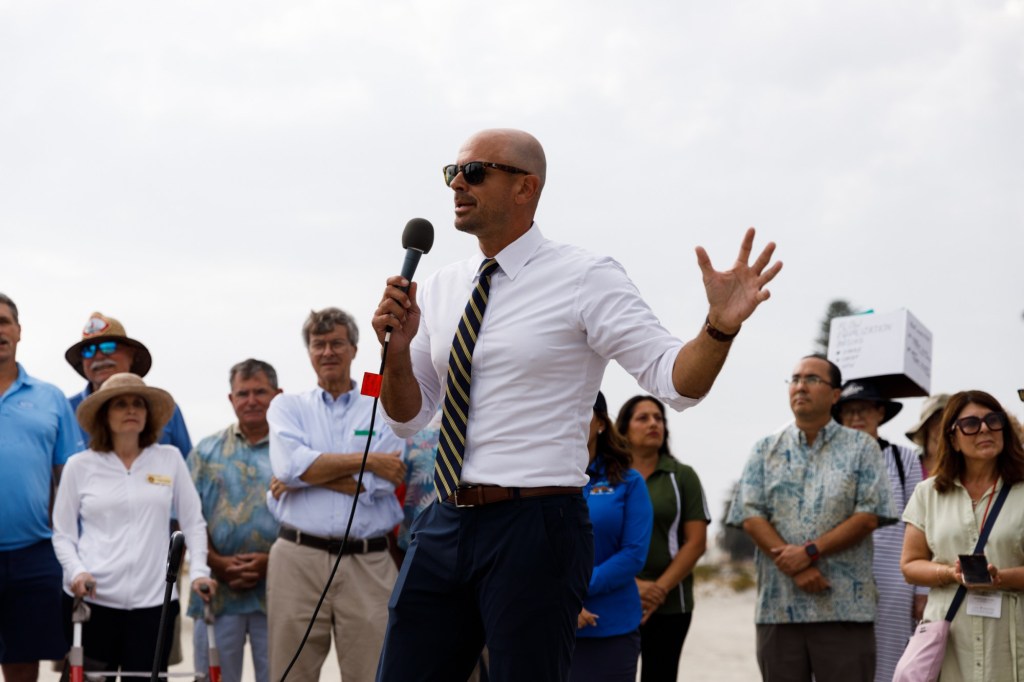
The outrage over the city’s new parking fees at Balboa Park seemed ripe for harnessing into an effort to repeal them.
Now there is an initiative drive aimed at doing just that spearheaded by former Coronado Mayor Richard Bailey, a relatively new resident of Point Loma running for San Diego City Council.
Backers of the initiative quietly filed the paperwork on March 6, though Bailey said a higher-profile unveiling is likely when they start collecting signatures in a couple of weeks.
That move follows a more public launch for a petition drive to at least temporarily do away with new city trash collection fees, which also triggered an uproar from those who have to pay them — single-family homeowners. That effort is being led by the Lincoln Club Business League and its CEO Kevin Faulconer, the former San Diego mayor.
There’s a lot more here than two former Republican mayors (Bailey has since changed his voter registration to NPP, or No Party Preference) potentially giving a bigger budget headache to the current Democratic mayor, Todd Gloria, and the members of the all-Democratic City Council, who already face a budget shortfall of at least $100 million.
Repeal of the fees would widen that gap by tens of millions of dollars. Critics of the repeal efforts, notably Councilmember Sean Elo-Rivera, say proponents lack credibility if they don’t give more specifics on how they would address the shortfall.
The coordinated repeals are also an effort to blunt what had been an emerging plethora of potential tax and fee increases for transportation, infrastructure, general operations and more. Some of those proposals have fallen by the wayside for this election cycle, others are being reconsidered, and some have been scrapped altogether, such as a fee on short-term vacation rentals in the city.
While it’s tempting to declare a sea change in momentum, the real test of where the pendulum is swinging may be the success or failure of the parking and trash fee repeals, as well as, conversely, whether voters approve of a levy on empty second homes — or any other city or county revenue-raising measure that makes the ballot.
For now, some conservative-leaning repeal backers sound emboldened and are already talking about pension reform and managed competition outsourcing to save money. Past city policies on both failed for various reasons, though backers say they wouldn’t have if done properly.
“Reforms to the city pension system must be an item of focus and remain on the table to ensure long-term sustainability for taxpayers and city employees alike. Managed competition needs to be used more aggressively when it comes to city contracts …” Bradley Schnell, a board member of the Lincoln Club, wrote in a commentary on the trash fee published by The San Diego Union-Tribune.
Bailey suggested it was a looming debate of city government’s role — “operator vs. oversight.”
That’s a big leap from attacking unpopular fees. The trash and parking fee repeals might be uniquely attractive to a broad swath of San Diegans in a way that may not translate to competitive bidding changes or even pension reform. The court-ordered unwinding of the previous voter-approved pension overhaul cost the city around $200 million.
Getting those Republican-favored policies through City Hall isn’t going to happen anytime soon, and the ballot measures would be shaped by the City Attorney’s Office and face stiff opposition from powerful labor unions.
As for the trash fees, it’s important to remember voters earlier had narrowly cleared the way for the concept in 2022, but the outcry exploded when they turned out to be much higher than advertised.
Still, with both the trash and parking fees people have the sense they are now paying for something they essentially had been getting for free. Some critics of the trash fee said their existing San Diego city general taxes should cover the costs, though most other cities routinely charge a separate levy.
(Interesting notes: Mayor Faulconer backed parking fees in Balboa Park in 2016 to help finance a proposed underground garage and other significant changes to the park. The plan failed. Mayor Bailey’s Coronado has charged a separate trash fee for some time.)
Problems with the city’s rollout of the trash and Balboa Park parking programs didn’t help, and further built on City Hall’s history of operational snafus and policy blunders. All this comes on the heels of other fee increases aimed at shoring up city revenues.
Bailey, who has been advocating repeal of the trash and Balboa parking fees for months, suggested there’s a synergy between both efforts and expected “cross-over support.”
“We’re coordinating efforts to the extent legally allowed,” he said.
He said the parking fee repeal proposal would also require voter-approval of any future Balboa Park parking fees. Bailey said putting the measure directly on the November ballot would require 80,000-plus signatures of registered voters in San Diego.
He said his group also could collect about 24,000 signatures to put the issue back before the council, amid election-year pressure. The council could simply accept or reject the plan or propose revisions.
Bailey maintained city officials had the wrong rationale for charging the fees, if they were to charge them at all at the park.
“From a public policy point of view, parking fees aren’t meant to be a revenue-generator for the city, but to encourage turnover that allows more people to enjoy a public amenity,” he said.
He called the $100 million budget shortfall estimate an operational deficit and said when maintenance and capital improvements are factored in, the gap rises to some $500 million a year. “These nickel-and-dime taxes and fees aren’t coming even close to that,” he said.
To right the budget, Bailey and Faulconer said the city should drastically reduce the number of middle managers, a highly-paid sector controlled by the mayor that has increased five-fold over the past decade, according to David Garrick of the Union-Tribune. City unions and council members earlier had urged cuts there.
Bailey said overall city staff and expenditures have grown significantly over the past 10 years, far more than the slight population increase (about 1.4 million residents last year vs. 1.39 million in 2015). He has called for city staff to be reduced to its size in 2015, when he said performance metrics suggested San Diego was operating more soundly. He made those and other arguments in a column in the Voice of San Diego in January.
In response, Michael Zucchet, general manager of the San Diego Municipal Employees Association, wrote in the Voice that Coronado’s spending had grown dramatically, much of it during Bailey’s time as mayor, at a greater pace proportionally than San Diego, despite a decrease in population.
He further said Coronado had a lower staff-to-population ratio than San Diego.
But Zucchet added: “Nothing written here is intended to throw shade on the city of Coronado. By most accounts, it is a well-run city with very strong financial reserves and generally satisfied residents.”
Not many people say that about San Diego these days.
What they said
Linda Stevens (@Linda__Stevens), adviser | technologist.
“It is all about Hegseth’s hair, not the war or the military service members fighting this unjustified war.”