
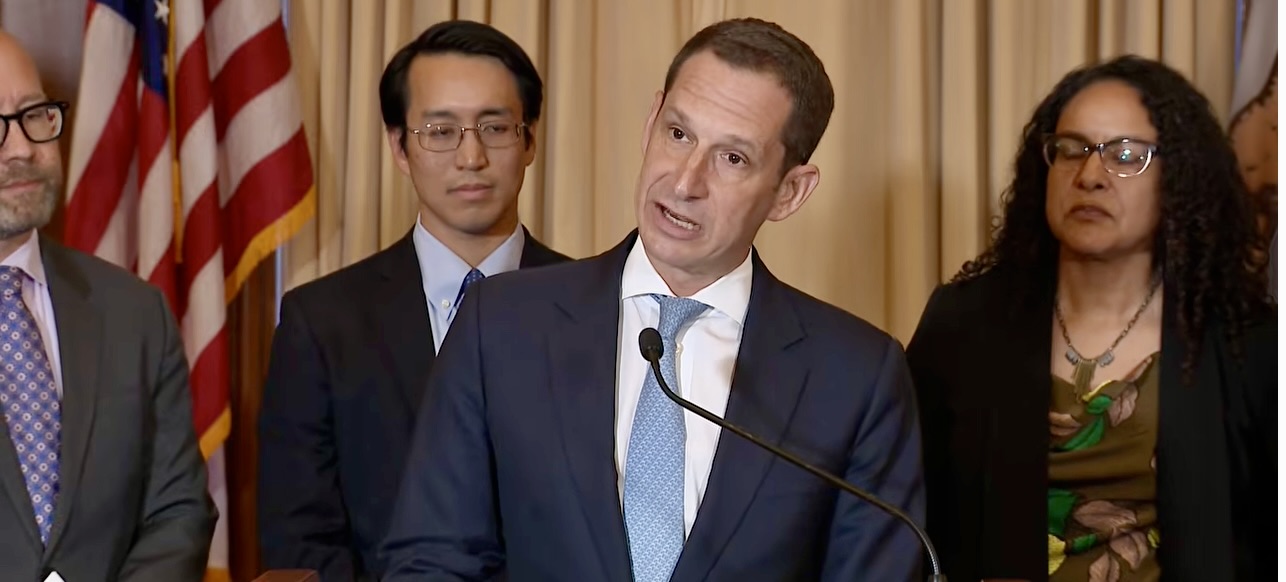
“For years we have seen the same pattern play out on our streets — people struggling with mental health and drug addiction cycling through our systems without the treatment to get better,” San Francisco Mayor Daniel Lurie began his March 12, 2026, press conference as he announced a nearly $100 million in Proposition 1 funding from the State of California aimed at increasing behavioral health treatment. Thanking Gov. Gavin Newsom for his leadership, Lurie said San Francisco will be able to nearly double locked bed capacity, including 50 locked beds and six psychiatric beds at UCSF Hyde Hospital, 44 treatment beds on Treasure Island, and a sobering center at 1660 Mission Street that will create a centralized hub for public health services.
Lurie also touted his administration’s Breaking the Cycle, which he announced in March of 2025. Described as a new vision to break cycles of homelessness, addiction, and government failure by fundamentally transforming the city’s health and homelessness response, the executive directive outlined a roadmap for immediate actions and longer-term reforms. Breaking the Cycle includes the 24/7 “police friendly” stabilization center at 822 Geary Street, and the Family Homelessness Prevention Pilot to help families on the brink of homelessness, an 18-month effort enabled by $11 million from Tipping Point Community, the nonprofit founded by Lurie.
Since its inception, Lurie said Breaking the Cycle has added “nearly 600 beds to meet the needs of people living on the street and combined nine neighborhood outreach teams into a single unified operation, breaking down barriers and increasing shelter placements by 40 percent.”
The mayor also said that the stabilization center located at 822 Geary Street has already shown success in connecting people in crisis to care, and the city will open the RESET (Rapid Enforcement, Support, Evaluation, and Triage) Center to get drug users off the street and connected to treatment. “Instead of working in silos, we are operating as one team,” Lurie continued. “Last month we recorded the lowest number of tent encampments, helped place more people living in RVs into dignified housing, and reconnected more people to loved ones than in any month since 2022 thanks to reforms in our Journey Home program.”
In his opening comments, Director of Department of Public Health Daniel Tsai said due to a lack of beds, San Francisco now sends people as far away as Santa Barbara for treatment. “We’d rather not send San Francisco residents out of county,” Tsai said. “We want to help them here.”
Related