
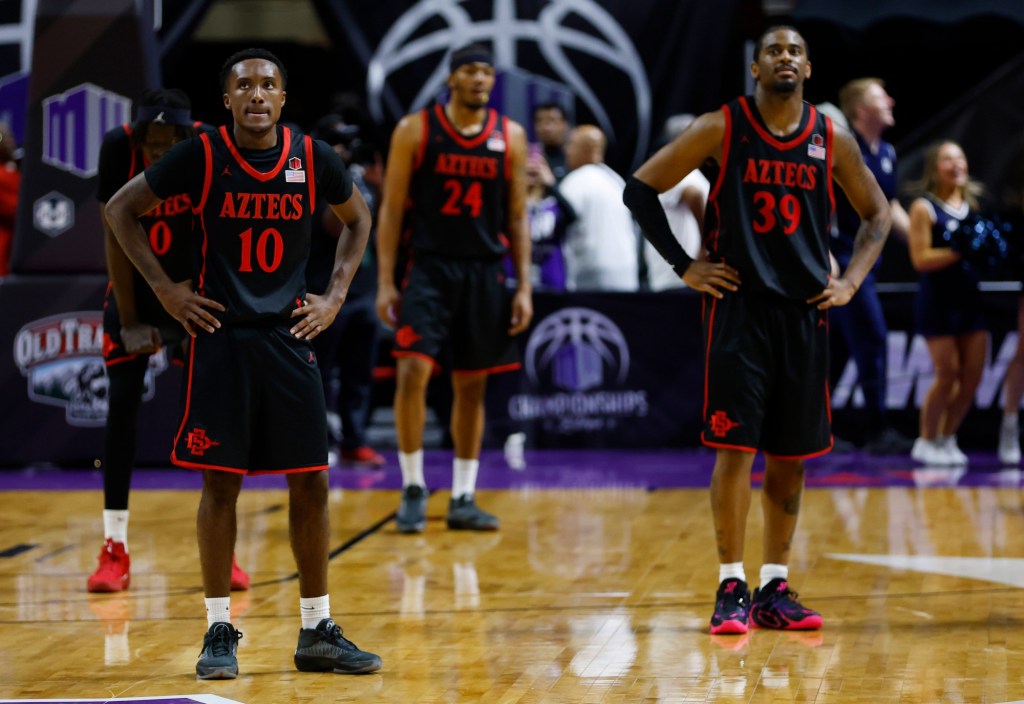
Their last game ended Saturday afternoon.
Their season officially ended Sunday afternoon.
San Diego State actually appeared on the CBS Selection Show, when the 68-team NCAA Tournament bracket was revealed, but toward the end, in a graphic showing the first four out. The Aztecs were third on the list, behind Oklahoma and Auburn.
Minutes later, coach Brian Dutcher issued a statement confirming what the Union-Tribune has reported for several weeks: That his 22-11 team would not accept an invitation to the NIT or any other postseason event.
“I’m disappointed for our players and our great fans that we weren’t selected to compete in this year’s NCAA Tournament,” Dutcher said. “There are only 68 spots available and unfortunately, we didn’t get one of them.
“Physically, our team is very banged up at this point. If we had received a bid for the NCAA Tournament, we would have competed. However, with where we are today physically, I don’t feel that playing in another postseason event would benefit us.”
It ends a streak of five straight NCAA appearances and is only the fourth time in the last 20 years that SDSU hasn’t played in the postseason (and one of those was 2020, when the pandemic prevented a 30-2 team from going to the NCAA Tournament).
Not counting that pandemic year, the 22 wins are the most ever by an SDSU team not to play in the postseason.
The Aztecs likely would have been a No. 1 seed in the 32-team NIT, meaning it would be in line to host each of the first three rounds until the semifinals in Indianapolis. But with the NCAA Tournament at Viejas Arena this week, that would have meant renting another local facility for at least two games — something the SDSU administration briefly explored before the NCAA-or-bust sentiment prevailed.
There was an injury component, with starters Miles Heide breaking his hand in the Mountain West Tournament semifinals and Elzie Harrington being shut down for the season, plus a hobbled Miles Byrd.
There is also, you’d think, an element of pride.
The NIT is not the prestigious event it once was, going the way of many college bowl games amid the increased transiency of college sports. Last year, the field included only four teams from power conferences plus 13-19 San Jose State and three members of the Big West.
This year’s field has three power conference entrants and five from the Mountain West: Colorado State, Nevada, New Mexico, UNLV and Wyoming. (UC San Diego was not invited.)
Another option is The Crown, an eight-team event in Las Vegas that offers modest NIL payouts but doesn’t start until April 1, when rosters are ravaged from impending transfer portal defections.
The College Basketball Invitational, which last year planned to have 16 teams but got only 11, announced last week it had canceled the 2026 event.
The goal, though, was always the Big Dance.
“We fought hard all year,” Dutcher said in his statement, “and in a league that featured seven teams that won at least 20 games, we completed the regular season alone in second place and reached the championship game of our conference tournament. All those are accomplishments we can be proud of, but in the committee’s eyes it just wasn’t enough to be included in the field.
“We respect the work they do.”
The bubble was the softest in recent memory, with one team after another stumbling late in the season. The Aztecs were one of them, unable to recover from losing four of five and falling short in Saturday’s championship game of the Mountain West Tournament that would have secured the conference’s automatic berth.
They finished 47 in the NET metric and 48 in Kenpom, slightly better than a year ago, when they were one of the final teams to make the field and were sent to the First Four in Dayton, Ohio.
Last season, they were 8-8 in Quad 1 and 2 games against the best competition. This season, 9-10.
Both years, they had a single Quad 3 loss and finished at 49 in the flavor-of-the-month metric called WAB (Wins Against Bubble).
But the enormous influx of money into college basketball has noticeably widened the gap between power conferences and mid-majors. The SEC got 10 NCAA bids, the Big Ten got nine, the Big 12 and ACC eight each. Mid-majors received only four at-large invitations, equaling the record low since the tournament expanded to 68 teams in 2011. That’s down from 10 in 2013 and seven just two years ago.
The Mountain West felt the squeeze. Seven teams won at least 20 games and were ranked in the top 100 of the Kenpom ratings, but it reverted to being a one-bid league for the first time in a decade. Over the previous three tournaments, it got four, six and four bids.
“I’ve said it all year: The parity has hurt our league this year,” Dutcher said Saturday after losing 73-62 against Utah State in the Mountain West Tournament final. “That’s what every league wants, is parity.
“So if you’re in a power (conference), the parity is fantastic. Get eight, nine teams in. But in the Mountain West, parity is not a good thing. There wasn’t enough separation between the top.”
Instead, North Carolina State, Texas, SMU and Miami (Ohio) received the final four at-large berths and a trip to Dayton. Miami was a controversial pick, going 31-1 but with one of the easiest schedules in the nation and a 93 Kenpom. (The next lowest Kenpom ranking to receive an at-large berth was Central Florida at 54.)
SMU went 20-13 and finished tied for 11th in the ACC at 8-10, but the Mustangs were slightly better than SDSU in all the major metrics (37 in NET, 42 in Kenpom, 45 in WAB).
North Carolina State (20-13) lost seven of nine games to close the season. Texas (18-14) lost five of six.
Dutcher predicted as much a day earlier.
“When people say, ‘Well, it’s a soft bubble and we don’t need to expand the field,’” he said, “we don’t need to expand the field if we’re taking mediocre power (conference) teams. … It might be soft with power (conferences), but it’s not soft with mid-majors. There are a lot of good mid-major teams, and we are one of them.”