
Craig Nagasawa is Godzilla.
The Berkeley-based artist often paints self-portraits in which Godzilla is a stand-in for himself. Nagasawa sees many parallels between himself and the infamous dinosaur-like monster. Like Godzilla, Nagasawa’s existence was shaped by the United States’ atomic bomb warfare with Japan. Like Godzilla, Nagasawa feels like he has never truly belonged in one place. Like Godzilla, Nagasawa changes over time.
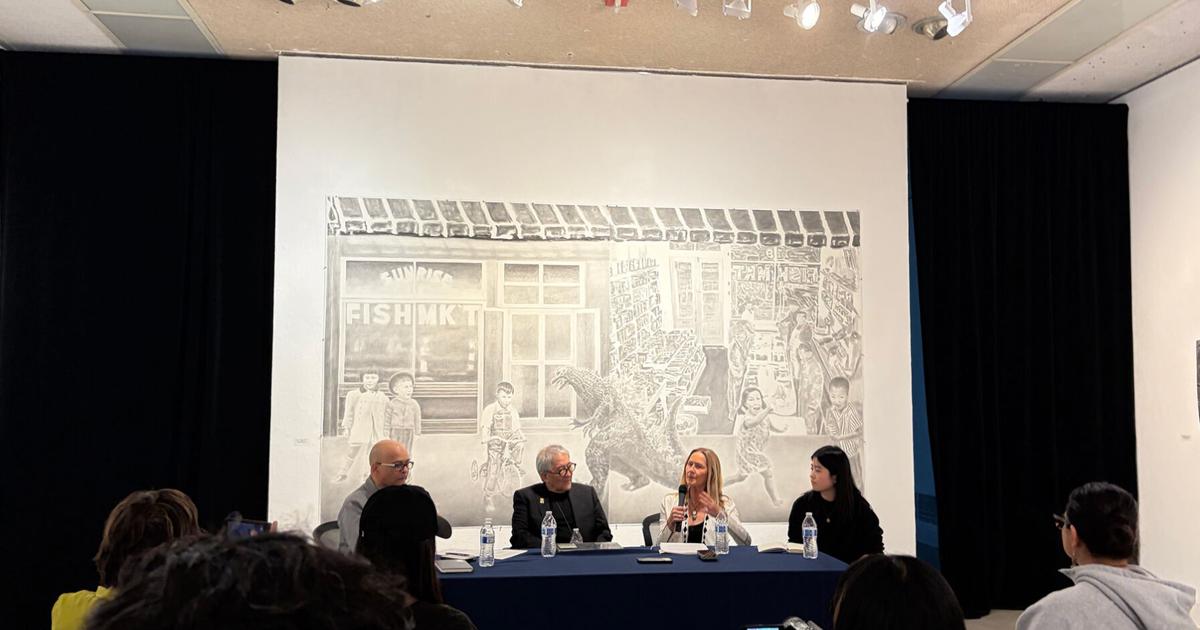
Since Feb. 19, Nagasawa’s artwork has been on display in a gallery at the Anthropology and Art Practice Building. The exhibition, titled J-Town Express, will conclude March 20 and aims to reflect the Japanese American experience. On March 12, a panel discussing Nagasawa’s work was held, attracting more than 50 listeners.
“I really seek to find a place where the narrative is completely open-ended. It’s a question. It isn’t meant to be a closure,” Nagasawa said of his artwork. “So the viewer has to negotiate those same issues that I negotiate, which is the technical part of the painting, the choosing of the images and the kind of hybrid cultural vignettes.”
The panel was moderated by campus art practice professor Al-An deSouza and featured prominent Asian American playwright Philip Kan Gotanda, campus English professor Hertha Sweet Wong and Grace Xiao, curatorial assistant at the Manetti Shrem Museum. They discussed the impact that Nagasawa’s work has had on them and how they deal with themes including transgenerational trauma, surrealism and the self.
The panelists sat between two of Nagasawa’s paintings, depicting broken clocks stopped at the times each atomic bomb was dropped. The exhibition also featured a backdrop of a traced film printing of Nagasawa’s parents in a fish market — with Godzilla intersecting it — a poignant reminder of the “confluence of time,” as deSouza put it.
“(Nagasawa) really knows his history, but he’s not just preaching to us, or nagging us or writing a story of trauma and loss. Even though that’s a part of the story, it’s not a whole story,” Wong said. “He talks about transgenerational trauma without ever really naming it, and was actually inviting in some cultural reference to being playful and joyful together.”
Following the panel was a Q&A with Nagasawa, during which he discussed his materials, struggles with the medium of painting and other topics. He shared that he sources raw traditional Japanese materials such as pigments and processes them himself by grinding down rocks.
Nagasawa’s art deals in many different styles, from traditional mineral-pigment painting, writing vignettes and charcoal drawing to performance video. The exhibition even featured a room dedicated to self-portraits of himself as Godzilla in everyday life, including boating and skiing.
In most of his self-portraits, Nagasawa’s face is missing, if not replaced by Godzilla. The gallery has paintings depicting Nagasawa with a bag over his head or looking away from the audience, and another that is just a floating hat.
“There used to be a thing called ‘The Roast,’ where there were all these comedians, and they’d give (one) a really hard time,” Nagasawa said. “So that’s what I was thinking might happen tonight. (But everyone was) so nice and respectful and I’ve never heard this many people talk about my work in one sitting. I really, really appreciate that.”