
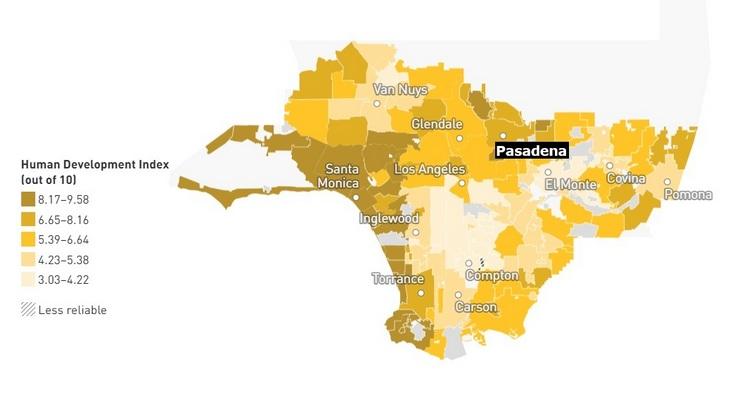
Before the Eaton Fire, Altadena was one of the most livable communities in Los Angeles County — a racially diverse, well-educated foothill neighborhood where residents earned above-average incomes, lived longer than most Angelenos, and had made some of the largest educational gains of any county community in the region over the past eight years.
That Altadena no longer exists. The January fire destroyed half the homes in the community, killed residents, displaced thousands of families, and left behind a toxic landscape dotted with ash, asbestos, lead, and arsenic that continues to impact people more than a year later. A community that had been steadily building toward a better future was, in the span of days, physically decimated.
A sweeping new Los Angeles County report released March 11 captures both sides of that story — the Altadena that was, measured in data collected through 2023, and the catastrophe that followed.
The juxtaposition is staggering. The same report that assigns Altadena a Human Development Index score placing it among the county’s highest-performing communities also warns that the gains those numbers represent may have been wiped out along with the homes, schools, businesses, and community spaces the fire consumed.
Pasadena, which was almost entirely spared the fire’s direct destruction, also ranks in the upper county’s tier. But the two communities now occupy fundamentally different realities, separated not by distance but by the path the fire took.
The numbers before the fire
“A Portrait of Los Angeles County 2026,” published by Measure of America, a project of the Social Science Research Council, scores every community in the county on a Human Development Index combining measures of health, education, and earnings on a 0–10 scale.
The report, funded in part by the Los Angeles County Department of Mental Health along with the James Irvine Foundation, the Ralph M. Parsons Foundation, the Conrad N. Hilton Foundation, and Cedars-Sinai, is a follow-up to a 2017 edition widely used by county departments and nonprofits for planning and policymaking.
Altadena received an HDI score of 7.54, ranking 24th among the 115 cities and unincorporated areas evaluated. Pasadena scored 7.31, placing it 28th. Both fall within what the report designates “Elite Enclave LA,” a tier of 32 communities with HDI scores between 7.0 and 8.99 that collectively are home to about 15 percent of the county’s population, or roughly 1.46 million people. Both exceed the countywide HDI average of 5.64. Nearby South Pasadena scored higher still at 8.66, ranking 15th.
In Pasadena, the typical worker earned $59,600 per year, well above the county median of $44,600. In Altadena, median personal earnings were $62,600. Life expectancy in both communities was 82.9 years, compared to 80.5 years countywide.
More than half of adults 25 and older in both communities hold at least a bachelor’s degree — 56.0 percent in Pasadena and 52.7 percent in Altadena — compared to the county rate of 36.6 percent. About one in four adults in each community holds a graduate or professional degree: 26.0 percent in Pasadena and 25.7 percent in Altadena.
Altadena was one of only nine places in Los Angeles County where the Education Index increased by more than one full point between 2015 and 2023, rising from 6.75 to 7.78. The share of Altadena residents without a high school diploma dropped below 10 percent, while the share holding at least a bachelor’s degree rose above 50 percent. That trajectory — the evidence of a community investing in itself and growing more educated year by year — makes what happened next all the more devastating.
What the fire did to Altadena
The report devotes significant attention to the January wildfires, describing them as among the deadliest in California history. In Altadena, half the homes were destroyed. In Pacific Palisades, 55.8 percent of single-family homes and nearly all mobile homes were lost. Countywide property damage from the Eaton and Palisades fires is estimated at as much as $131 billion, with economic disruption and job losses expected through 2029.
But the property statistics, as staggering as they are, only begin to describe what happened.
Anyone who has driven through Altadena since January knows the numbers do not capture the scale of the destruction. Block after block of homes reduced to concrete foundations and ash. Entire neighborhoods erased. The landscape stripped bare. The community’s physical identity — its tree-lined streets, its churches, its small businesses, its schools — mostly gone.
The human toll extends far beyond the initial casualties. The report cites a study by the Boston University School of Public Health and the University of Helsinki attributing 440 additional deaths beyond the initial 31 deaths to the wildfires, as smoke and displacement stress exacerbated existing health conditions and disrupted access to care across the region.
Survivors have been grappling with grief, fear, uncertainty, and displacement from cherished communities while navigating the practical nightmare of finding housing, clothing, masks, air filters, physical and mental health care, and accurate information about the long-term health effects of the smoke and debris.
Those health effects are not theoretical. The report notes that people in or near the fire zones whose houses are still standing face ongoing dangers from toxic contamination. Debris, smoke, soot, and ash contain hazardous substances including asbestos and heavy metals like lead and arsenic.
Getting insurers to pay for environmental testing and remediation has been, the report states, extremely difficult if not impossible for many fire survivors. Insurance claims more broadly have been complicated and emotionally taxing, with some companies imposing strict damage standards that conflicted with state law.
Across the region, some 700,000 children and young adults saw their daily lives and educations upended, according to the document. A year after the fires, the report notes, the majority of affected residents remained displaced and continued to struggle with housing support.
What the scores mean now
The report is candid about the bitter irony of its own findings. In its description of the highest-scoring tier, “Glittering LA,” which includes Brentwood-Pacific Palisades, the report acknowledges that the data “comes with a huge caveat” because “the very people whose score was highest when calculated using 2023 data are now grappling with worlds of loss.”
The same applies to Altadena. The report states directly that Elite Enclave residents “are not immune to hardship; Altadena, for example, which suffered harrowing losses in the January Eaton Fire, is an Elite Enclave community.”
While residents of these communities generally have the educational credentials, earnings, insurance, and savings that reduce their exposure to risk and help them recover from setbacks, the wildfires demonstrated the limits of those advantages. As the report puts it, “capabilities like high earnings, good health, and access to knowledge, so critical to well-being, are not guarantees.”
For Altadena, this is not an academic observation. The community’s HDI score is a snapshot of a place that, in its physical form, no longer exists. The educated residents, the rising property values, the families who had built lives there over decades — those people are now scattered across Southern California, many still waiting for insurance settlements, many unable to return to land that remains contaminated, some wondering whether there will be a similar Altadena to come back to.
Pasadena’s position
Pasadena, though physically spared the fire, is not insulated from its consequences or from the broader countywide pressures the report documents.
The report tracks youth disconnection — the share of young people ages 16 to 24 who are neither working nor in school. In the Pasadena neighborhood cluster, the rate is 9.4 percent, representing about 1,100 young people. That is below the countywide rate of 11.9 percent, which represents 133,900 disconnected young people across Los Angeles County, but it still represents more than a thousand young Pasadena-area residents the report portrays without a clear path forward.
Several countywide trends documented in the report carry direct implications for Pasadena. Life expectancy across Los Angeles County fell from 82.1 years to 80.5 years between the 2010–2014 and 2019–2023 periods, a 1.6-year decline driven primarily by the COVID-19 pandemic, rising drug overdose deaths, and increased cardiovascular disease. Every major racial and ethnic group experienced a decline. Drug overdose was the eighth-leading cause of death countywide, though 2024 data show a 22 percent reduction in overdose deaths.
Housing costs continue to impact residents at every income level. The report finds that in every single Los Angeles County neighborhood, a resident earning the median salary for that neighborhood would need to work more than 40 hours per week to afford monthly median housing costs without being considered cost-burdened. In 31 neighborhoods, a median-salary earner would need to work more than 80 hours per week. Countywide, 58 percent of renters spend 30 percent or more of their income on rent.
The cost of childcare now exceeds housing costs in nearly all of California. In Los Angeles, tuition for one infant and one preschool-age child in a childcare center totals approximately $25,100 per year — 56 percent of the median Angeleno’s annual income of $44,600. Just 8 percent of eligible infants and toddlers in Los Angeles County have spots in publicly subsidized early childcare programs.
Federal funding cuts compound the pressure. The report describes the July federal budget legislation as having “major implications” for Los Angeles County. The county’s public health system faces a loss of $750 million in annual support, leading to hiring freezes and potential hospital closures. Over $800 million in education funds meant for teacher training, after-school programs, and services for English learners were temporarily withheld from California. The report states that these cuts “are expected to create significant challenges for public services and working families.”
Racial and ethnic disparities
Both Pasadena and Altadena are racially diverse communities, and the report’s countywide findings on racial disparities are relevant to both. The countywide HDI score of 5.64 masks deep inequities. Asian residents scored highest at 7.68, followed by white residents at 7.37. Black residents scored 4.70, Latino residents 4.45, and Native Hawaiian and Other Pacific Islander residents 4.01.
A 15-year life expectancy gap separates the longest-living racial and ethnic group (Asian residents, 86.2 years) from the shortest (NHOPI residents, 71.2 years). In earnings, white men earn $80,300 at the median, while Latina women earn $31,800. These countywide disparities manifest at the neighborhood level in both communities.
The report’s recommendations
The report concludes with nine recommendations developed by advisory committees of county officials and civil society representatives. Among those with direct relevance to Pasadena and Altadena: ensuring equitable distribution of wildfire recovery resources, particularly for Altadena and other fire-affected communities; expanding access to affordable housing and preventing displacement; investing in high-quality early care and education from birth to age 5; expanding mental health and substance use treatment; and building climate resilience to prevent future disasters.
The report specifically names Altadena in its disaster recovery recommendations, calling for helping residents of Altadena, Pacific Palisades, and other fire-affected communities to continue rebuilding their lives, avoid further exposure to hazards and toxins, and get the help they need to deal with their trauma, loss, and grief as a top priority.
Critically, the report calls for rebuilding processes and financing that are inclusive of renters and workers in fire-affected areas, not only homeowners. It states that community-driven survivors’ networks can provide support to residents and advocate for equitable recovery.
For Altadena, these are not policy abstractions. They are the difference between a community that rebuilds and one that is permanently erased — not by the fire itself, but by the failure to respond to it.
About the report
“A Portrait of Los Angeles County 2026” was authored by Kristen Lewis, Alex Powers, Kate Harvey, and Tara Shawa at Measure of America. The report uses 2023 data from the U.S. Census Bureau’s American Community Survey and 2019–2023 mortality data from the California Department of Public Health. It incorporates input gathered from community data walks with more than 200 residents held across the county.
The full report and interactive data are available at measureofamerica.org/los-angeles-2026.
 Get our daily Pasadena newspaper in your email box. Free.
Get all the latest Pasadena news, more than 10 fresh stories daily, 7 days a week at 7 a.m.