
.jpg "Students walk by a new gateway sign at the entrance to Fresno State at Maple and Shaw avenues, Friday, May 2, 2014. The stone and metal sign lies across from a sculptural element, called a sprout to reflect the school's agriculture, nature, native history, programs and education, made of perforated metal and wood. The signs at Maple and Shaw are the part of the university's Campus Identity and Exterior Wayfinding Comprehensive Sign Program. New gateway signs at the Cedar and Shaw and Cedar and Barstow entrances will be installed later this summer. CRAIG KOHLRUSS")
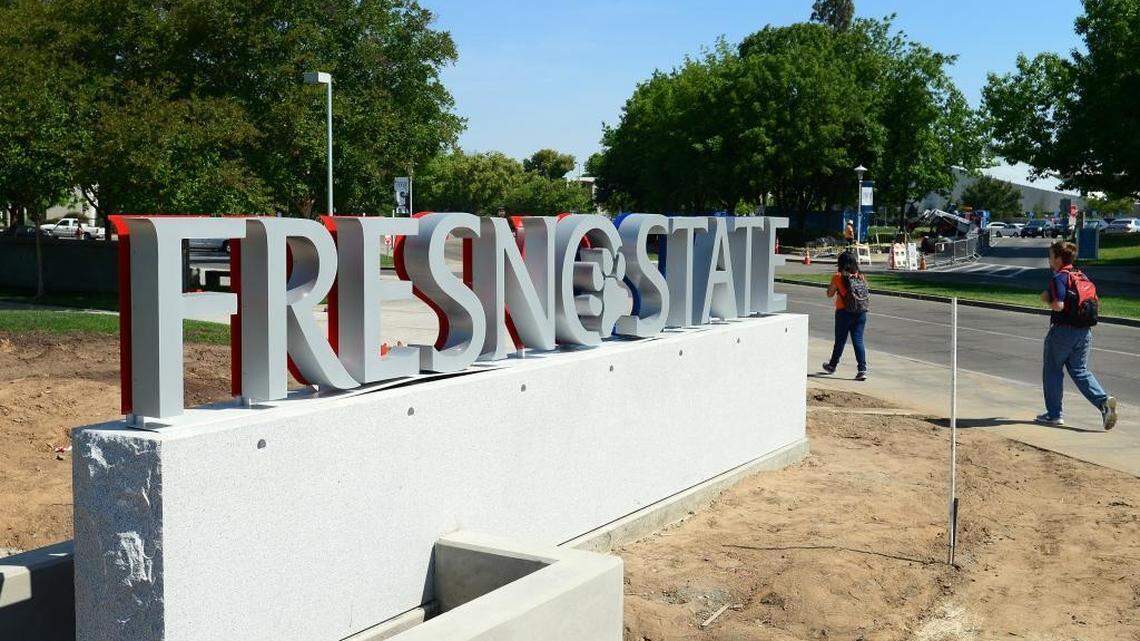
Students walk by a new gateway sign at the entrance to Fresno State at Maple and Shaw avenues, Friday, May 2, 2014. The stone and metal sign lies across from a sculptural element, called a sprout to reflect the school’s agriculture, nature, native history, programs and education, made of perforated metal and wood. The signs at Maple and Shaw are the part of the university’s Campus Identity and Exterior Wayfinding Comprehensive Sign Program. New gateway signs at the Cedar and Shaw and Cedar and Barstow entrances will be installed later this summer. CRAIG KOHLRUSS
CRAIG KOHLRUSS
Fresno Bee Staff Photo
The Fresno State Foundation, which controls more than $300 million in university endowments and grants, eliminated term limits for its board of governors in February 2022 and has been operating contrary to industry best practices in that key governance area for the past four years, The Fresno Bee has found.
In addition, at the time the term limit rule was dropped, the foundation board already was without staff/administration, faculty or student representation in violation of state regulations.
Both were among governance and operational issues highlighted in an advisory review by the California State University, which was released in January and found those weaknesses left the foundation vulnerable to financial misstatement or fraud.
The foundation is a nonprofit organization that operates independently of the university but manages its endowment of $250 million, as well as $65 million in research grants. It redistributes the money to pay for research, student scholarships, employee salary support and other important initiatives at the university.
The CSU found no malfeasance in its advisory review, which looked at foundation operations over the 2024 fiscal year. But the review detailed 46 areas that were in need of remediation action, including in the areas of board governance and operations and organizational structure.
The review, which was conducted by CSU Audit and Advisory Services, was requested by Fresno State president Saúl Jiménez-Sandoval, as a result of the foundation’s misinterpretation of the state Nonprofit Integrity Act of 2004, a set of rules nonprofits must follow in areas of governance and financial practices. Jiménez-Sandoval is the only university employee on the foundation board.
Prior to the elimination of term limits, board members were supposed to be restricted to two consecutive, four-year terms with an option to serve again after a one-year absence, though that apparently was loosely enforced. Foundation chair Vinci Ricchiuti has served on the board for 31 years in a row, four others have served for more than 20 years, including two for 29 years, and five others have been on the board for 12 or more years.
According to board meeting minutes reviewed by The Bee, the board’s governance committee discussed term limits and ways to ensure board stability and engagement with Jiménez-Sandoval in 2022. After what was called “thoughtful discussion,” the five-person committee collectively agreed to a new board structure without term limits. When a board member’s term expires, the university president, board chair and governance committee are to make a determination whether it is in the best interests of the corporation to recommend reelection to the board, according to the new language in the bylaws.
The board approved the revised bylaws as presented, the meeting minutes indicate.
There were no details recorded in the minutes of any discussion on the topic, including the impetus for or reasoning behind the change. Ricchiuti, the board chair, supported the change to bylaws to eliminate term limits, the minutes show.
The limited turnover on the board and leadership positions, coupled with minimal university representation and outdated governing documents, has reduced transparency and resulted in misalignment with the university’s strategic priorities, according to the CSU review.
The review cites seven foundations on its campuses that all have explicitly stated term limits for their board members.
Fresno State Foundation officers and board members volunteer their time to serve and are not compensated by the foundation, according to its tax documents.
Jiménez-Sandoval declined to comment for this story. But in a statement in January that accompanied the release of the report on the CSU review, he cited board structure and governance as points of emphasis for the university and foundation board in developing an action plan to address the 46 findings.
George Soares, who is chair of the foundation governance committee and has served on the board for 10 years, did not respond to a phone message or an email from The Bee.
That lack of turnover can have a deleterious effect on a nonprofit philanthropic board, industry experts told The Bee, impacting governance and weakening oversight and accountability.
“I often ask organizations, ‘Are you doing what you’re doing out of history and habit or effectiveness and efficiency?’ When you have board members or trustees who serve for a very long time, you get into history and habit behavior,” Dave Sternberg, founding partner of a management and fundraising consulting firm for nonprofit organizations, told The Bee in January.
“This report is certainly evidence that there were behaviors that they just continued, and when it’s the same people over and over the question becomes, ‘Where is the sense of inquiry and the ability to ask, Is this the way we should be doing things?’ When you stay for a long time, that’s what you find.”
The CSU review uncovered a number of issues including core financial processes that no longer met the needs of an organization of its size or were based on outdated assumptions. Fund balance reconciliations, IDC (Indirect Cost) allocations and endowment-income distributions all relied on manual practices, according to the review.
The most critical risks, according to the review, involved banking practices and segregation of duties, which left it vulnerable to financial misstatement or fraud.
There were instances, the CSU review found, where the same individual prepared and approved multimillion dollar wire transfers. That same individual had administrator access within the foundation’s financial system, allowing access to post transactions, revise vendor records and process payments. That, combined with infrequent bank reconciliations, at times performed by that same individual, created significant opportunities for unauthorized or undetected activity, according to the review.
This story was originally published March 16, 2026 at 5:07 AM.
Related Stories from Fresno Bee