
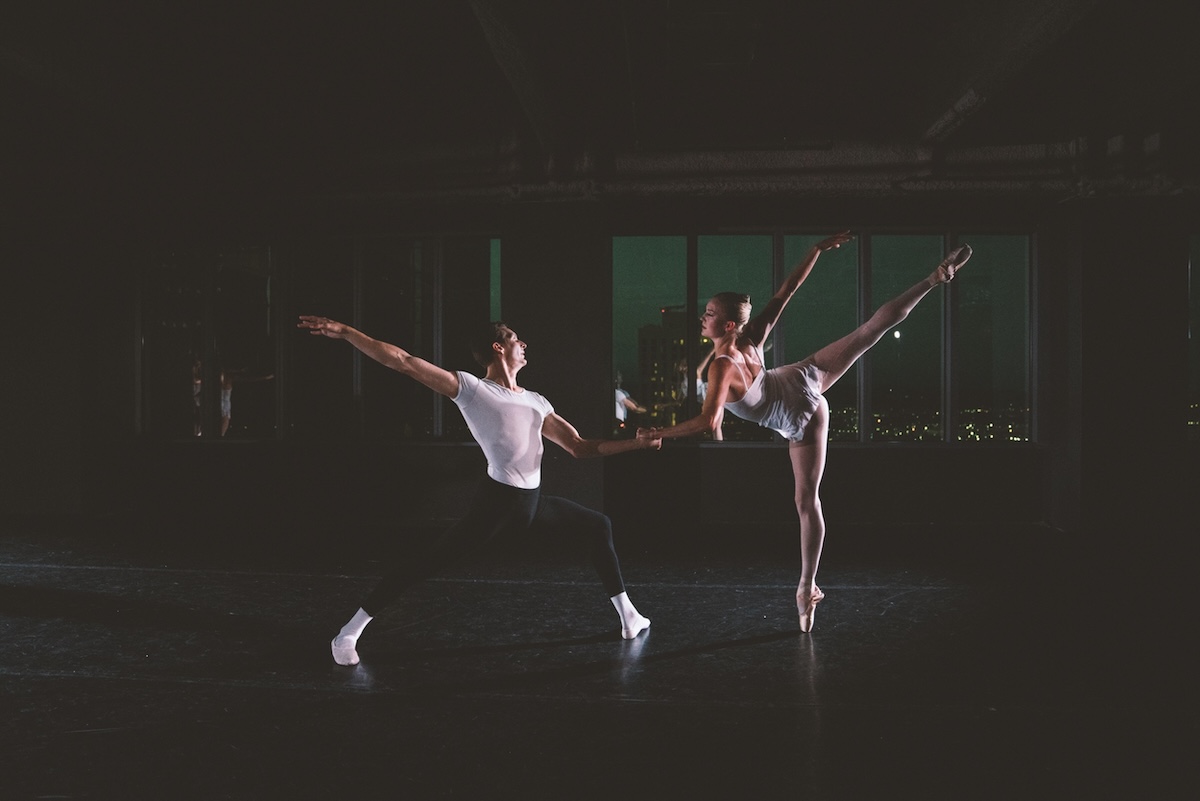
While Hollywood reels from ongoing disruptions such as major mergers and mass layoffs, a niche ballet company has been quietly leaping into the spotlight, competing for Angelenos’ attention.
American Contemporary Ballet Inc., a nonprofit organization founded by choreographer Lincoln Jones and dancer Theresa Farrell in 2011, celebrated its 15th anniversary this year by adding four members to its board. Additionally, it announced plans to select an executive director – a newly created role – and a permanent performance venue beyond its current home in the Bank of America Plaza on Bunker Hill. A future company dance school is also in the pipeline, though the timeline is yet to be revealed.
“To me, ultimately, ballet is an instrument for revealing the human soul,” said Jones, who serves as Artistic Director. “It’s an exciting art to be part of because you’re working with a lot of people, but that means it takes a good team to be able to put it on. So, what the board is bringing is the business acumen and the wisdom to bring that vision to full fruition.”
 Founder: Lincoln Jones of the American Contemporary Ballet Inc. (Photo c/o Victor Demarchelier)
Suzette Ramirez-Carr, the new president of the board, said as the company sets out on a path of growth, the board would focus on attracting high-impact donors and exploring multiple streams of revenue. This includes the dance school.
“We’re focused on fundraising and getting philanthropists involved who are really interested in the arts and interested in shaping the ballet company’s future,” she said. “We come with a passion, we come with a network, and we come with a dedication to sharing the mission and the vision of the ballet with others, in the hopes that others will be as excited about it as we are.”
Originally a two-dancer operation that started in a borrowed warehouse, the company has grown into a 20-member ensemble with more than 70 performances a year. Known for intimate, industrial performance spaces with live music instead of a proscenium theater that separates the dancers from the audience, the company just entered its 14th season with a 11-dancer troupe, featuring Georgian American choreographer George Balanchine’s “La Source” and “Concerto Barocco.”
Los Angeles is traditionally known for its films, but with Hollywood in decline, the audience has been actively hunting for entertainment alternatives. An Eventbrite Inc. report noted that 79% of adults under 35 plan to attend more events this year, with a particular appetite for “gatherings that feel less choreographed and more real, unrepeatable moments that could only happen once.”
Live events are soaring to meet the demand. Indian research firm Coherent Market Insights projects the U.S. live events market to grow from $466 billion in 2025 to $651.53 billion by 2032, with personalized event experiences gaining popularity. As the only ballet company in L.A. to perform exclusively to live music, American Contemporary Ballet finds itself well-positioned to fulfill a niche.
That is especially the case when the city’s ballet scene does not present a highly saturated market, Ramirez-Carr said.
“There is a place for American Contemporary Ballet to establish L.A. as an important region for the ballet,” Ramirez-Carr said. “There’s a void there that we can fill.”
The company also prioritizes breaking down the common perception of ballet as a form of inaccessible high art. Jones compared the origin of ballet to the Met Gala in the Metropolitan Museum of Art in New York, where dance was a social event that drew people together. The dancefloor at American Contemproary Ballet often “turns into a nightclub” after the show, where the audience joins the dancers to celebrate and dance, Jones said. By bringing the audience to the same plane as the stage and breaking down the traditional format of engaging with ballet, the audience gets an immersive experience that brings ballet back to its social roots.
“What I want people to understand is that what the dancers are doing on stage is just a high level of what you might do going to a nightclub or a wedding or on TikTok,” said Jones. “It’s very important for me to bridge the worlds of popular experience and high art experience.”
American Contemporary Ballet dancer Hannah Barr added that the close-up performance space completes the immersive experience.
“(The audience) gets to see the athleticism of the dancers. They get to see how much we’re sweating, hear us breathing hard … even just the noise of the shoes, I think, adds to the whole experience, and it just makes it immersive, almost,” Barr said. “This intimate setting makes it more real, and they see the human part of us.”
However, the path to success would not be a smooth walk.
While dance companies usually stay financially afloat with a variety of sources, recent budget cuts for public institutions would send ripples through the scene. The L.A. County Department of Arts and Culture got a $1.7 million reduction for the 2025-2026 fiscal year, and it was forced to limit the Organizational Grant Program, Community Impact Arts Grants Program and Arts Internship Program.
 Dance: American Contemporary Ballet has over 20 ballerinas in its current troupe lineup. (Photo c/o Norman Jean Roy)
“There are always challenges in the arts, and especially the nonprofit arts realm, (such as) making sure that they have access to space for facilities or rehearsal, funding to pay their artists and dancers, and of course, marketing their performances and their activities,” said Kristin Sakoda, director of the department.
Economic headwinds may also shrink donations, USC dance professor Jackie Kopcsak pointed out.
“It’s harder for the smaller companies, because there’s these big presenting houses and big institutions that are sponsoring the cost of presenting live performance, and it’s a lot harder for the smaller companies,” Kopcsak said.
A way to stay financially afloat would be balancing traditionally popular pieces such as Swan Lake and the Nutcracker – which American Contemporary Ballet does – with fringe, experimental pieces in the rest of the season that could be funded by revenue streams from the former, Kopcsak said.
L.A.’s vibrant commercial dance scene and collaborations with the film and fashion industry, however, could provide a clearer path forward.
“We’ve seen some collaborations (in dance), and I think we will continue to see that, whether it is in fashion or in commercial, advertising or being part of film or TV,” said Sakoda. “They’re facing both positive opportunities – because I think L.A. has proven that there are audiences for dance here.”
Jones, in any case, seems unfazed.
“A lot of ballet companies have tried in LA and they haven’t succeeded, and I think that’s because there’s a lot of competition for people’s time in Los Angeles,” Jones said. “Here you really have to compete for attention, and the only way to do that, I think, is to do something that is relevant and original.”