
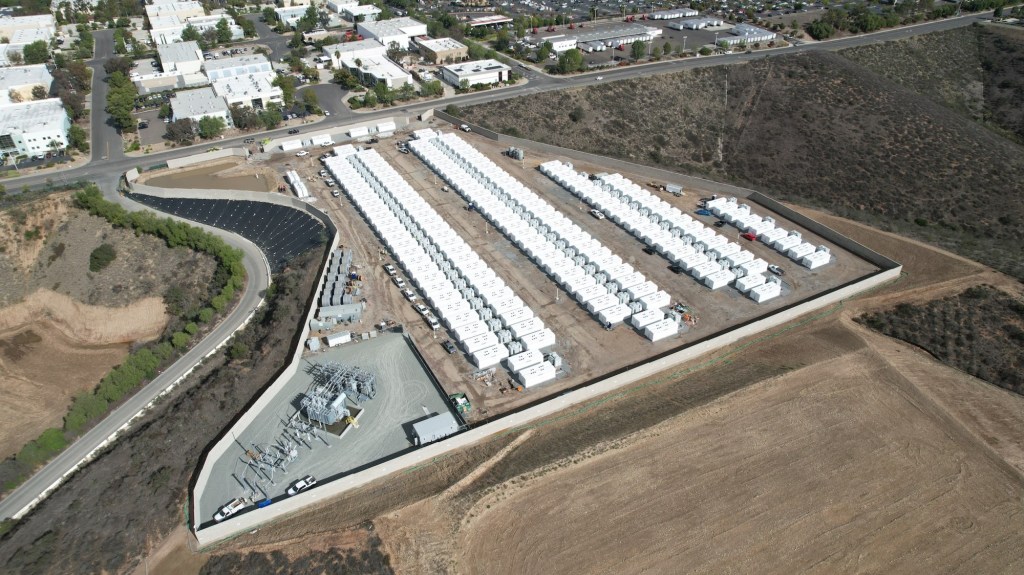
The Nighthawk Energy Storage Project in Poway is scheduled to begin operations within the next two months.
The sprawling facility by Arizona-based renewable energy company Arevon will have 300 megawatts and 1,200 megawatt-hours of storage capacity — enough electricity to power about 385,000 homes for four hours during peak demand periods — and contain 329 battery enclosures.
“It is nearly complete,” said Arevon CEO Justin Johnson. “We’re hoping that we’ll be operational between like mid-April and May … We’re doing the final touches.”
In terms of size, Johnson described Nighthawk as ranking “in the top 10%” of battery projects in the nation.
Arevon will own and operate Nighthawk. Through a long-term agreement, the battery storage facility will provide resource adequacy capacity to Pacific Gas & Electric Company and help support California’s reliability and clean-energy goals.
State policymakers have mandated that 100% of California’s electricity must come from carbon-free sources by 2045, if not sooner.
Even though PG&E’s service territory is located in Northern and Central California, Johnson said Nighthawk will boost overall grid reliability to customers in the San Diego area, too.
“If there’s any sort of risk of blackouts or anything like that, this is the type of resource that is super helpful in mitigating those risks,” Johnson said.
Energy storage typically takes solar power generated during the day and discharges the electricity later, especially from 4 to 9 p.m. when California’s grid is under the most stress. Batteries can help reduce the risk of rotating power outages and replace natural gas “peaker plants” used during those critical hours when customers crank up their air conditioners.
Johnson said Nighthawk can also help “ameliorate the price spikes that happen on the wider transmission system at the end of the day, because you’re releasing power that you have charged up earlier in the day.”
Arevon estimates Nighthawk is expected to deliver more than $30 million in property tax payments that can support schools, infrastructure improvements and other public services over its lifespan.
But the project had to overcome concerns from some about the risk of battery fires.
“Please reconsider, all of you. This is wrong,” one homeowner in nearby Stonebridge Estates said during a 2024 Poway City Council meeting. “I’m all for clean air and all of that but this (project) is a disaster waiting to happen.”
Nighthawk is located within a Very High Fire Hazard Safety Zone, but a Poway city staff report said the facility will have a protection system that will automatically shut down and prevent the spread of fire to other battery modules.
The Poway City Council approved the project in September 2024 on a 5-0 vote.
Though supporters of battery technology say fires are rare, a trio of outbreaks in the San Diego area occurred in the space of one year:
Arevon officials say that unlike the older-model lithium-ion batteries that have been involved in recent fires, Nighthawk will use Tesla Megapack 2XL batteries that use a lithium-iron phosphate, or LFP, chemistry that the company says are “orders of magnitude” more stable and less likely to overheat and ignite.
Johnson said batteries in previous fires were often stacked in big warehouses, where “you could have a thermal event happen in one area of the facility, and it was hard to prevent them just cascading throughout a facility.”
In the Nighthawk design, Johnson said the Tesla Megapack batteries are contained within a single steel enclosure so that if there were an ignition in one battery, it “would not consume the other ones around it.”
The batteries will be equipped with sensors that detect any kind of temperature deviation. “If that occurs,” Johnson said, “that immediately shuts down the megapack and triggers an alarm.”
The system will also be monitored remotely 24/7 and fire department training will be conducted before the project begins operating. Among other precautions, Arevon will build a 12-foot masonry wall completely around the site and pledges to “fully reimburse the city for all costs” incurred from responding to any fire at at the facility.
Nighthawk is located on a parcel of land in an industrial park off Kirkham Road in Poway. The facility will be connected via a 138,000-volt transmission line to San Diego Gas & Electric’s Sycamore Canyon Substation at the Marine Corps Air Station (MCAS) Miramar, which distributes energy to the greater San Diego area.
Last week, Arevon announced closing on a $920 financing package for the Nighthawk Energy Storage Project that includes $482 million in company debt and $169 million in preferred equity.
Arevon also operates the 200 megawatt/400 megawatt-hour Peregrine Energy Storage Project on Main Street in Barrio Logan, which opened last year in the shadow of the Navy yard near San Diego Bay.
Plus, the company has a power purchase agreement with San Diego Community Power at the Vikings Energy Farm in Imperial County that provides solar plus battery capacity.