
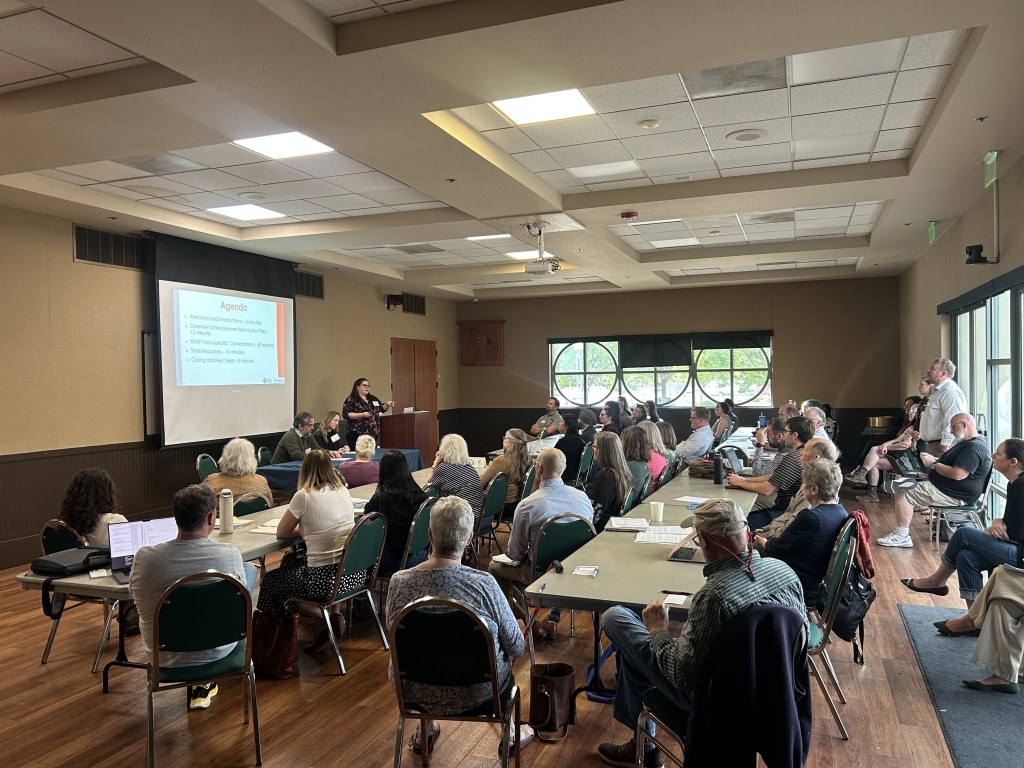
 Community members participate in a listening workshop focused on the impacts of rising heat. Photo by Annelise Pierce
Officials with California’s Natural Resource Agency and Environmental Protection Agency were among several state representatives in Redding today to talk about the impacts of extreme heat.
The state categorizes heat as extreme when temperatures rise above historic averages for a particular region and remain elevated over a period of time. It’s a public health risk that particularly impacts seniors, infants and the unhoused as well as those with disabilities. Across California, communities work to combat that risk by providing warnings related to extreme heat and opening cooling centers.
But there’s much more to the issue of responding to extreme heat, as documented in California’s Extreme Heat Action Plan. California first launched the plan in 2022. An update is due July 1. That’s why hearing about heat response from those across the state is top of mind, officials said today.
Community members representing a variety of local organizations gathered at the Redding City Hall Community Room. After a brief introduction on the topic of extreme heat and the state’s efforts to respond to the issue, organizers divided the room into four listening groups and encouraged movement from table to table to allow those present to weigh in on the central goals of California’s newest draft plan.
Those goals include building public awareness and notification processes related to heat risks, strengthening community services and responses, increasing the resilience of infrastructure and finding ways to utilize nature-based solutions to increasing heat.
Summer temperatures soar in Redding and across parts of Shasta, making the topic one of vital importance to a wide spectrum of community leaders. And while climate impacts, including extreme heat, are considered political topics by some, comments today showed the broad impact that intense heat can have on a community’s needs.
Nick Zettel, the director of Redding Electric Utility, was among many to share his thoughts about what the needs are for the rural north. Pointing out that wildfire risk is driven by extreme heat, Zettel said he finds it concerning that the state isn’t offering funding to support municipalities with addressing wildfire mitigation as part of electrical infrastructure updates.
“If the state doesn’t help,” Zettel said, “rate payers are the ones who have to take on that cost.”
A state representative nodded vigorously as they took notes on their laptop. While the economic costs of extreme heat were front of mind for some who attended today’s session, others were focused on encouraging policy changes related to issues including landlord responsibilities, power company shutoffs and accessibility of cooling centers.
Meanwhile, urban planners and environmentalists alike chimed in on the need for both preserving and planting trees in an effort to increase Redding’s shade canopy. A representative from the Shasta Regional Transportation Planning Agency (SRTA) said it’s easy to get funding to plant shade trees along routes like Highway 273 where lower-income community members both live and walk, but money to maintain those trees once planted remains a barrier.
The need to protect critical infrastructure also came up. Former Shasta Registrar of Voters Cathy Darling Allen chimed in on that topic, saying that more care should be taken to safeguard election processes amid rising heat. She noted that 33% of Shasta’s county-wide elections over recent years have taken place on days with temperatures above 90 degrees, suggesting that more attention should be paid to how extreme heat could impact voter access.
Community members were perhaps most engaged on the topic of improving public outreach efforts related to extreme heat. That’s something the state is working on, representatives said. The state has rolled out CalHeatScore, a centralized site with a mapping tool intended to increase awareness and information about heat. But some said today that the state needs to increase accessibility, especially for the most vulnerable citizens.
“There are too many people who aren’t in the alert system,” tech business owner Jason Salter said, noting that the state’s current approach requires signing up to receive information. A model that proactively provided information to those who need it is more likely to be effective, especially with those most at risk, he said — emphasizing that such a system should be clear, defined and directive.
“We need a system that says, ‘This is the danger, this is what you need to do next, and here’s where you can go,’” Salter explained, amid emphatic nods of agreement from around the table.
Through April 8, the public comment period for California’s draft Extreme Heat Action Plan remains open. Community members can submit ideas and comments by mail, email or online.
Do you have a correction to share? Email us: editor@shastascout.org.