
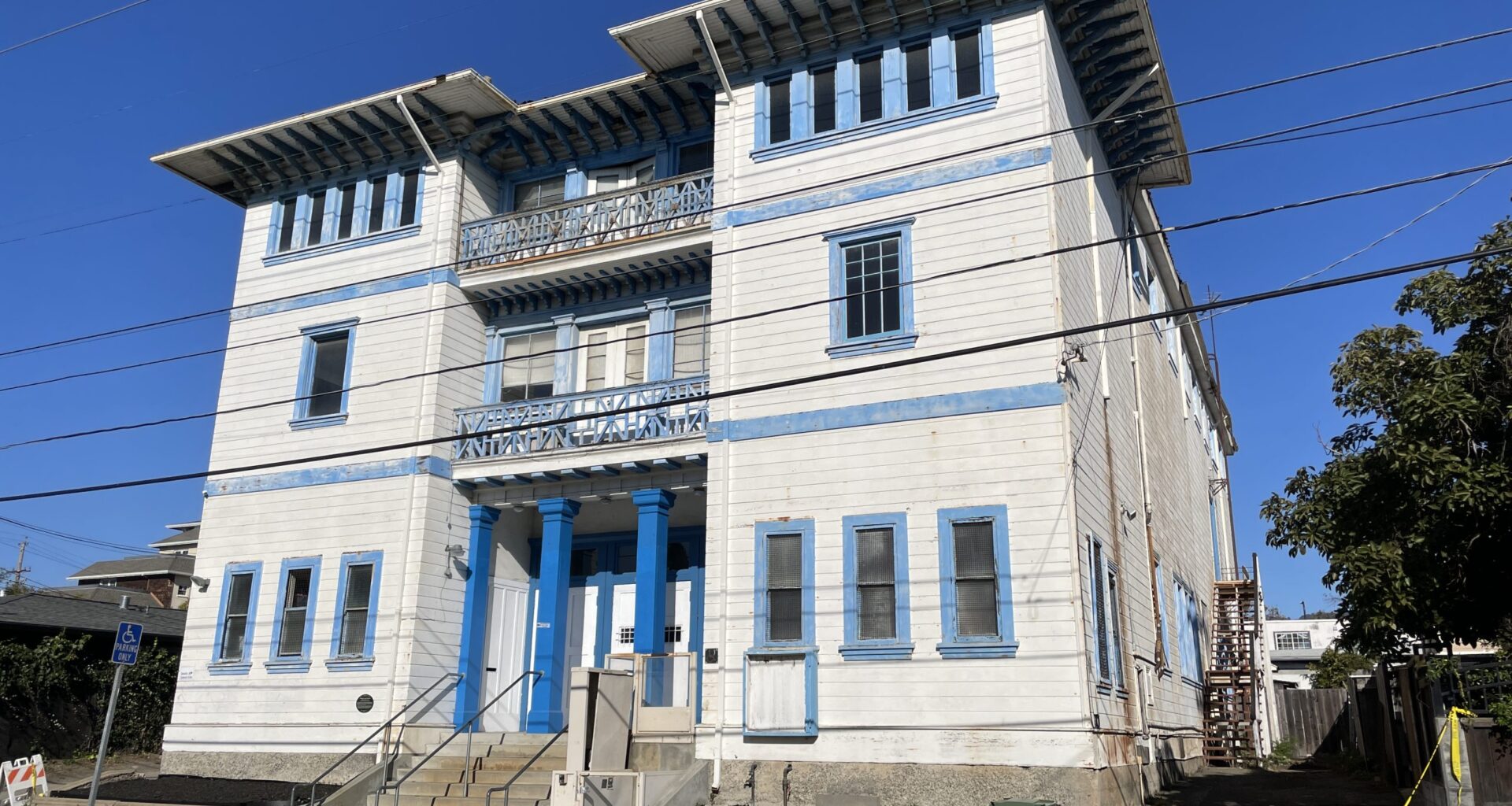
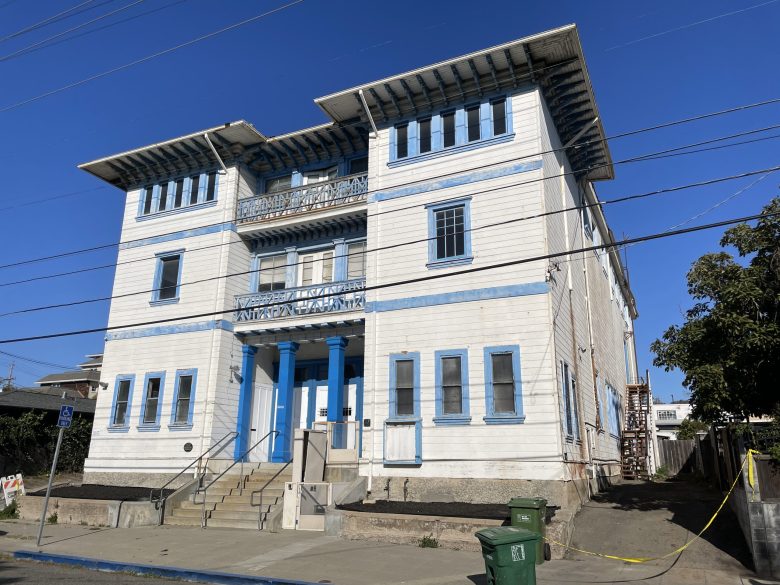
 Berkeley’s Toveri Tuppa Finnish Hall, at 1819 10th St., is heading to the tax default auction block. Credit: Zac Farber/Berkeleyside
After years in an ownership black hole, with community members donating their time and dollars to keep it from falling apart, the next chapter of Berkeley’s Old Finnish Hall will soon be up to the county auction block.
The 1908 building has racked up nearly $1 million in back property tax to Alameda County, a mushrooming liability years in the making that shows no signs of abating.
And so the hall, which has been declared a city historical landmark, will come up for sale at Alameda County’s online tax defaulted property auction, which starts Friday and runs through Monday, along with more than 200 other properties countywide. (Interested bidders must submit a refundable $5,000 deposit by 1 p.m. Tuesday.)
“I just hope whomever takes on the building is willing to preserve it and find the best possible use for it, preferably as a community asset,” said Krista Gulbransen, executive director of the Berkeley Property Owners Association, a landlord group, and one of several people who’ve volunteered over the past several years to help the landmark.
Architecturally distinct, if maintenance challenged, the hall is located on 10th Street between Hearst Avenue and Delaware Street.
Known by the Finnish name Toveri Tupa, which translates closely to “Comrades Lounge,” the hall was once a popular gathering place for Berkeley’s sizable Finnish immigrant population in the early 1900s. Many Finns moved to Berkeley after San Francisco’s 1906 fire.
The building later transitioned to more general community use. A leaking roof and other upkeep issues halted most public use for several years, but today it hosts occasional rentals.
This Finnish-rooted center isn’t to be confused with Berkeley’s other The Finnish Hall, on Chestnut Street, which was built in 1932. That hall, run by a nonprofit, has had some financial struggles over the years, but maintains a strong rental calendar and is paid up on taxes.
Efforts to prevent auction sale failed
One of the challenges faced by the volunteer group trying to stabilize Toveri Tupa over the past several years — they spearheaded a project replacing the building’s roof in 2022 — is that the property doesn’t really have an owner.
The nonprofit organization that owned and ran the hall since it was built, Finnish Hall Inc., has been defunct for years, with no functioning board and no budget. It’s not listed on the state’s registry of charitable organizations.
Based on interviews and records, the business kept up on taxes until about 15 years ago, when it hit rough times. In 2009, the organization didn’t pay property taxes for Toveri Tupa, which were then about $21,000 for the year.
Taxes were paid in 2011, but nothing has been paid since. The tax bill now runs to around $950,000, which includes more than $500,000 in fees and penalties.
The community group trying to preserve the hall, which includes the office of Councilmember Rashi Kersawani, whose district it’s in, hoped the original nonprofit owner could be made viable, or that another organization would take over.
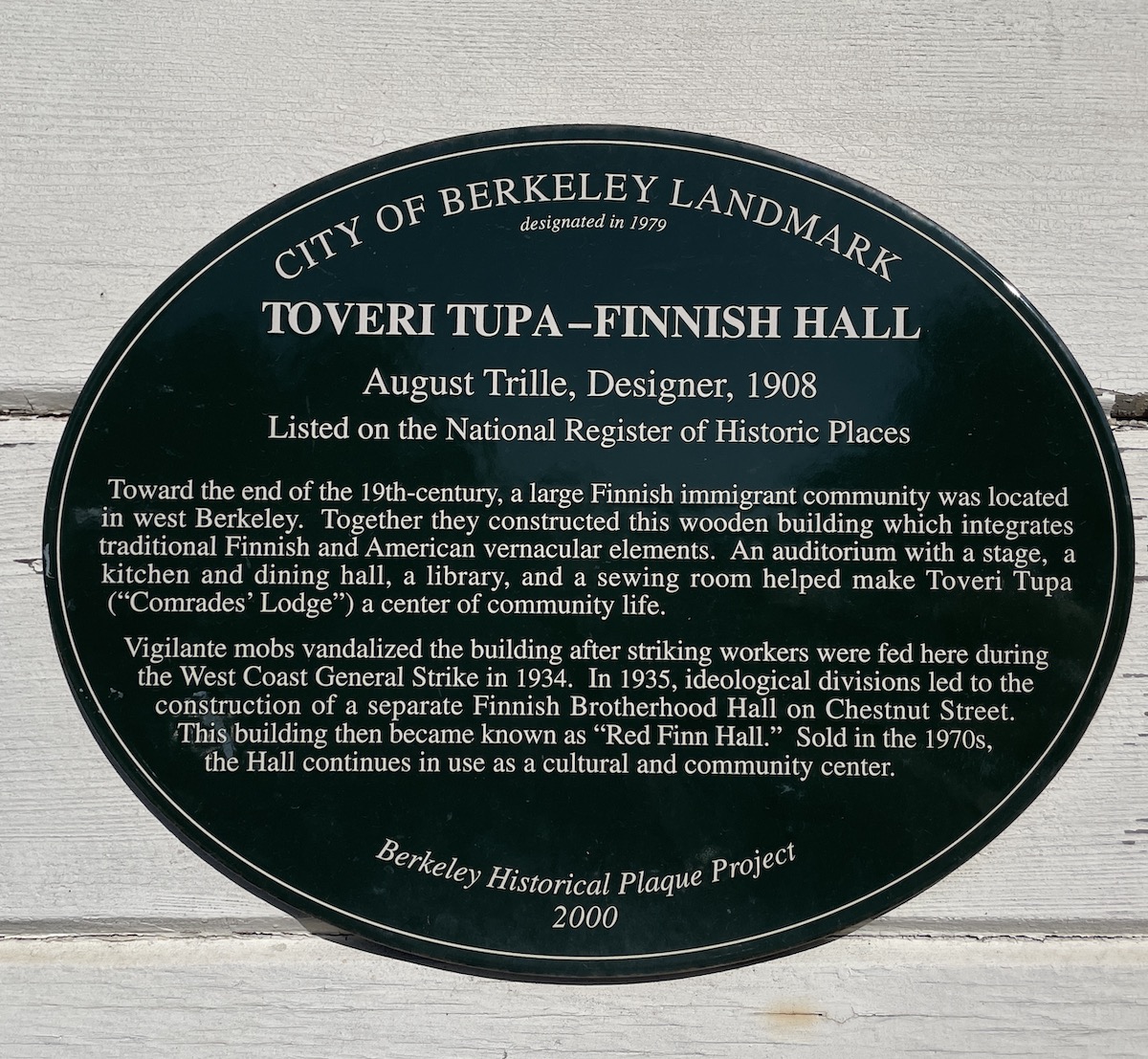 Toveri Tupa is a city of Berkeley landmark and listed on the National Register of Historic Places. Credit: Zac Farber/Berkeleyside
After years of discussions, neither took hold.
“We had been in conversations with nonprofit agencies regarding this property but that was some time ago and have heard nothing since,” said Beth Gerstein, staff person to Kesarwani.
Todd Jersey, a Berkeley architect active with the roof project, said: “We all gave up.”
Hank Levy, Alameda County’s tax collector and treasurer who oversees tax auctions, was among those working with the group with the goal of keeping the building in productive, sustainable use.
“I was hoping that a coherent development plan would be forthcoming,” Levy said.
When property taxes go unpaid for five years, the county tax collector is required by law to step in. Tax collectors can sell to the highest bidder at auction (called Chapter 7) or to sell outside of an auction to a viable nonprofit or government entity planning to use it for public benefit (called Chapter 8), such as affordable housing.
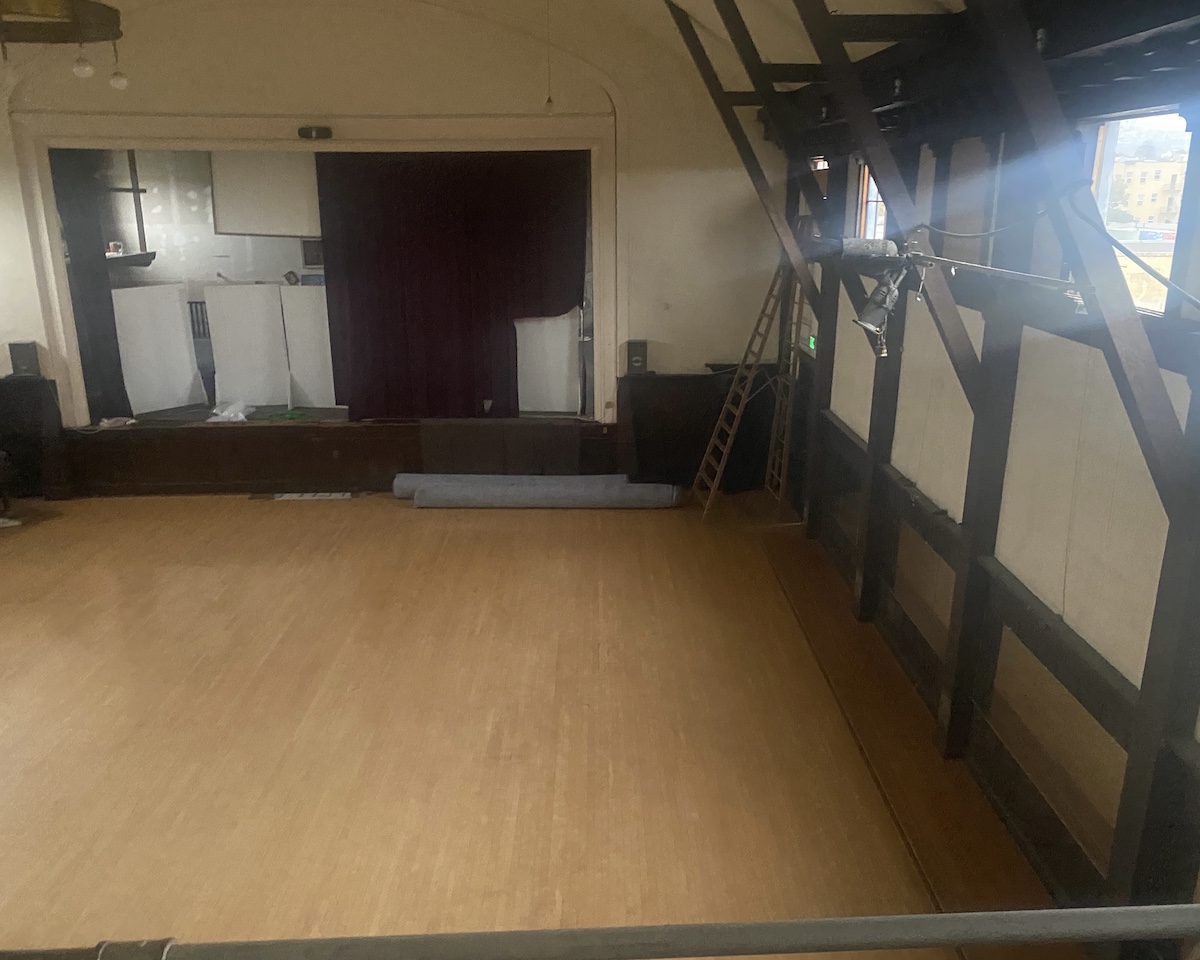 Toveri Tupa’s second-floor theater. Submitted photo
When properties go to auction, the minimum bid is set to recoup back taxes and associated fees and fines. For properties sold under a Chapter 8 arrangement, the main goal is to get the property into beneficial public use, with some pricing leeway. Assessments are required to help set a base price. Tax auctions are unpredictable. Some properties are competitive; others get no bidders.
If the hall isn’t sold in March, it will be re-listed at a follow-up auction in May, Levy said..
If still not sold then, the tax collector has greater ability to negotiate a sale to a government entity or nonprofit, including on the price.
Live-in caretakers, landmark status come with the mix
Among the looming unknowns of Toveri Tupa’s future is the fate of the elderly caretakers who’ve lived there for more than 30 years, a husband and wife who raised their now-adult kids at the hall.
The couple live in an apartment unit created in the back of the building, rent-free in exchange for maintenance and keeping an eye on the property.
Around the time of the roof project, the nonprofit Rebuilding Together helped with safety repairs of the apartment. There were also efforts to help them find alternative housing.
In earlier reporting, Berkeleyside interviewed the caretakers, and one of their adult daughters, who asked not to be named citing concerns for their privacy given the attention they were getting as word spread of the hall’s tax vulnerability. Berkeleyside reached out to the caretakers again recently by phone and email and hasn’t received a response.
 Built in 1908, Toveri Tupa served for many years as a hub for services and events for the Finnish community. Submitted photo
The question of what happens to the caretakers if the hall sells was a pressing issue for the community group working on salvaging it. Their status as renters is a little murky.
Under Berkeley’s rent control regulations, evictions are only allowed for “just cause” such as for lease violations or nonpayment of rent. The sale of a building isn’t considered a just cause — tenants and leasing terms pass to the new owner.
New owners can relocate tenants for major construction, but must pay relocation assistance, and, in some cases, allow them to move back when work is done.
Live-in units in nonresidential spaces are usually subject to Berkeley’s rental laws.
But the specifics of the caretakers’ live-work arrangement from the time they moved in are key, said DéSeana Williams, executive director of the Berkeley Rent Board.
It makes a difference if they were employees or tenants first, she said.
“If the couple moved in as employees, they likely would not have any right to stay in the unit if that employment contract is terminated. In other words, they would not have any protections,” Williams said.
“If, however, the couple moved in as tenants and thereafter began working as caretakers, their tenancy would be covered by rent control, and they would have eviction protections.”
Another issue for a potential new owner is the hall’s status as a city landmark, a designation made in 2000.
Any changes to the building’s exterior would require a structural alternation permit, which could trigger a hearing with the city’s Landmarks Commission depending on the scope and nature of proposed changes, said Denise Hall Montgomery, the commission’s chair.
The decision of the landmark’s commission can be appealed to the City Council.
We know that most readers don’t get to the end of the article. But you did! To support our in-depth, rock-solid reporting, please consider making a donation to our nonprofit newsroom today. We rely on our readers — particularly the ones who read the whole story!
“*” indicates required fields