
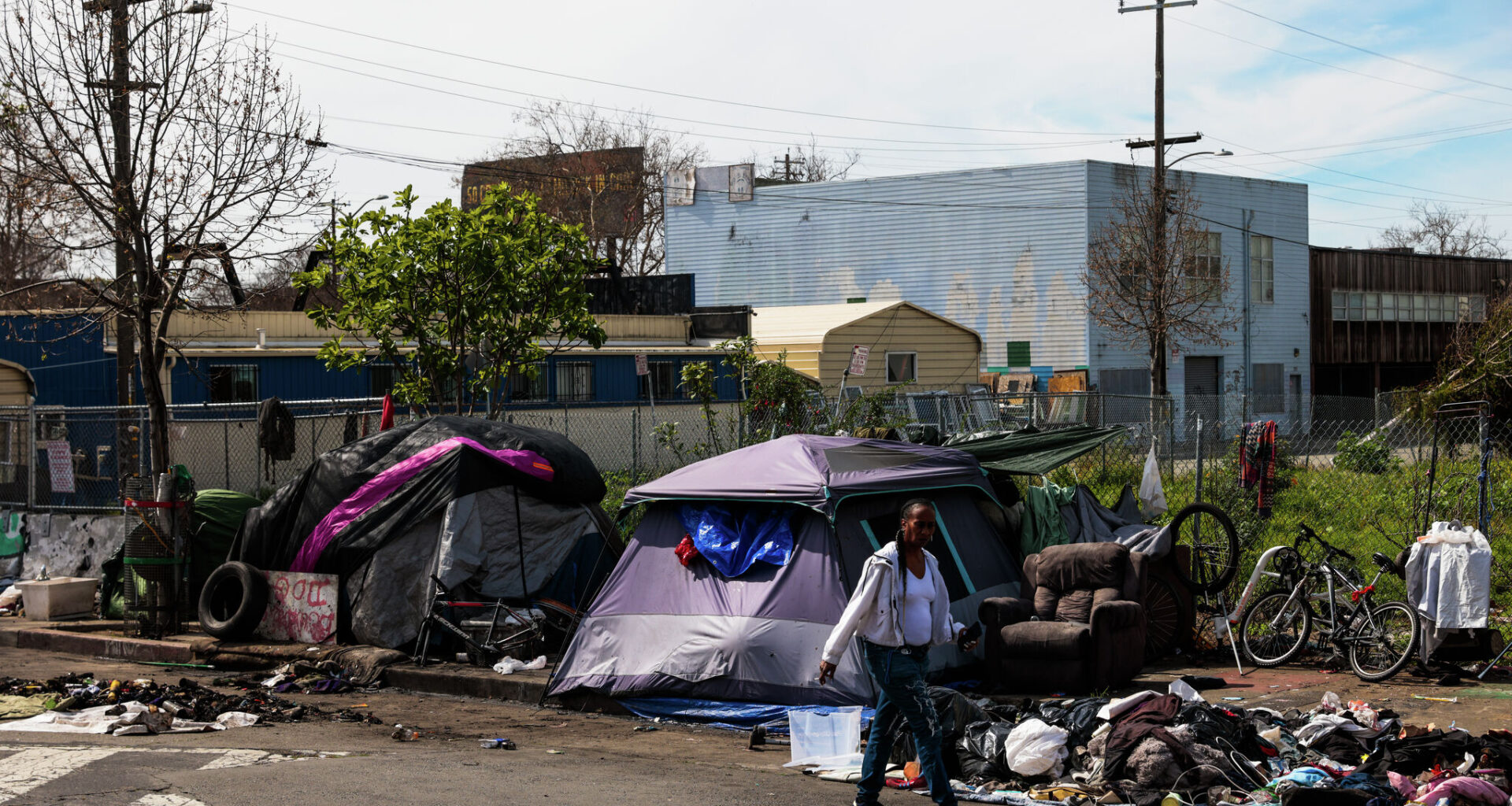
A homeless encampment on Fifth Street, off of Mandela Parkway, is seen from the West Oakland BART Station. Mayor Barbara Lee’s homeless plan will require hundreds of millions of dollars in new investments.
Yalonda M. James/S.F. Chronicle
It’s a feat that no big city in California has ever achieved: cutting street homelessness in half in just five years.
But this month, approaching the end of her first year in office, Oakland Mayor Barbara Lee unveiled plans to do just that.
Lee says clearing more encampments and cracking down on those living on the city’s sidewalks and underpasses has not worked. In fact, homelessness has increased even as the city has significantly increased sweeps.
Article continues below this ad
The spike is driven by the fact that the number of people becoming homeless outnumbers those who are getting housed. Oakland’s programs help house 1,500 homeless people each year, but more than 2,500 people in Oakland become homeless annually, according to city data.
Randall Hall, 65, sweeps trash near the site where he and his wife, Diane King, 68, are sleeping on San Pablo Avenue in Oakland.
“We’re homeless, not hopeless,” Hall said. “People keep dumping and I’m trying to keep up with it.”
Yalonda M. James/S.F. Chronicle
Lee’s plan would focus on prevention and increasing housing capacity for the city’s thousands of homeless residents — a strategy backed by homelessness experts.
San Francisco Chronicle Logo
Make us a Preferred Source to get more of our news when you search.
Add Preferred Source
“We can do a great job of housing people, but as long as more people are entering homelessness than exiting, we’re just running on a treadmill,” said Edie Irons, spokesperson for All Home, a nonprofit working on regional homelessness solutions.
Article continues below this ad
But Lee’s plan will face significant challenges.
Lee’s goal is ambitious. Past pledges from Bay Area mayors have proved difficult to deliver, as they confront the realities of funding and local politics. In San Francisco, Mayor Daniel Lurie initially pledged to build 1,500 shelter beds in his first six months in office, a promise that his administration later walked back.
“The question really comes down to resources and execution, and Oakland residents are unfortunately very used to seeing the city fail spectacularly when it comes to resources and execution on these sorts of issues,” said Jason Overman, an Oakland-based political consultant and lobbyist.
Implementing Lee’s agenda would cost dramatically more than Oakland’s current budget allows, even with a major boost from newly available county homelessness dollars.
A man sleeps under harsh sunlight at a massive homeless encampment at the intersection of Brush Street and San Pablo Avenue.
Yalonda M. James/S.F. Chronicle
There are also questions about whether her plan is urgent enough to appease voters who have grown impatient with street homelessness. By focusing on prevention and rehousing, Lee differs from her counterparts in San Francisco and San Jose, who — while still making major investments in prevention and supportive housing — have projected to voters that they aim to rapidly build more interim shelter to get people off the streets now.
Article continues below this ad
Even the Oakland City Council is responding to voters’ desire for change, as it considers reforms to the city’s encampment management policy that would allow sweeps to proceed even if the city doesn’t have available shelter for displaced residents.
“The mayor’s plan is really thoughtful and data driven, but it runs the risk of not satiating the average voter’s desire to see action right now,” Overman said. Through a spokesperson, Lee declined to be interviewed for this story. But details of her plan were outlined in a 70-page document that has been circulated among council members and city staff.
Oakland is home to some 5,500 unhoused people — just over half of Alameda County’s homeless population, even though Oakland represents just 22% of the county’s total population. Of them, 3,700 are unsheltered.
Despite spending some $120 million a year on homelessness, Oakland’s overall homeless population grew 9% between 2022 and 2024 — and since 2015, it has more than doubled. The unsheltered population grew nearly 11% between 2022 and 2024 to 3,659.
Trash has been dumped at a massive homeless encampment in Oakland.
Yalonda M. James/S.F. Chronicle
Oakland has struggled to build interim shelter and permanent supportive housing as quickly as have San Jose and San Francisco. Oakland has just 1,200 interim housing beds across shelters and tiny homes, versus some 3,600 in San Francisco.
Article continues below this ad
Lee’s plan calls for adding about 860 interim housing beds and units over five years, expanding Oakland’s system to roughly 2,000 beds citywide. San Jose, by comparison, has added some 1,500 units since 2023 between emergency interim housing sites and conversions of hotel rooms into homeless shelters.
Lee’s plan also calls for the city to house 730 additional people each year, either through housing vouchers or new permanent supportive housing units. Since voters approved the city’s Measure U housing bond in 2022, Oakland has funded about 930 new homes dedicated to people experiencing homelessness, though most are still in pre-development or under construction. A new unit of affordable housing in the East Bay typically costs around $800,000 to build and, per the report, costs about $20,000 in annual expenses.
Lee’s priority is not clearing encampments — but managing them to ensure that they’re not nuisances to their surrounding neighborhoods by boosting trash removal services and containing them to specific areas.
It’s a position backed by affordable housing and homeless advocates.
Article continues below this ad
“If we just keep doing sweeps, we are just pushing people around from one place to another,” said Jeff Levin, of East Bay Housing Organizations, at a recent committee hearing.
A pedestrian passes by trash that has been dumped at a massive homeless encampment at the intersection of Brush Street and San Pablo Avenue in Oakland. Mayor Barbara Lee wants to cut street homelessness in the city in half within 5 years.
Yalonda M. James/S.F. Chronicle
But a recent survey released by the East Bay Polling Institute found widespread support among Oakland voters for clearing encampments, with 79% of respondents saying they should be removed from public spaces like parks and sidewalks.
A 2024 Supreme Court ruling gave cities broader authority to ban public camping, accelerating a shift toward tougher enforcement across the Bay Area.
San Jose and Fremont last year passed policies that would allow police officers to arrest unhoused residents if they repeatedly declined offers of shelter.
Cities have also been ramping up their sweeps since the Supreme Court ruling — Oakland included. Last year, it cleared more encampments than it has in the previous three years.
Sweeps would still continue under Lee’s plan. For now, Lee’s popularity among both Oakland residents and the council has meant that even the most fervent supporters of sweeps aren’t criticizing her plan — at least not publicly.
City Council Member Ken Houston, who is leading the charge on the new encampment abatement plan, said in an interview that he envisions Lee’s plan working in conjunction with his proposed encampment policy.
“Her plan and my policy will work together,” Houston said. “I’m very in line with this.”
Lee hasn’t publicly taken a stance on Houston’s plan.
The message “4: We want decent housing fit for shelter of human beings” is seen on a structure at a massive homeless encampment in Oakland.
Yalonda M. James/S.F. Chronicle
Lee’s strategy would cost $406 million per year — $284 million more than what the city and county currently spend on homelessness in Oakland. Achieving all that the plan envisions — increased rental subsidies for prevention, funding for interim and supportive housing, and improved case management — would require a major infusion of new funds from Alameda County, as well as philanthropic organizations and potentially even a new bond measure.
Lee is pushing for Oakland to receive some 65% of funds raised through Measure W, a 10-year 0.5% tax measure passed by Alameda County voters in 2020 that is expected to raise some $1.4 billion for homelessness and social services. Lee is justifying concentrating the funds in Oakland, given the city carries the majority of the county’s homelessness population. But while Lee has support from some county supervisors, like former Council President Nikki Fortunato Bas, it’s unclear how the rest of the supervisors might come down on the funding allocation.
Lee also aims to raise money through philanthropy, and potentially an additional ballot measure. Miya Saika Chen, Lee’s chief of staff, said that Oakland has up-front commitments and is working to bring in additional donors, too.
Lee’s plan indicates she may also ask voters to pass a new tax, though Chen said it’s too soon to know how much the city would ask for.
Oakland residents already pay for two 0.5% sales tax increases — one for the county, and another for the city, which go toward their general budgets and to fund homelessness programs and other services. They have also voted twice in the past decade to increase their property taxes to pay for $1.4 billion worth of bonds.
A sign stating, “This site is closed; no dumping; no encampments” is posted near a massive homeless encampment at the intersection of Brush Street and San Pablo Avenue in Oakland.
Yalonda M. James/S.F. Chronicle
And in June, the city will also ask for a $192 annual parcel tax to raise some $34 million annually to balance its budget.
The request to spend millions more on homelessness comes as Oakland faces questions about what results it has produced with the millions spent on homelessness, largely through contracts with outside providers. In 2022, a report by the Oakland city auditor found that between 2019 and 2021, Oakland spent nearly $69 million on contracts for homeless services but did not track outcomes.
But city and county leaders say that they have been pushing for greater accountability.