
A long-awaited report on smoke damage claims by the California Department of Insurance was released on Friday, nearly a year after Los Angeles fire survivors began expressing concerns about their insurers dismissing the toxic chemicals left in their homes.
The report, written by a task force put together by the California Department of Insurance, suggests the state should develop a tier system of what needs to be done to remediate homes based on how much they were impacted by the fire. It also recommends that state agencies should establish training and certification programs for smoke damage remediation to ensure less confusion and more consistency in future fires.
But it stops short of issuing concrete recommendations or standards for what to test for, such as lead or asbestos, or how to clean these contaminants if they’re found.
The issue of how to address the toxic contamination spread by wildfire smoke has sparked intense debate among those impacted by the Eaton and Palisades wildfires in Los Angeles County, which destroyed 16,000 structures. For every home destroyed in the burn zone, another was left standing, according to state data; many of those homes and others near the area were left contaminated with smoke, experts previously told the Chronicle.
Insurers operating in California are, in theory, supposed to cover damage from smoke, even if the structure itself is outwardly unharmed. But in practice, they have often balked. In Los Angeles, survivors whose homes were badly contaminated but remained standing have engaged in lengthy battles with their insurers over what needs to be done to make their properties habitable. Many struggled to get the insurers to pay for testing. Some were told that common cleaning methods would be sufficient to remove some toxic contamination, even as academics studying the fallout warned that wildfire smoke can penetrate deep into walls and belongings and requires specialized cleaning methods to remediate.
First convened last summer following hundreds of consumer complaints, the task force’s original mission was to “recommend science-based standards, best practices for smoke restoration of homes and personal property, and enforcement tools,” according to the insurance department. Its 13 members included representatives of the insurance industry, consumer advocates, public health officials and restoration professionals.
For some wildfire survivors, the group’s makeup raised concerns. A Chronicle investigation found that three of the committee’s five experts on wildfire smoke damage drew a significant share of their business from the insurance industry. These experts have endorsed practices to address smoke damage that have concerned independent scientists and advocates for homeowners in Los Angeles, including in some cases by dismissing the concept of rigorous testing of homes before they are cleaned to determine what toxic substances exist.
In response to the Chronicle’s reporting and criticism from homeowner advocacy groups, the department maintained that the task force was balanced, and its recommendations would be, too.
While the task force reached agreement on several issues, such as the fact that wildfire smoke has grown more toxic in recent years, the report notes that the group could not come to consensus on some of the most vital questions facing wildfire survivors – such as whether it’s necessary to test a home to determine the potential contaminants inside of it before cleaning.
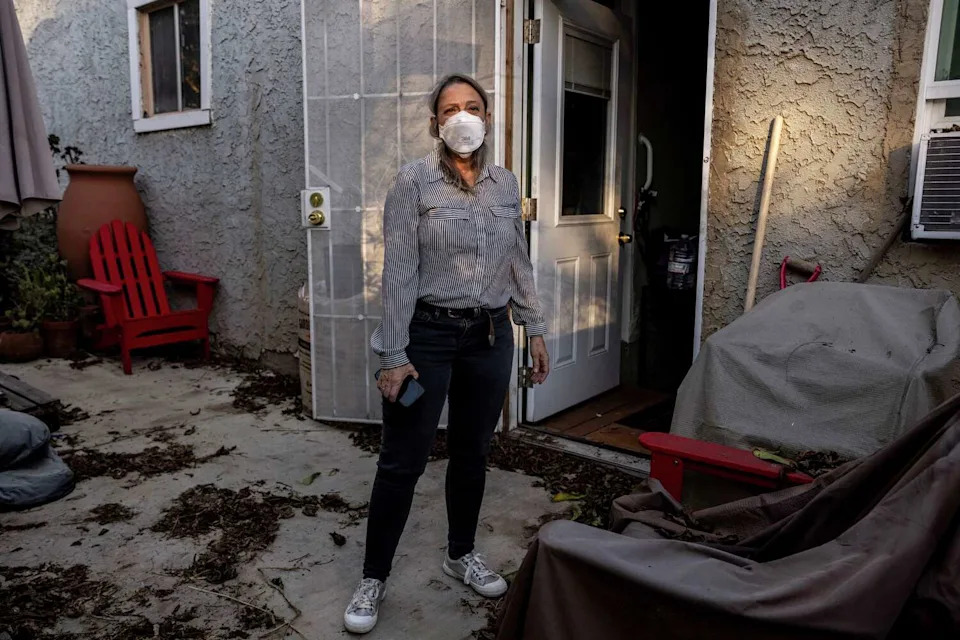
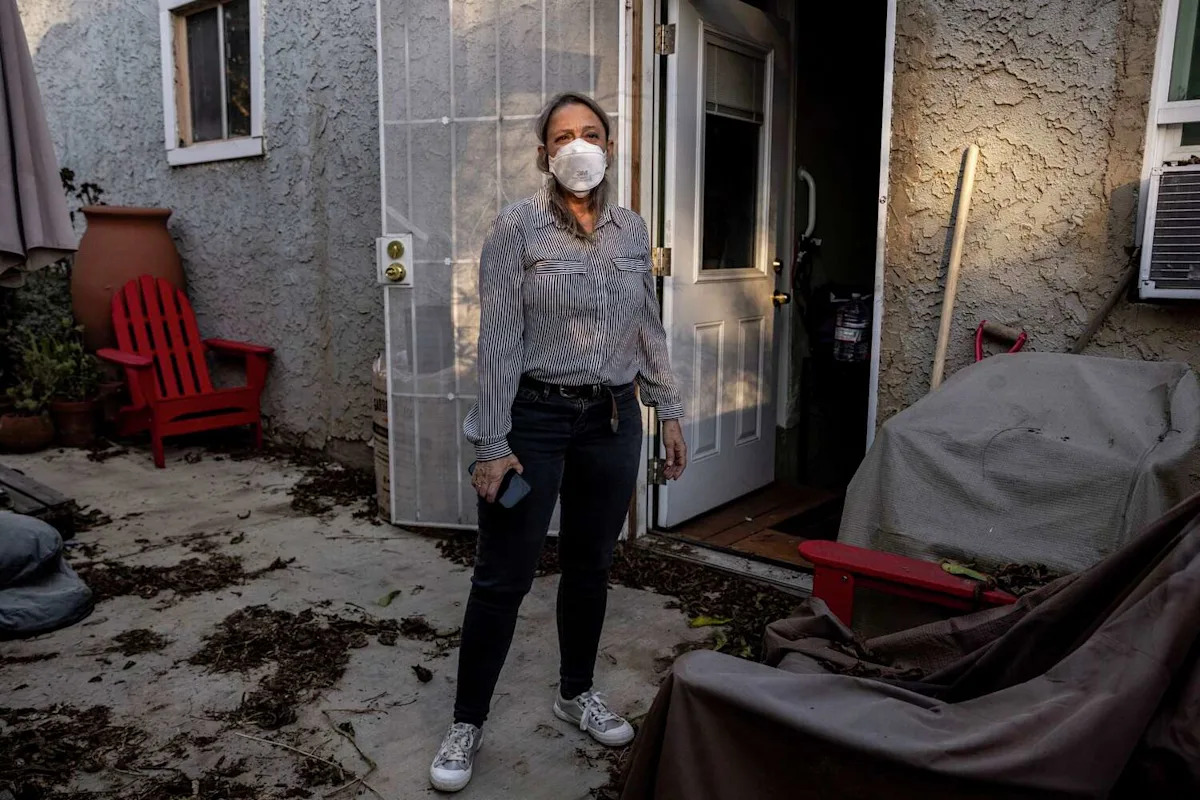
A woman stands outside her home in Altadena in October 2025. The home was damaged by smoke and soot from the Eaton Fire. (Stephen Lam/S.F. Chronicle)
Karen Collins, one of two insurance industry trade group representatives on the panel, said in a statement that the report “highlights both progress made and areas where standards continue to evolve.”
“Wildfire survivors deserve clarity, consistency, and confidence as they recover, and insurers support science-based approaches to evaluating smoke damage and guiding remediation,” Collins said. “This report offers credible, practical insight for states grappling with similar challenges.”
Andrew Whelton, a professor of engineering at Purdue University who presented his research to the task force, endorsed the idea of a tier system. However, he pointed out that proximity to the main blaze alone doesn’t alone determine how contaminated a home might be, citing an example where a home containing a stockpile of ammunition burned and sent high amounts of lead into surrounding houses.
“You would want to know what the sources of contamination are that are burning nearby, not just distance from a burned structure or age of home,” he wrote in an email to the Chronicle after reviewing the report.

An air quality monitor installed after the Eaton Fire is seen at a home in Altadena in October 2025. (Stephen Lam/S.F. Chronicle)
California legislators have proposed two different bills asking state agencies to pursue first-of-their-kind standards for how to properly test and clean homes that survive wildfires. One of those bills, AB 1642 by Assembly Member John Harabedian (D-Pasadena), moved forward out of committee last week. That bill does not mention the work of the task force.
The other, AB 1795, was authored by Assembly Member Mike Gipson and co-sponsored by Lara. That bill currently states the legislature will consider the task force report when crafting standards,” as well as other relevant scientific and health-based sources.”
This article originally published at California report on wildfire smoke-tainted homes highlights lack of consensus on insurance testing, cleaning.