
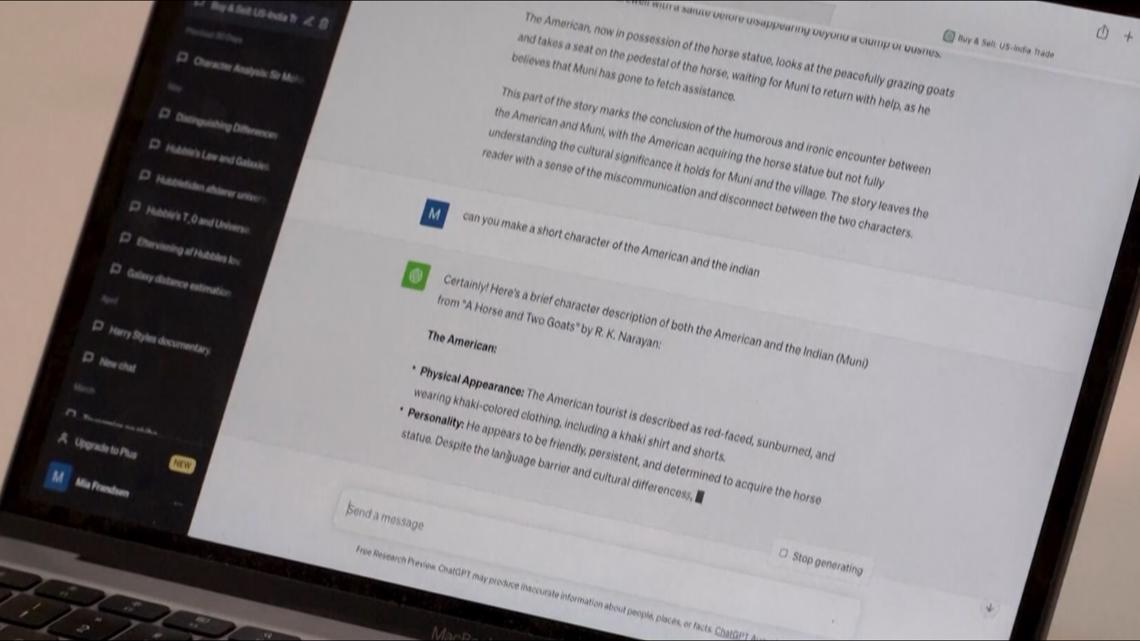
A new study warns AI could pose risks to learning if overused, as San Diego schools begin exploring how the technology can be used responsibly in the classroom.
SAN DIEGO — Artificial intelligence tools are quickly becoming part of the classroom experience, including in San Diego schools. But a new global study is raising concerns about how the technology could affect student learning.
Researchers with the Brookings Institution’s Center for Universal Education reviewed hundreds of studies and spoke with students, parents and teachers to better understand how generative AI is being used in education. Their findings suggest the risks may currently outweigh the benefits if students rely on the technology too heavily.
AI tools can offer feedback, provide learning resources, write essays and even solve math problems. While those capabilities can be helpful, researchers warn that overreliance on the technology could put students’ fundamental learning skills at risk, including critical thinking and problem solving.
At the same time, the study notes that AI can still serve as a valuable learning tool if it is used appropriately and with clear guidelines.
Locally, the San Diego Unified School District is working on developing a policy aimed at using AI to enhance teaching and learning while also promoting responsible and ethical use.
Jen Roberts, a high school English teacher in the district, said she has already incorporated some AI tools into her classroom, but with clear boundaries.
“For example, I might give my 9th-graders a writing feedback tool that knows the assignment they’re working on, knows the rubric they’re working on, and when they’re ready, they can paste in what they’ve written and get feedback that is specific to that assignment,” Roberts said.
Roberts said concerns about cheating and overreliance on AI are valid, but she’d rather students learn how to use it from a trusted adult rather than explore it themselves.
“I do still catch students using it irresponsibly, frequently, and we have conversations about that, because I have 180 students, and a large percentage of them are going to try it at some point,” she said.
To adapt, Roberts has redesigned some assignments to include more in-class discussions and collaborative work. She also said the technology can be useful for teachers, particularly when it comes to providing feedback to students more quickly.
“With the assistance of the AI, I can provide that feedback in two or three days instead of two or three weeks,” Roberts said. “And what that means for my students is they get their paper back while they still remember writing it.”
As schools continue experimenting with how AI fits into the classroom, the study suggests the key challenge will be using the technology as a tool for learning, without allowing students to rely on it too heavily.
“It’s not an everyday thing, it’s not something that we’re relying on a really regular basis,” Roberts said. “But when those moments come that it’s useful, it’s useful, and I think that’s probably going to increase.”