
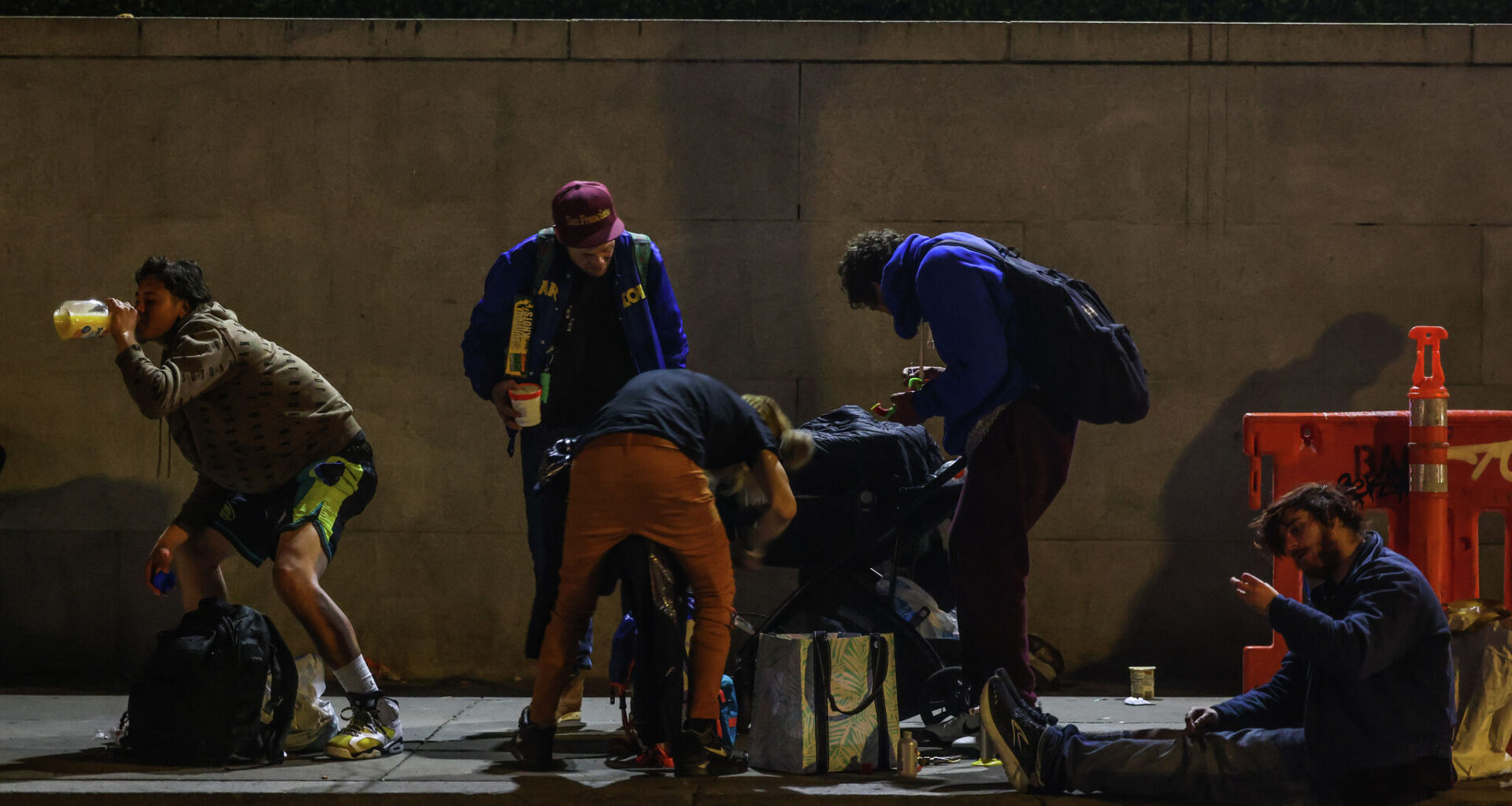
People apparently high on fentanyl gather on Hyde Street in San Francisco’s Tenderloin in 2024. Mayor Daniel Lurie calls a new triage center a “fundamental change” in addressing the city’s drug crisis.
Gabrielle Lurie/The Chronicle
San Francisco has a new, expensive plan to fight public drug use. The Rapid Enforcement, Support, Evaluation and Triage Center will open this spring under a 26-month contract for $14.5 million.
Mayor Daniel Lurie calls the center a “fundamental change” in how the city addresses the fentanyl crisis, while Supervisor Matt Dorsey deemed it the “single most important policy shift” since the crisis began. Let’s be precise about what this place actually is, and what it is not.
The center is a room with 25 reclining chairs at 444 Sixth St. If arrested for public intoxication in the South of Market area, police can drop you there instead of booking you into the county jail. A nurse is on-site, a case manager may speak with you, and you are expected to stay until sober (nominally up to 23 hours).
Article continues below this ad
You are not booked or charged, yet you cannot simply leave. San Francisco Sheriff Paul Miyamoto insists it is “absolutely legal,” but the City Attorney’s Office is not so sure. They flagged this as carrying “very high legal risk” because the center is neither a jail, a licensed detention facility, nor a voluntary drop-in.
This legal ambiguity is consequential. Supposedly, if you leave early, you can be rearrested outside, but there is no clear legal mechanism to prevent you from walking out. You are neither formally detained nor free to go. That is a thin reed on which to build a $14 million intervention center in a time of budget crisis.
San Francisco Chronicle Logo
Make us a Preferred Source to get more of our news when you search.
Add Preferred Source
The police have the authority to arrest for public intoxication, but the center is not a standard arrest. Lacking the procedural protections of voluntary care and a real arrest, the center will exist in a legal gray area. The sheriff and the city’s director of public health praise the center as a diversion, even though it doesn’t use the threat of punishment to compel a real solution. Here, it’s just a chair and a brief conversation with an unclear threat of potential rearrest.
It is not rehabilitation. Addiction medicine shows that readiness matters and that voluntary engagement produces better outcomes than coercion. People will arrive at the center involuntarily, likely in withdrawal, with one goal: leaving.
Article continues below this ad
“Nobody is going to sober up and want anything but to get away from the cops and back to where their people and s— are,” a man living near Mid-Market told the Gazetter. These are accurate predictions of human behavior.
And a sobering center is not, despite the marketing, a solution for entrenched addiction. A day in a reclining chair is not a meaningful clinical model and can increase drug cravings; this population needs sustained care and stable housing.
Supporters offer contradictory justifications. Is the goal to prevent overdoses? Connect people to treatment? Clean up streets? Free up officers?
A 23-hour hold might prevent overdosing that day — a real benefit — but it does not disrupt the open-air drug market. Curtailling public drug markets requires deterrence and community-specific strategies, Mike Scott, director of the Center for Problem-Oriented Policing at Arizona State University, told the Gazetter. A 23-hour involuntary hold is a particularly blunt instrument for building long-term treatment trust.
Crucially, the most effective intervention targets people actively seeking help. Investing in radically accessible treatment for them saves more lives per dollar. The new center is optimized for street-level optics instead. A prior triage center on this same Sixth Street corridor quietly failed, while the voluntary stabilization center at 822 Geary St. has shown real success: It placed 88 of its first 344 patients in residential treatment, more than any other program. The city’s new experiment comes at the expense of scaling proven voluntary options.
Article continues below this ad
Voters respond powerfully to policies that thread the needle between punishment and compassion, especially if they emphasize non-punitive consequences. “Arrest and treat” is perfect political framing: tough enough for voters who want order, humane enough for voters who want care.
According to Lurie, the new center will allow officers to “arrest those engaged in public drug use at a speed and volume we have never seen before” while giving them “a real chance to choose recovery.” It’s effective messaging, but what politicians present as having it both ways usually means achieving neither. The enforcement is legally uncertain. The “treatment” is too brief to matter. The 25 reclining chairs will barely move the needle.
Guest opinions in Open Forum and Insight are produced by writers with expertise, personal experience or original insights on a subject of interest to our readers. Their views do not necessarily reflect the opinion of The Chronicle editorial board, which is committed to providing a diversity of ideas to our readership.
Read more about our transparency and ethics policies
There is a better way to design solutions. The reporters who walked the streets of SoMa and the Tenderloin and asked people directly already did some of that work. When people living outside tell you that a coercive 23-hour hold will send them straight back to the streets, we should believe them. As a postdoctoral researcher at UC Berkeley, my research shows that when the people most impacted by an issue clearly signal what actually works, the broader public is willing to follow their lead, cutting through traditional political divides.
Getting a dangerously intoxicated person into a medically supervised space is better than leaving them on the sidewalk. But San Francisco has a genuine crisis, and the city deserves a response equal to that scale. What it got is a legally ambiguous room with 25 chairs and a 23-hour clock.
Article continues below this ad
Dvir Yogev is a postdoctoral researcher at UC Berkeley. Their research on public opinion and criminal justice reform has appeared in Criminology and in Public Opinion Quarterly.