
California’s gubernatorial primary is a marathon in disguise as a sprint.
It’s a marathon because no one runs statewide without time, money, organization, travel, media, and the stamina to keep going long after the cameras move on. California is too vast and expensive for a serious candidate to quickly introduce themselves to voters.
It’s also a sprint because most voters don’t pay attention until the final stretch.
That’s not a theory. In the Public Policy Institute of California’s February 2026 survey, about half of likely voters said they weren’t following the governor’s race closely, while about seven in 10 said they were interested in debates and town halls. Voters are just starting to pay attention, and they want to hear from the candidates before they decide.
That is why USC’s choice to “select” candidates for its March 24 gubernatorial debate is so offensive.
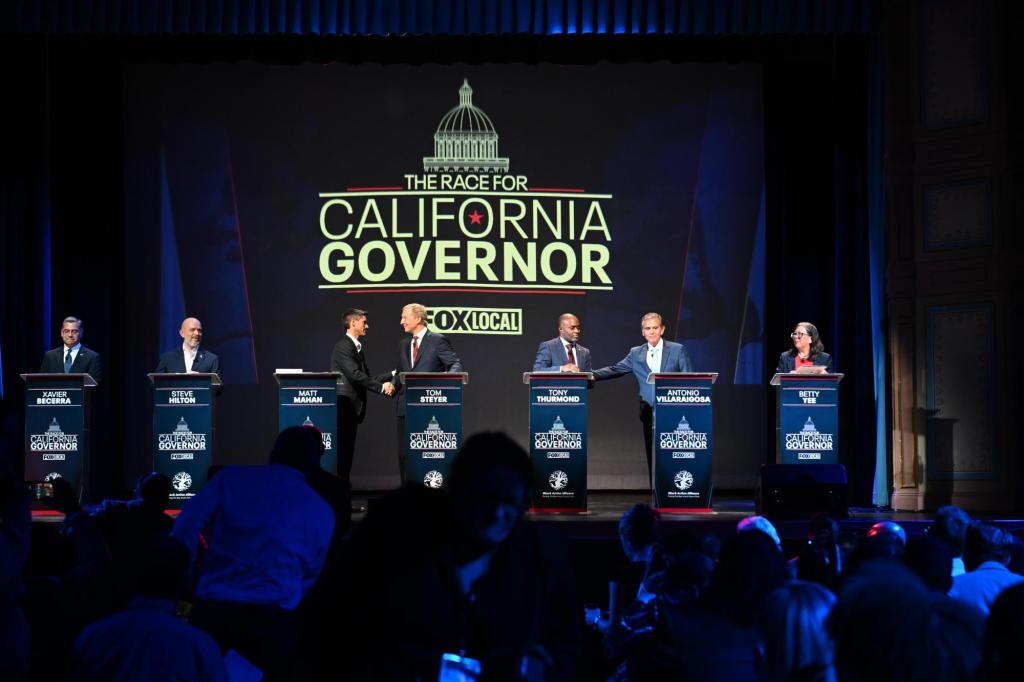
USC and ABC7 announced a six-candidate debate that includes Republicans Chad Bianco and Steve Hilton, and Democrats Eric Swalwell, Katie Porter, Tom Steyer, and San Jose Mayor Matt Mahan. Excluded from the stage were Xavier Becerra, Antonio Villaraigosa, Betty Yee, and Tony Thurmond. Put plainly, every Democratic candidate of color was left out.
That result alone should have halted the process.
InThis arbitrary selection was not a neutral act of civic stewardship. It was a gatekeeping exercise disguised in academic language. When controvery hit, USC hid behind a supposedly objective formula created by a professor.
Campaigns are not academic exercises. Voters are not lab rats. A gubernatorial primary is not something to be engineered by an ivory tower professor with no real-world accountability to voters. The purpose of an early debate is to help Californians evaluate a still-developing field, not to let academics and media sponsors freeze the race before most people start paying attention.
To critique the professor’s methodology specifically, polling and money might be useful data points, but they aren’t equivalent to democratic legitimacy, and they should not replace a voter’s right to hear from viable candidates in a live campaign. The formula becomes even more dubious when one considers how it benefited Matt Mahan.
The Los Angeles Times reported that USC’s original methodology stated fundraising would be based on semiannual Secretary of State filings, but USC later clarified that late contribution reports were also included. This matters because Mahan entered the race late and did not file the same type of semiannual report as more established candidates. This update is not a minor clarification; it represents a major methodological shift that benefited a late-entry white candidate who, according to all public polling, has yet to exceed low single digits.
Then there are the optics, and the optics stink.
Mike Murphy is not a detached academic observer. USC describes him as the co-director of its Center for the Political Future, a successful Republican political consultant, and likely to lead a Mahan independent expenditure campaign. Rick Caruso is not merely any alum; he served as chair of the Board of Trustees from 2018 to 2022. Meanwhile, the San Francisco Chronicle reported that Caruso is among the key funders supporting Mahan’s campaign. Murphy is also a consultant to Caruso.
USC and Murphy can talk all they want about “Chinese firewalls,” but when a university connected to powerful political figures ends up promoting Mahan while excluding every Democrat of color, Californians have the right to ask whether this is a genuine debate or an inside game with stage lights.
Becerra’s letter to USC’s president hit the point: with over two and a half months before the June 2 primary, there’s no valid reason to rush excluding candidates when voters are just starting to engage. If media outlets and debate hosts, KABC-TV and Univision, endorse this flawed process, they set a precedent for future debate organizers to selectively decide which candidates voters can hear from. That’s not democracy. That’s curation.
California voters don’t need USC playing political bouncer at the door. They don’t need an academic formula to decide who is worthy in a wide-open race. They don’t need unelected gatekeepers narrowing the menu before the customers have been seated
If USC wants to serve democracy, it should widen the stage, not rig the sightlines.
In a 2026 governor’s race that is this fluid, this early, and this important, the voters should do the choosing, not the ivory tower.
Matt Klink is owner and president of Klink Campaigns, Inc. He is a past president of the International Association of Political Consultants.