
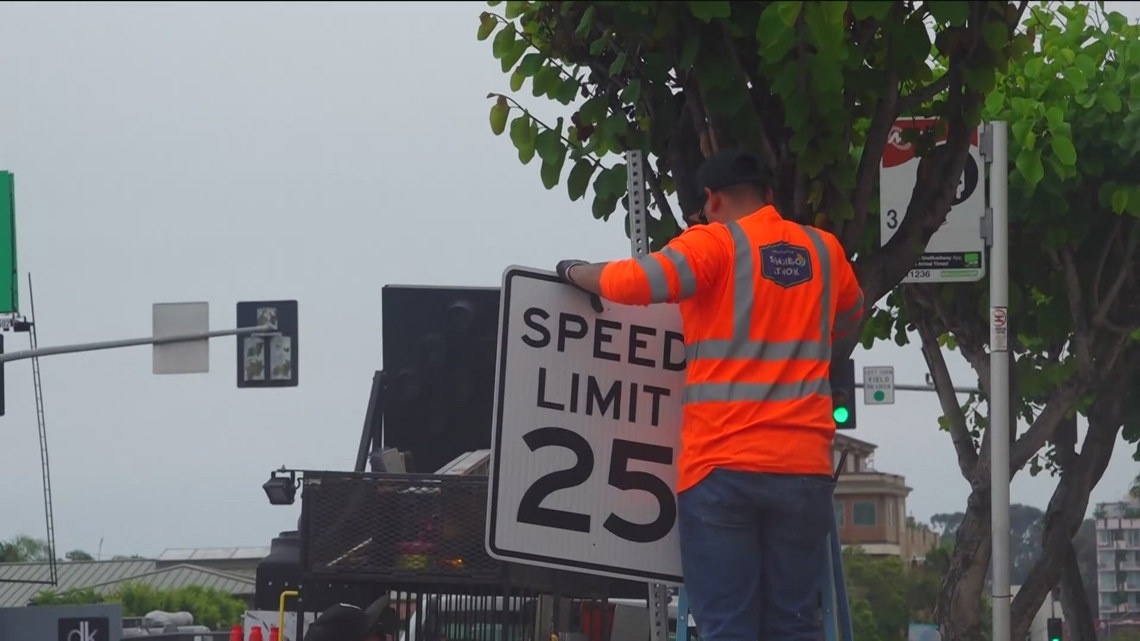
San Diego City Council unanimously approved a speed management plan reducing limits on 20% of city roads, including school zones.
SAN DIEGO — San Diego residents stood before the city council on Monday and pleaded for slower speeds on city streets, recounting children killed while walking to school and loved ones struck down on their bikes.
The San Diego City Council unanimously approved the Comprehensive Speed Management Plan, targeting roughly 20% of the City’s entire road network.
Among the streets included is Jackson Drive in San Carlos, where an 11-year-old boy was killed while walking to school with his siblings last October.
Under the plan, safety corridors, streets with higher concentrations of fatal and serious injury crashes, and high pedestrian activity areas could see a 5 mph reduction. Business districts could drop to 25 mph. And for the first time, school zones are included, dropping to as low as 15 miles per hour.
Councilmember Stephen Whitburn, who championed the plan, said school zones are the priority. He said the city can begin installing new signs immediately and hopes to have the entire plan rolled out within a year.
The plan is now possible because of a recent change in state law giving cities more flexibility to set speed limits based on safety, not just how fast drivers are already going.
CBS 8 covered the city’s first reduced speed signs installed in 11 corridors last July, where the city says violations and crashes have since gone down.
CBS 8 also found several high-crash areas on the city’s own improvement list, including 15th and F Street, where four people were injured by a DUI driver the same weekend that list was released, which also made the speed reduction cut.
Laura Keenan, co-founder of Families for Safe Streets San Diego, co-founded the group after her husband Matt was struck and killed by a driver in 2021 while riding his bike to a nearby movie theater on Camino del Rio South. The posted speed limit was 35 miles per hour.
“Every mile per hour makes a difference,” Keenan previously said. “Had the driver been going just five miles per hour slower, he likely would be alive today.”
Implementation is expected within a year. The 2.4 million dollar cost comes from the general fund and still requires budget approval before work can begin.
For the full list of proposed locations, click here.