
As the former battalion chief responsible for firefighter health and safety for the City of San Diego, I spent much of my career confronting a reality that every firefighter, paramedic, police officer and soldier eventually learns: The most serious injuries in these professions are often not the ones sustained during the emergency itself. They are the injuries that remain afterward, long after the smoke clears and the sirens fall silent.
Anyone who has spent time as a first responder or in military service understands this truth instinctively. Some calls never really leave you. They are stored not only as memories, but also as physiological patterns in the nervous system. In other words, the body remembers, and the effects can remain long after the emergency or the battle has passed.
Mostafa Alkharouf/Anadolu via Getty Images
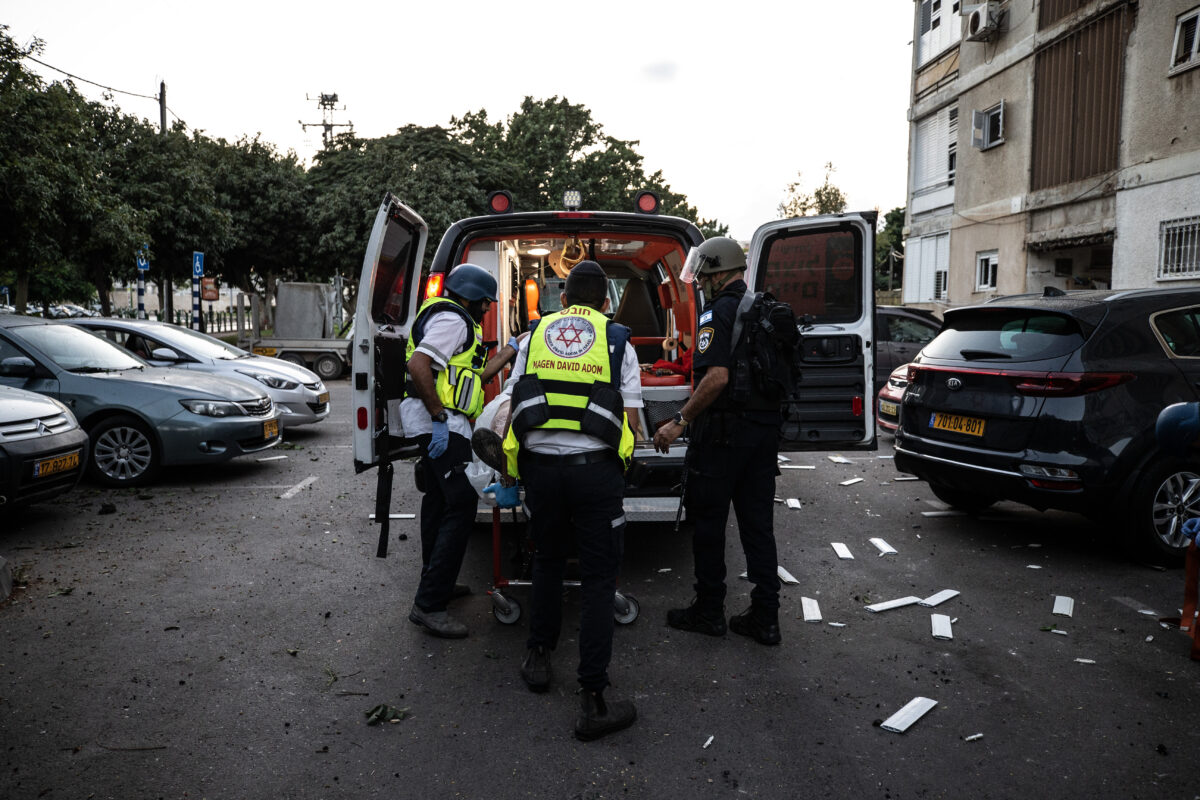
Medics load an injured person into an ambulance after a rocket launched by Palestinian terrorists strike the Israeli city of Ashkelon on Oct. 10, 2023.
What is becoming increasingly clear to clinicians and researchers alike is that these patterns are not necessarily permanent. When the right systems of care exist, even deeply rooted trauma injuries can begin to heal.
Increasingly, research confirms what many first responders and combat veterans have observed through lived experience. In both Israel and the United States, more first responders now die from suicide than from injuries sustained in the line of duty. For Israel’s firefighters, paramedics, police officers and the IDF soldiers and reservists who stand alongside them on the country’s front lines, that reality carries an especially heavy weight.
Israeli first responders and military personnel operate in an environment unlike almost any other. They respond to suicide bombings, missile strikes, mass casualty attacks and combat operations with a frequency and intensity that few societies experience. They arrive first when alarms sound and smoke fills the air. They treat the wounded, search through rubble and sometimes recover those who could not be saved. In some cases, the victims they encounter are not strangers but neighbors, friends, members of their own communities.
Experiences like these leave marks that cannot be seen on the surface. Over time, many first responders, soldiers and reservists develop a combination of conditions that reinforce one another, including complex post-traumatic stress, traumatic brain injury, chronic pain, severe sleep disruption, depression, anxiety and substance misuse. Researchers increasingly recognize that these conditions share underlying biological and psychological mechanisms. When they occur together, they can create a downward spiral that gradually erodes health, relationships and identity. Too often, that spiral ends in suicide.
The consequences extend well beyond the individual responder or soldier. Spouses carry the strain. Children grow up in households shaped by the emotional and physiological effects of repeated trauma exposure. Researchers are now examining how prolonged trauma can influence stress responses across families and even across generations. In a country like Israel, where first responders and reservists operate under the constant pressure of violence and conflict, the cumulative impact becomes not only personal but societal.
Israel is widely respected for its leadership in trauma medicine and emergency response. Israeli physicians, military medical teams and rescue personnel have pioneered techniques used around the world to save lives during the most critical moments after catastrophic injury. Yet trauma does not end when the patient leaves the emergency room or when a soldier returns from deployment. Long-term recovery for those who repeatedly respond to tragedy requires a different kind of infrastructure.
That is what makes the conversations taking place this week in San Diego particularly meaningful. Hundreds of Jewish philanthropists have gathered for the Jewish Funders Network International Conference to discuss Israel’s resilience and its future. San Diego understands the responsibility carried by first responders; firefighters, paramedics and police officers here have also confronted the cumulative effects of trauma within our own ranks.
For many years, complex trauma among first responders was widely viewed as something that simply came with the job. Departments did their best to support their people, yet the underlying conditions often persisted for years. Careers ended early. Families struggled quietly. Too often, the assumption was that these injuries would remain for life.
Over the past several years in San Diego, that assumption has begun to change. Four years ago, the City of San Diego created a partnership with the Institutes of Health and its First Responder Institute to address the combination of trauma-related conditions that frequently appear together among first responders. The work was built on more than four decades of clinical leadership focused on complex trauma and disability.
The central insight behind the partnership was straightforward but powerful. Conditions such as complex PTSD, traumatic brain injury, chronic pain and the depression or substance misuse that often follow are not isolated problems. They interact with one another, and treating them separately rarely produces lasting recovery.
Instead, the partnership between the City of San Diego and the Institutes of Health developed what can best be described as a transdisciplinary biopsychosocial ecosystem of care. In these programs, physicians, psychologists, neurologists, rehabilitation specialists and behavioral health clinicians work together simultaneously. Rather than sending a responder from one specialist to another, the care team collaborates in real time to address trauma as a single interconnected condition.
What ultimately changed the trajectory in San Diego was not merely recognizing the problem but seeing what happened when injured first responders were treated within this ecosystem of care. Over the past several years, the City of San Diego and other public safety agencies began sending firefighters, paramedics and police officers who had been injured by the cumulative effects of trauma to the campuses of the Institutes of Health.
For many departments it was the first time they had seen these conditions treated in an environment designed specifically to address the full intersection of trauma-related injuries. What followed challenged long-held assumptions. First responders who had struggled for years with the combined effects of complex PTSD, brain injury and chronic pain began recovering. Many returned not only to work but to their families and to their sense of purpose.
Cases once assumed to lead to permanent disability are now being consistently reversed, with the vast majority of first responders returning to active duty. In San Diego’s experience, the figure is roughly 96%.
Joseph Sousa, deputy director for risk management and workers’ compensation for the City of San Diego, has described the change in direct terms. What the city now sees, he says, is that through this transdisciplinary biopsychosocial ecosystem of care, conditions that were long believed to be permanent are being systematically reversed.
The work unfolding through the partnership between the City of San Diego and the Institutes of Health has not remained confined to local programs. Over the past several years, the experience of San Diego and the clinical work of the Institutes of Health have been presented to scientific and medical organizations throughout the United States and internationally.
Across California, departments are studying and adopting similar approaches. The IOH campuses built around this model in San Diego, Riverside, Anaheim, Burbank and El Centro are receiving patients from across the state. As public safety agencies began seeing the outcomes, municipalities, government agencies, major employers, insurance carriers and third-party administrators have increasingly requested additional IOH campuses and clinics so their personnel can gain access to the same system of care.
Interest has also spread internationally. Delegations from Germany and Japan have traveled to Southern California to observe how these ecosystem models operate in practice. Representatives from the Tokyo Fire Department, one of the largest fire and rescue services in the world, recently visited San Diego to study the system and its outcomes.
The experience here has also extended beyond public safety agencies. Sharp HealthCare, the largest healthcare organization in San Diego County, now sends its own employees who experience traumatic incidents to the Institutes of Health programs. According to Scynthia Syfrett, Workers’ Compensation Manager for Sharp HealthCare, the results have been striking. Employees who once struggled for years with the effects of trauma are returning not only to work but to their lives stronger and more resilient than before.
For those of us in the first responder community, these developments carry enormous meaning. Firefighters, paramedics, police officers, soldiers and reservists share a brotherhood and sisterhood that extends across departments, across countries and across cultures. It is a culture built on sharing experience — and solutions. When one department learns something that protects its people more effectively, others listen.
When we see what Israeli first responders, IDF soldiers and reservists confront each day, their experiences resonate deeply with us. They are facing levels of trauma exposure few professions anywhere encounter. Helping them confront the consequences of that service is not simply a policy question. It is a moral one.
Israel is widely recognized as a world leader in trauma medicine and emergency response. Yet researchers, first responders, soldiers and members of the military themselves acknowledge that Israel does not yet have specialized campuses and clinics built around the kind of transdisciplinary biopsychosocial ecosystems that are now changing outcomes throughout California.
For a country whose first responders, soldiers and reservists carry such an extraordinary burden of trauma exposure, building that infrastructure could make a profound difference. What San Diego and the Institutes of Health have demonstrated together is that these trauma trajectories are not inevitable. With the right systems of care in place, these epidemics among first responders can be prevented, treated and reversed.
Battalion Chief (Ret.) David Picone served with the San Diego Fire-Rescue Department is currently president of the Health and Safety Leadership Alliance.