
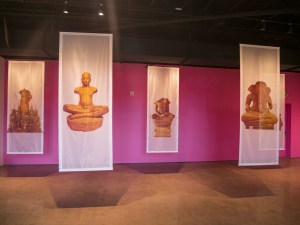

Huynh’s exhibition “Life in Many Worlds” at the Fullerton College Art Gallery.
Fullerton College has one of the few community college art departments in the country that offers a prestigious Artist-in-Residence program. After talking with Seija Rohkea, Art Gallery Technician at Fullerton College, I learned that the gallery was welcoming Los Angeles-based multimedia artist and educator Phung Huynh to the campus this March to take part in the department’s annual, four-day residency. Huynh brought with her graphite sticks, colored pencils, and oil paints, among many other materials, to share her artistic practice with a classroom full of students. She closed out her residency with an over-hour-long artist talk to the college community, followed by a gallery walkthrough of her solo exhibition. During the week, I had a chance to interview Rohkea about the history of the Fullerton College Artist-in-Residence Program, and between classes, Huynh talked with me about her experiences as a refugee, as an artist and as an educator.
 Jumping back in time to 1972, when Fullerton College’s Artist in Residence (AiR) program began, I learned from Rohkea that California-based artist Wayne Thiebaud was the first to launch this week-long program, which soon became an annual tradition for the campus’ Art Department.
Rohkea said, “Our catalog mentions the beginning of the AiR program starting in 1972, with the community services sponsoring the first AiR program with Thiebaud. The AiR program’s beginnings, however, stem back to 1965 with the help of Ferdinand Roten Gallery, which helped to conduct print sales on our campus. This annual event culminated in the Artist in Residence program just seven years later.”
Some of the most notable artists to come out of Fullerton College’s Artist Residency Program prior to Phung Huynh include Miriam Schapiro, Frank Romero, Pavel Acevedo, Chris Sickles, Lisa Congdon, April Bey, Gronk Nicandro, and Thomas Campbell.
“Artists are selected through a committee. Faculty members propose artists and the committee decides, then emails the artists for availability, starting with the first choice,” said Rohkea. “We specifically look for national and international artists who represent a whole range of styles, themes and issues in their work and can teach their practice to our students for a week.”
 Rohkea explained that this annual four-day residency includes a series of studio demonstrations, an evening slideshow lecture, and an exhibition of the artist’s work to be displayed in the college’s art gallery for five weeks, with an opening reception that brings the Fullerton community together.
For the current artist in residence, Phung Huynh’s exhibition, titled “Life in Many Worlds,” the space was used to explore Huynh’s cultural experiences as a refugee.
“The work is about the refugee experience, it’s about displacement due to U.S. imperialism,” said Huynh. “My family and I spent eight months in a refugee camp in Thailand. I’m a multiethnic South East Asian with a cultural identity that’s Cambodian, Chinese, and Vietnamese. My mother’s parents left Southern China during the Japanese occupation of World War II and sought refuge in Vietnam, where my mother and I were both born.
My father is Cambodian and left Cambodia because of civil war, genocide, and…brutal dictatorship; he bicycled to the border between Cambodia and Vietnam, and briefly remade a life in Vietnam. Within three years, my father met and married my mother, had me, and brought our immediate and extended families to the Thai refugee camp by pretending to be a fisherman and hiding forty-one family members under the boat stack. We eventually resettled in Michigan in December of 1978, and then moved to Los Angeles in 1981.”
 Huynh’s exhibition at the Fullerton College Art Gallery includes oversized banners depicting decaying Khmer Buddha statues, among mixed media illustrations, paintings, screen prints and pieces made throughout Huynh’s artistic journey. The gallery hosted an opening reception for Huynh’s exhibit on February 19, 2026 that included performances by a Long Beach based Cambodian dance company, which according to The Hornet, “blessed the space with ‘Rombam Jun Por,’ a dance traditionally performed to welcome and bestow good fortune to guests, and ‘Preah Thong and Neang Neak,’ a dance depicting the mythical origin of Cambodia.”
One art professor who attended the exhibit’s opening said to me, “I’ve long admired Phung’s work, so it’s especially exciting to see it here and have the students experience it up close. Her work brings out a powerful way that merges the past and the present together. The ceremonial opening was such a thoughtful addition to the reception. It was welcoming and intentional.”
Arriving early on Monday morning at the start of Huynh’s residency, I walked upstairs in the historic 1000 Building of Fullerton College and visited the drawing and painting classroom where she was setting up for the first class of the day. From day one to day four of her residency, Phung posed an interesting question to the students, asking them to contemplate and considerwhat kinds of food they would take with them if they suddenly found themselves displaced from their family and country of origin. She encouraged each student to either write about or draw thefood they would carry with them within the 2D outlines of an empty container.
 Students pondered this question of displacement and borrowed colored pencils from the front of the classroom to start drawing. During the first week in March, students filled an entireclassroom wall of empty cans with colored pencil and graphite drawings, including: shu mai, coffee, frijoles, mole, peaches, pan dulce, pozole, tamales, collards and yams, grapes, strawberries, tacos, and musaf, among many diverse food offerings. Different classes came through the room at different times, but each student left their own unique impression on the corkboard wall with the label“Displaced” on it.
When asked how her teaching experience influences her art, Huynh said, “Teaching has really influenced my work because it forces me to think about the future, and I feel like change takes many generations…My grandfather has always said, ‘When I think about what I do, I think about seven generations after me.’ And so, thinking about the future, thinking about emerging artists, thinking about my role as a mom (’cause they always call me their ‘art mom’) has built community. I feel like teaching has made me more of a community artist and seeing more of the impact, rather than just making work and showing it, but seeing direct relationships, direct connections…It moves me so much that every part of this process has been with the students.”
Huynh’s exhibition, “Life in Many Worlds,” remains on view inside the Fullerton College Art Gallery, located in Room 1004 on the community college campus, until March 25. The Gallery is open Monday to Thursday from 10am to 12pm and 2pm to 4pm. Admission is always free and open to the public. To view a list of exhibitions from previous artists in residence at Fullerton College, visit: https://art.fullcoll.edu/event_artistinresidence.php


Like this:
Like Loading…
Related
Discover more from Fullerton Observer
Subscribe to get the latest posts sent to your email.