
Emily Leach is the opinion editor of the Daily Titan. All opinions expressed in this article are those of the author and do not reflect the opinions of the Daily Titan as a whole.
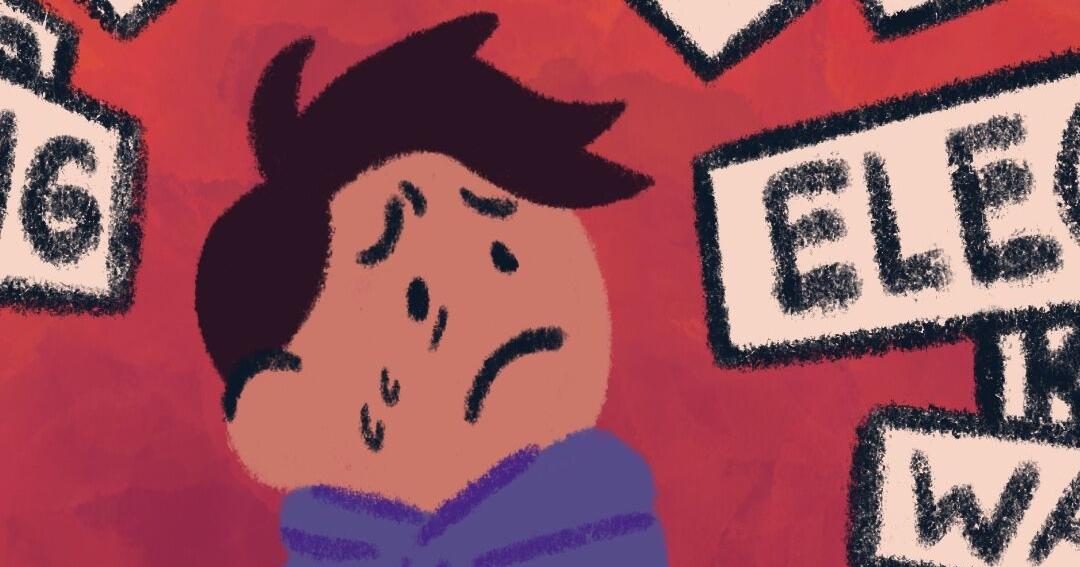
Amidst a socio-political climate defined by corrosive polarization and aggressive partisan hostility, college students are navigating a surge of political anxiety. As international conflict and domestic upheaval collide, the oversaturation of political news erodes the mental health of a generation coming of age in crisis.
University students should not be left to manage this psychological burden without professional support. To safeguard the well-being of its students during this era of instability, CSUF must expand its mental health and informational resources to address the political anxiety students face.
Concerns regarding raids by Immigration and Customs Enforcement and the United States’ declaration of war against Iran have fostered sentiments of instability and uncertainty regarding the American political sphere.
“I’ve noticed a certain compartmentalization happening,” said Kayla Borlasa, a second-year Kinesiology major. “I have noticed a lot more conversation regarding, you know, what is happening with the war in Iran and other stuff like that, but I think there is kind of a general feeling of burnout.”
The effects of political burnout have plagued Gen Z, contributing to rising levels of democratic disengagement. Data from Tufts University found that Gen Z voter turnout dropped from over 50% in 2020 to 42% in 2024, reflecting a growing sense of detachment from political processes.
Implementing anti-burnout resources in CSUF can help address this problem. Providing opportunities for discussion can support politically disengaged students in a remobilizing way, empowering college students to participate in civic processes with confidence.
“I think if students had more knowledge about what different forms of civic engagement could look like, they wouldn’t maybe feel so lost as to what they can and can’t or what they should and shouldn’t be doing,” said Asya Harrison, assistant professor of psychology and assistant director of the Institute of Black Intellectual Innovation at CSUF.
Anxieties regarding political turmoil may also stem from domestic actions that risk the livelihoods of many.
Reports from BBC estimate that ICE has placed 51,302 in detention facilities as of June 1, 2025, with 44% of detainees having no criminal record outside of illegal entry into the U.S.
Rising ICE activity in Orange County has also severely impacted its local communities.
Genevieve Van Swearingen, a second-year psychology major, shared how fears surrounding immigration enforcement have impacted her and her peers’ lives as students at CSUF.
“I remember there was a scare about possible ICE agents being on campus, and then they (CSUF) sent out that email that said it was just canine dogs training,” Van Swearingen said. “But that’s worrisome for me because I have lots of friends that look like the kind of people that ICE has been targeting.”
Concerns about immigration officers on campus led some professors to cancel classes and pushed many students to skip them out of fear. When political anxiety begins to disrupt the classroom, uncertainty and stress can interfere with students’ ability to fully participate in their education.
To combat declines in academic performance, CSUF should offer clear education around complex political issues alongside professional support for students affected by ongoing domestic developments. Students who know where to turn for reliable information and mental health support will feel more secure in engaging with campus culture.
The impact of university neglect on students’ psyche can be serious and long-lasting. Results from the 2024-2025 Healthy Minds Survey found that 37% of college students experience severe depressive symptoms and 32% experience moderate to severe anxiety symptoms.
With political uncertainty being a core concern for Americans right now, a lack of resources to address such uncertainty can impact on-campus student engagement.
“The data is telling us that there is an increase in mental health disorders in young people. And if students don’t feel like their campus or their university is providing those resources, they’re gonna be harder to access,” said Sawssan Ahmed, associate professor of Psychology at CSUF.
Universities cannot control national politics, but they can influence how students cope with it. By strengthening emotional and informational systems, CSUF can ensure that students feel supported during an array of uncertain political moments.
“We (CSUF) want students engaged, we want them to feel like they belong and we want them to feel supported,” Ahmed said.