
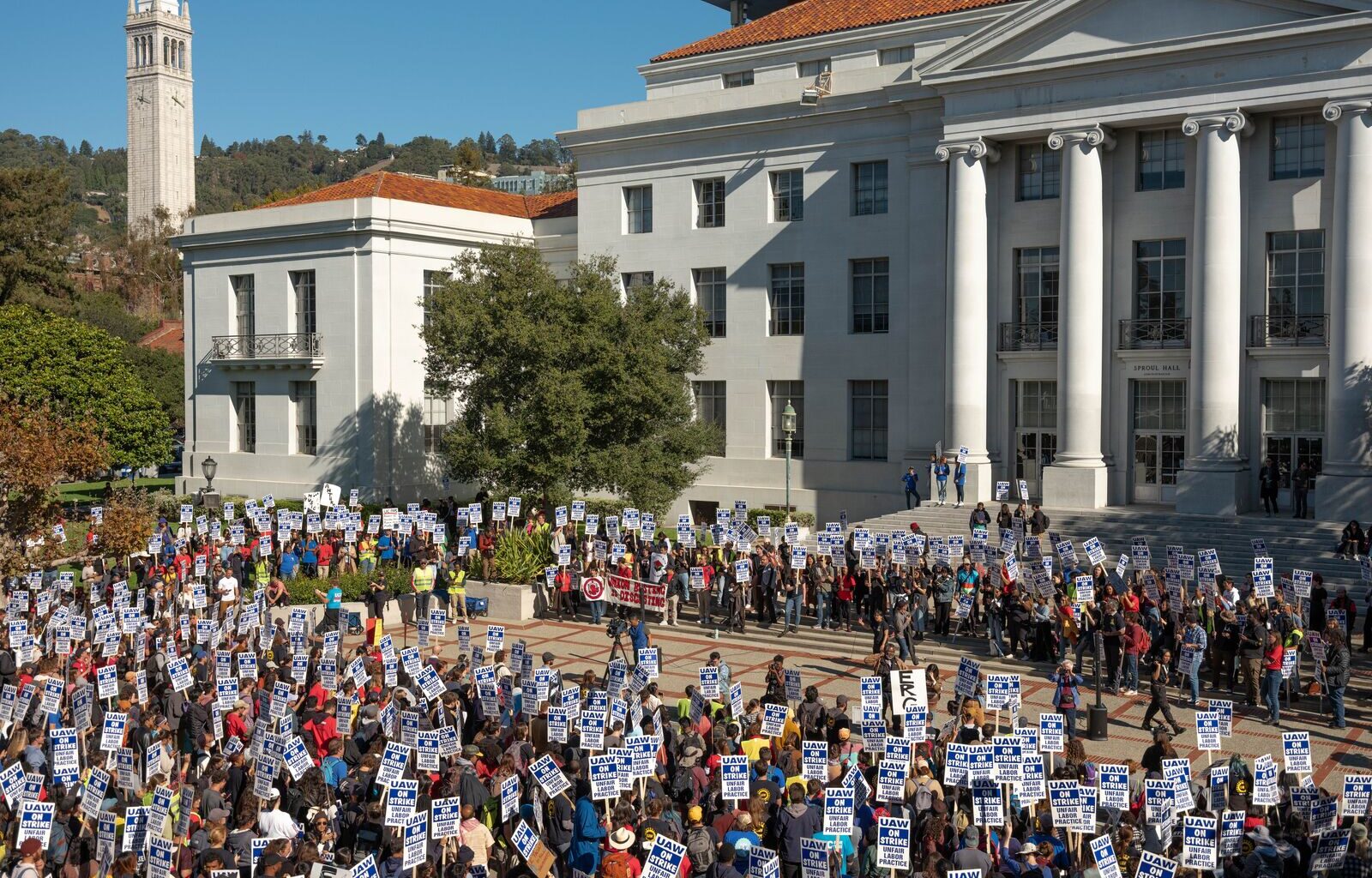
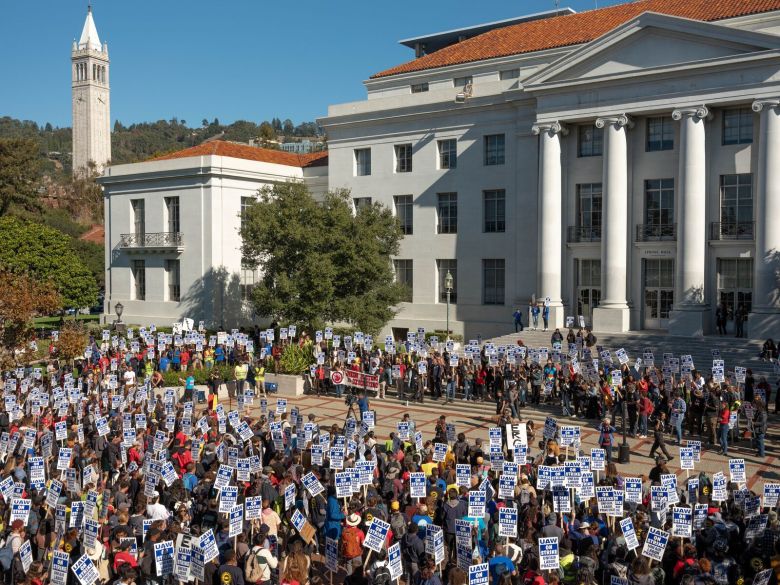
 UC Berkeley academic employees rally on Sproul Plaza on Nov. 14, 2022. The union reached a tentative agreement with the University of California over a new contract on Friday.
University of California graduate student workers and professional staff reached tentative agreements with the university on Friday after months of often-contentious contract negotiations centered on cost-of-living increases and protections for international workers.
The proposed deals include what union negotiators described as the strongest protections in the country for international student workers, along with sizable pay increases over four years. If union members vote to ratify the four-year contracts this week, they would cover roughly 40,000 workers at UC Berkeley and the other nine UC campuses.
The agreements come after the workers, organized into three separate bargaining units all represented by the United Auto Workers union, voted to authorize a strike last month after accusing the university of unfair labor practices. Thousands of university workers also turned out to picket at UC campuses Thursday, urging the university to settle the contracts.
Teaching assistants and graduate student researchers had pushed for job security, pay bumps and aid for international student workers who have found themselves under pressure from a xenophobic Trump administration.
The tentative agreement they reached, covering some 28,000 graduate student workers, including 15,000 at UC Berkeley, includes pay raises ranging from about 3% to 6% annually for salaried workers depending on job category and experience, a guarantee that teaching assistants will receive appointments of at least half-time, and increased child care benefits. The university would set up a $400,000 legal fund for international workers, allow them to take up to three weeks of paid leave to handle visa issues, and rehire them if their visas are temporarily revoked and then restored.
“I’m thrilled to have reached this agreement because it’s really going to improve my working life and the working life of so many of my coworkers, and also just make our university stronger by defending the important research and teaching that we do,” said Tanzil Chowdhury, a UC Berkeley Ph.D. student in materials science and engineering who chaired the graduate student workers’ negotiating committee.
Less-experienced teaching assistants at some campuses could receive up to a 45% pay bump over the life of the contract as they ascend up the salary scale and annual increases kick in, Chowdhury said.
Chowdhury said the pressure created by workers’ strike vote nudged negotiations across the finish line. “[The university] understood that it was their last chance to stop bargaining in bad faith and come to a fair agreement and that’s what they did,” he said.
Missy Matella, the university’s associate vice president for employee and labor relations, said in a statement that both sides “remained committed to productive, good-faith negotiations throughout bargaining.”
“We are grateful to achieve agreements that mutually benefit the University’s academic student employees and new staff units,” she said.
Some UC Berkeley graduate student workers said the proposed contract doesn’t go far enough to address the Bay Area’s high cost of living or the insecurity of their appointments, which are not always funded for the entire calendar year or the full length of a student’s degree program.
“It’s better than nothing, but it’s not much, especially considering the scale of the crisis and the potential leverage that tens of thousands of graduate workers could have wielded if we had organized and negotiated more strategically,” said Andy Haas, a union steward in the English department. Haas said he and his English department colleagues planned to vote no on the deal, though he predicted it would be ratified.
The agreement would by 2029 eliminate pay disparities between teaching assistants at campuses in areas with higher costs of living – including UC Berkeley, UCLA and UC San Francisco – and their peers at other campuses. Teaching assistants at UC Berkeley, whose pay currently starts at $38,000 for the school year, would receive annual raises of about 3%. Hourly tutors would get larger percentage increases.
About 12,000 UC professional staff – including advisors, program administrators and data analysts – reached a separate tentative agreement Friday on their first contract after joining UAW last year. Besides seniority-based pay steps and a cap on health insurance premiums, the contract will allow staff to collectively address issues through a formal grievance procedure, said Christine Mullarkey, an advisor at UC Berkeley who served on the unit’s bargaining team.
“I’ve had so many people tell me today, ‘I feel like I can stay at the UC. There’s some stability. There’s some clarity,’ ” she said.
Voting on both contract proposals will run through Friday.
“*” indicates required fields