
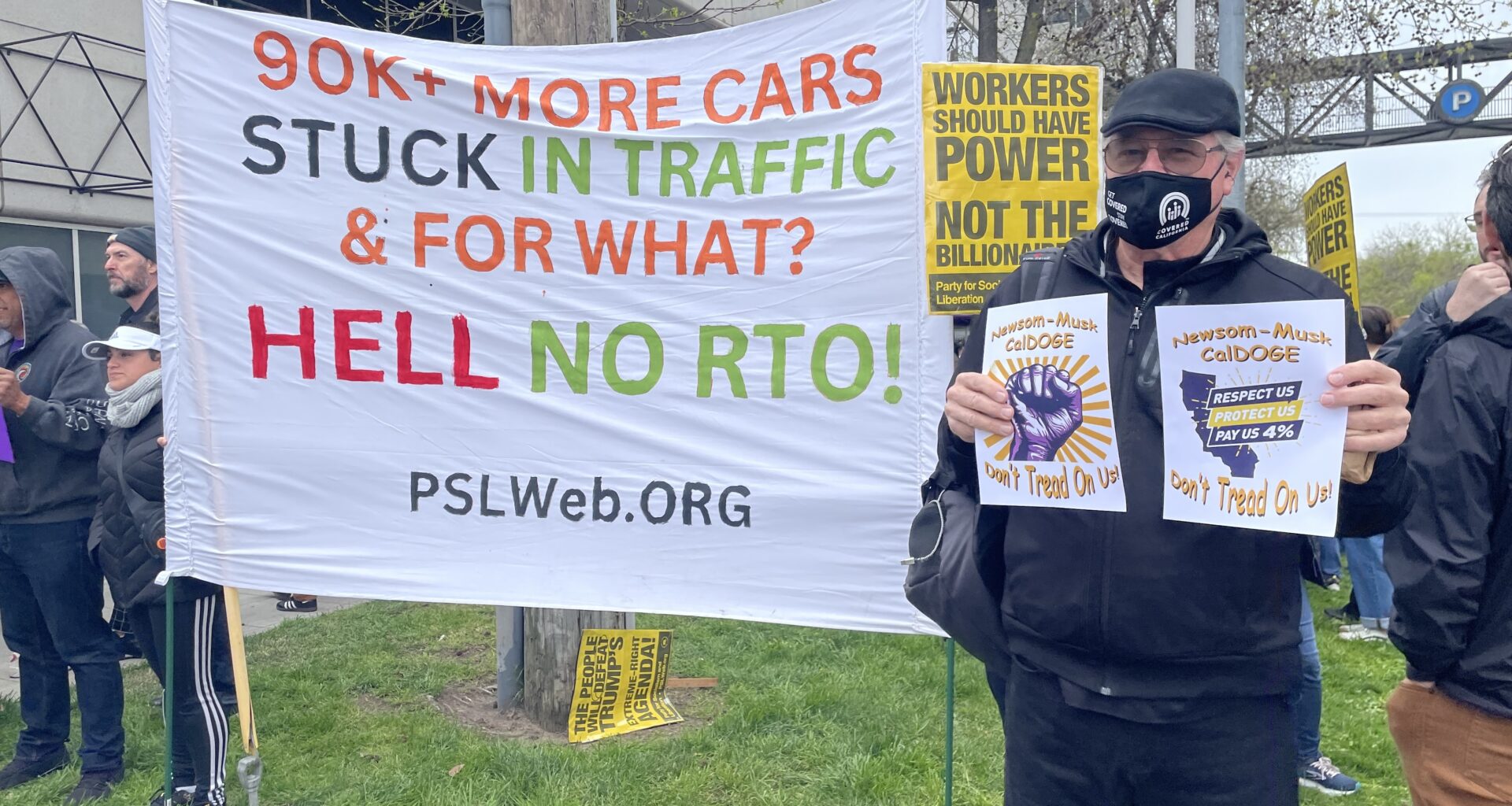
Governor Gavin Newsom has been calling for most state employees to return to the office four days a week.
Newsom has consistently said the revitalization of downtown Sacramento has been a major driver for his return-to-work order, which would apply to all state employees that serve in departments or agencies that allow telework. Newsom also argues the return would improve their productivity and work quality.
In 2024 state workers were ordered to return in-person two days per week, but last summer Newsom upped the requirement, which is scheduled to take effect July 1.
But the order has been on hold amid pushback from state worker unions, with employees saying they benefited from the flexibility of working remotely, from saving commuting costs to spending more time with their families. Workers also said the ability to telework is a big draw for state jobs.
A bill working its way through the legislature from Democratic Assemblymember Alex Lee would also require each state agency to develop its own teleworking plan, and facilitate remote work options. It would also require California to create a dashboard to calculate the taxpayer benefits of state workers teleworking.
A 2025 State Auditor report estimated that continued telework for state employees would save California around $225 million a year in real estate and facility costs.
The legislation has the backing of multiple unions including SEIU Local 1000, which is the largest state worker union in California and represents 96,000 employees.
The fight for telework has also become a focus of union negotiations for a new contract. Last week SEIU Local 1000 released its latest demands which include 100% full-time telework for eligible employees, free parking and a variety of stipends for state workers that cannot work fully remote.
Gina Garcia-Smith works for the California Department of Education and is a job steward with SEIU Local 1000. She spoke with Insight Host Vicki Gonzalez about how state workers are responding to these ongoing negotiations.
This interview has been edited for length and clarity.
Interview highlights
How are SEIU members feeling right now as negotiations are progressing?
We’re all really optimistic. We really like SEIU Local 1000’s initial proposal around telework. I think telework is a hugely galvanizing issue for my co-workers. We’re really motivated by it and I think that we really are excited to see where this can take us.
The current requirement is for state employees to work two days in office. How has that been going?
I think through the pandemic we proved that we can really effectively do our jobs 100% remote. We provided excellent services through remote work throughout the pandemic. When we went back two days a week, that didn’t change. We continue to provide those excellent services as California state employees.
Do you like going back two days a week?
I don’t personally feel like it is essential for my role. The reason behind that is just because a lot of what I do is statewide. So, I’m not collaborating with people here in Sacramento or in the office. I am collaborating with county offices of education, with school districts throughout the state of California all the way through the Oregon border to the Mexican border.
How has the job changed post-pandemic where, as you’re arguing, a worker might not need to go back in-office four days a week?
I think the nature of work has fundamentally changed. I started at the California Department of Education in 2017, so I worked there previous to the pandemic. Everything was really hard copy — forms that we had to turn in, physical folders, everything that moved was a paper. What was great about the pandemic is it really pulled state agencies into the 21st century. For the first time we’re able to use things like Zoom; we didn’t even have a Zoom subscription before in my agency.
Having all of these online collaboration platforms really allow us to do our work effectively, and I would honestly say more effectively because we’re able to have a wider reach [to] everyone that we support throughout the state of California, because a lot of our work is beyond Sacramento.
Governor Newsom still wants you to go back to work four days a week. If that does take effect what are your main concerns?
My main concern is around attracting and retaining high-quality state workers. We know that wages as a state worker have not kept up. A lot of us require advanced degrees for the work that we do, and other jobs really do provide more of a pay incentive. So adding a commute on all the costs that go along with that, especially with soaring gas prices like we have currently, really is going to take a hit.
I do believe that a lot of folks, honestly our best workers, are going to be the ones that we don’t keep. These are people who have other options, who could go elsewhere, and I’ve already lost excellent state workers who have left because of the two-day [requirement.]
I would like to get your thoughts on SEIU’s proposal, which was posted online last week and includes demands for full-time remote work and a variety of stipends for workers that have to come in. How have workers’ lives changed post-pandemic to need this additional support?
I think a big part of it is just the costs of living have increased greatly. I don’t know what state workers are going to be spending $20 on a sandwich. We really just don’t have the expendable income to be able to single-handedly save downtown Sacramento. This would be a huge added cost for us.
Also, the reality is that we’re doing the job effectively. So why bring folks back when the job is getting done, and well?
For people who aren’t state employees, what would you like them to better understand about these negotiations?
I am a former middle and high school English teacher, so I used to serve in the classroom and there are some jobs that do need to be done in-person. And what I’d like them to understand is that nobody wants to be stuck in traffic on the way to work. Fewer cars on the road means more open freeways, and your commute time is less. If we can give you the services that you need [as California citizens] from a remote perspective, it’s a win for you. It’s going to save your tax dollars and it’s also going to save you time in your daily commute.
CapRadio reached out to the California Department of Human Resources for comment and received the following statement: “CalHR respects the confidentiality of the bargaining process and does not speak on ongoing negotiations. CalHR looks forward to bargaining in good faith with SEIU in the weeks ahead.”
You can hear more of this conversation, and from CapRadio Statehouse Politics Reporter Laura Fitzgerald, here.
CapRadio provides a trusted source of news because of you. As a nonprofit organization, donations from people like you sustain the journalism that allows us to discover stories that are important to our audience. If you believe in what we do and support our mission, please donate today.