
Help us ensure local governments are accessible
Give $10
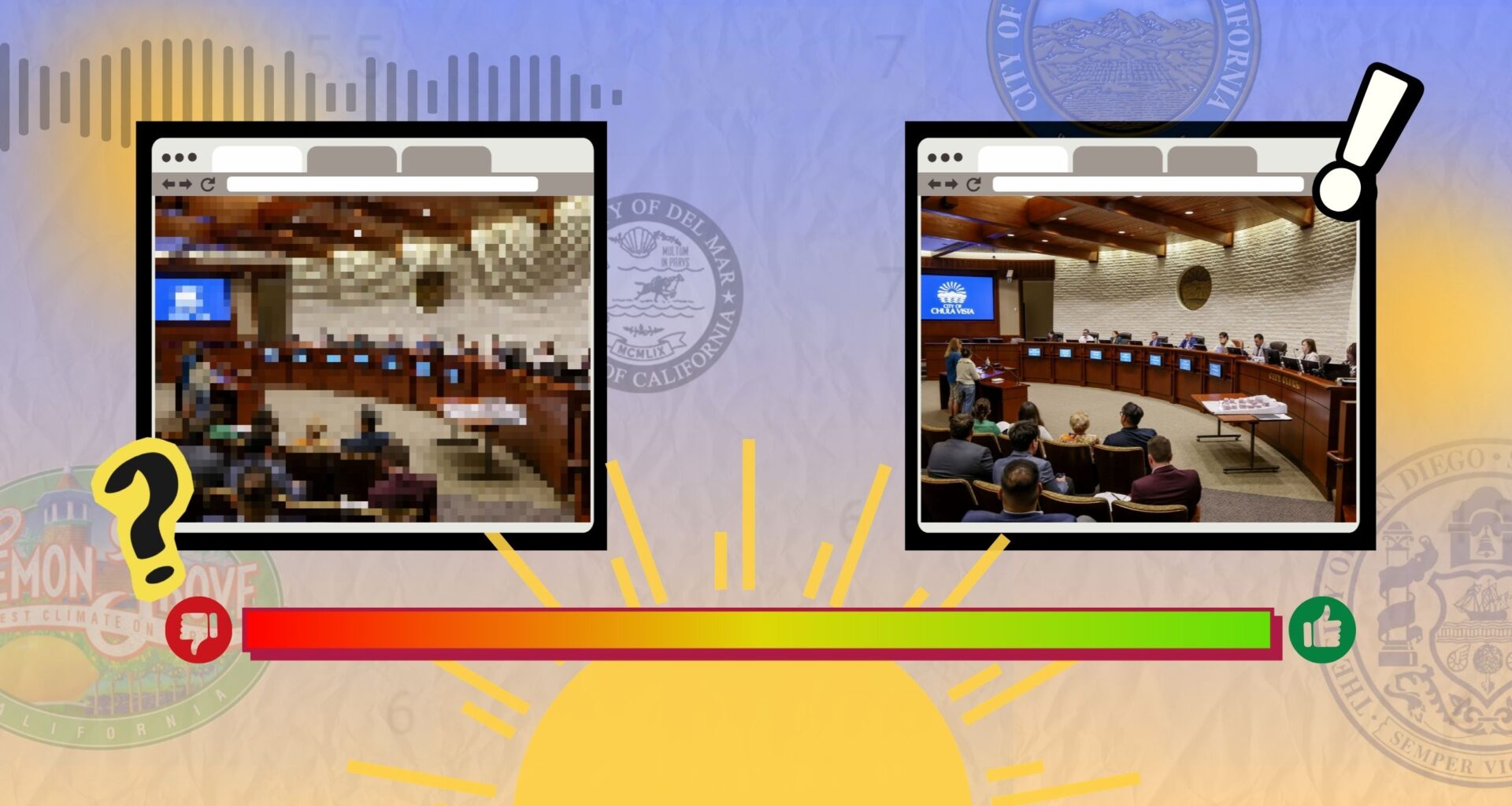
Most cities in San Diego County have some catching up to do in order to comply with a new state law that aims to increase government accessibility.
A review by inewsource and its Documenters program found just four cities — San Diego, National City, Vista and La Mesa — and the county Board of Supervisors allow residents to participate in live public comment during their meetings.
That means nearly three-fourths of cities in the region have less than four months to comply with new legislation that requires them to provide an option for people to make public comments through the phone or digital tools.
Those cities said that they are working to implement the feature by the July deadline.
The Brown Act Modernization Act, which Gov. Gavin Newsom signed in October, is a major update to the state’s law guaranteeing public access to legislative bodies. Cities will also be required to translate meeting agendas for languages other than English, depending on their local populations.
While the law is meant to expand remote participation in public meetings, it comes after at least one local city debated removing the option. As inewsource and the Documenters previously reported, Councilmember Sean Elo-Rivera in 2024 proposed ending San Diego’s yearslong practice of virtual comment at City Council meetings. He subsequently decided against the proposal after hearing from hundreds of opposing community members.
Our review of the cities comes during Sunshine Week, a national event meant to shine a light on the importance of public records and open government.
In addition to evaluating remote public comment options, we also checked cities’ websites — whether agencies offered livestreams and transcripts of their meetings, if recordings were available and clear to understand, if elected officials provided biographies and contact information, and more.
Our rubric not only checked for features required by the state, but also included categories that some agencies voluntarily provide to the public.
Most agencies fared well in our review, particularly in areas that the Brown Act requires. All had a direct link to information about the city council or, for the county, supervisors; access to their agenda within the required 72 hours in advance of the meeting; and recordings for past meetings online. They also had a consistent meeting time.
But we found room for improvement, too — and a willingness by cities to make changes to their website and improve access to public information. Nearly half of the cities do not provide direct phone numbers for their elected leaders, and video recordings showed officials at times were difficult to identify during meetings.
Several said they plan to make updates, including adding officials names to agendas and livestream links to lower-level commission meetings.
Oceanside topped our list. Lemon Grove came in last.
Take a look at how your city fared and what it had — or didn’t have — to say about it.
North County+
Carlsbad+
Population: 115,000
The city was missing meeting minutes for the second-to-last meeting as of late February, which was common among many government agencies we surveyed. Spokesperson Amy Ventetuolo said that the city makes what are known as “action agendas” available within 24 hours of each meeting while the minutes are being prepared.
Del Mar+
Population: 4,000
The city website also lacks direct phone numbers for councilmembers, making it difficult for members of the public to reach them. Del Mar City Clerk Sarah Krietor said that councilmembers serve in a part-time role and do not have offices at City Hall. The city does provide email addresses.
Encinitas+
Population: 62,000
Encinitas councilmembers sit behind physical nameplates that identify them, though video recordings show during certain angles that they’re difficult to read.
The city also lacks biographies of 50 words or more on each councilmember. Those can be useful for people who want to know more about those elected to make decisions on their behalf.
“Transparency and public participation are important to the City of Encinitas,” spokesperson Alex Saint said. “We appreciate the review and will look at the areas identified as we continue improving how residents can access meeting information and participate in City meetings, especially as new state modernization requirements for public meetings take effect over the next few years.”
Escondido+
Population: 151,000
Escondido councilmembers had short biographies and the city’s website does not list clear phone or email addresses for them. The councilmembers do have a “contact” template to fill out online, and a phone number to a receptionist who can direct calls, Communications Manager Mike Thorne said.
Oceanside+
Population: 174,000
Oceanside was the most accessible cities according to inewsource’s rubric.
We found councilmembers have physical nameplates that are sometimes difficult to identify in videos because of certain camera angles and graphics. But that may improve soon.
City Clerk Zeb Navarro said they’re in the process of transitioning to electronic nameplates, which are expected to be installed by the end of summer and will make it easier for viewers to read and identify councilmembers during meetings.
“We appreciate this feedback and will also work with our local public television partner, KOCT, to improve broadcast framing and better capture the lower portion of the screen where nameplates are located,” Navarro said.
Oceanside also lacks a list of public speakers’ names. That’s a feature that can be critical especially for identifying who stood where on controversial issues.
Navarro said there is a virtual speaker queue that displays the names of public commenters during the meetings, and that people can obtain a full list after the fact through a public records request.
Oceanside does not have a written transcript of its meetings available, though one is generated on its Youtube page. Navarro said that has to do with a 2012 decision, when councilmembers directed the city clerk to get rid of “verbatim minutes” due to the significant staff time and lack of public demand. Instead, the city creates “summary action minutes.”
The city is also working to enact the live remote public comment capability and “will definitely be meeting the requirement by the deadline, if not sooner,” Navarro said.
Poway+
Poway also did not have meeting minutes available for the second-to-last City Council meeting during the February review.
Rene Carmichael, the city’s community outreach coordinator, questioned why that matters.
“What is this threshold about?” she said. “Council meeting minutes are posted after they are approved.”
Our review found seven city councils along with the county board were approving and posting meeting minutes within that timeframe.
Carmichael also said that the city posts an action agenda, which is a draft of the actions taken by City Council, the day after each meeting so that the public has a record of what happened.
Poway also does not have a biography of at least 50 words for each elected official.
“We have always been brief in what we post on the council member pages as they are part time positions. We post who they are, how to get in touch with them and what organizations they are appointed to as the representative for Poway,” Carmichael said.
San Marcos+
Population: 95,000
inewsource identified an issue for San Marcos that the city may not have known existed: Its video feature that allows users to navigate between agenda topics on council videos did not appear to work.
Communication Manager Nikki Matosian said that the city has the feature in the videos it archived, but acknowledged an issue in the meeting inewsource reviewed.
“It looks like there is a problem with our hosting app because they should all be indexed like this one. We’ll work to get that corrected right away,” Matosian said.
San Marcos does not have its councilmembers clearly listed in its agenda, and councilmembers were also not always clearly identifiable in its meetings.
Solana Beach+
Population: 13,000
Solana Beach lacked several components, but the city hopes its new platform will help with agenda transparency. During the February review, we found minutes were not available for the second-to-last council meeting; there were no written transcripts of council meetings available; and there was no biography of at least 50 words provided for each elected official.
City Manager Alyssa Muto said the city recently transitioned to a new platform, eScribe, on which it publishes agendas the week before the meeting with all attachments and minutes following review and approval by the council at a subsequent meeting.
In January, the city added YouTube streaming with translation and transcription functions available, which Muto said goes “beyond the requirements for a City of our size and demographic for translation functions.”
Muto said that the city will be in full compliance with the other aspects of the new law by July 1.
Vista+
Population: 98,000
Vista was one of the only government agencies that already has the ability to comment live and remotely.
The city does not have video navigation tools when watching council meeting recordings online, but Communications Director Fred Tracey said the city is “exploring this for the future.”
The city does not have transcripts for its meetings, but Tracey said the city posts about the actions the council took a few days after each meeting. While the city provides agendas and reports, its system is difficult to maneuver and are not included in a shared file.
The city also did not have biographies over 50 words for each councilmember.
South Bay+
Chula Vista+
Population: 275,000
Chula Vista does not have written transcripts of council meetings, but the videos on the website do have closed captioning in both English and Spanish.
The city also did not have meeting minutes available for the second-to-last meeting at the time of inewsource’s review.
Chief Communications Officer John Cihomsky said that two February meetings were canceled, which would have affected inewsource’s review.
In general, he said minutes are prepared by staff and approved at a subsequent meeting.
“Our goal is to include draft minutes on the agenda for approval at the next meeting whenever possible,” Cihomsky said, adding that time constraints can add delays and that the council typically meets weekly.
Coronado+
Population: 20,000
Coronado does not clearly list its officials names in the agenda; did not have meeting minutes available for the second-to-last council meeting; does not have a written transcript of meetings; and does not have direct phone numbers for its councilmembers. City spokesperson Kaylee Ricci told inewsource it had no comment on our findings.
Imperial Beach+
Population: 26,000
When contacted by inewsource about components we noticed the city was missing, Imperial Beach pledged to begin incorporating many accessibility features.
Imperial Beach did not have officials’ names clearly listed on the agenda. After inewsource pointed that out, City Manager Tyler Foltz said the city would begin including that.
The city also had a faulty link to its livestream, which Foltz said officials will resolve.
Councilmembers were also not always clearly identifiable in all of the videos, which Imperial Beach said it will work on.
“It is intended for the names to be clearly identifiable,” Foltz said.
The city also lacked meeting minutes for its second-to-last meeting during the February review.
“We endeavor to provide the minutes as early as feasible dependent on staff availability. As of the next meeting, all meeting minutes will be up to date,” Foltz said.
National City+
Population: 56,000
National City stood out as one of the only government agencies that already has the ability to comment live and remotely.
It also made several commitments to improve its website after being contacted by inewsource. The city said it will ensure that officials’ names are listed in all versions of meeting agendas — right now, the names are only visible in the PDF version, not in the agenda’s HTML format.
In some parts of videos, nameplates of all the councilmembers are difficult to see. The city said nameplates are typically displayed and it would work to ensure they were in the future.
“It appears that a few were removed during the March 3rd meeting,” said City Clerk Shelley Chapel. “We will ensure that all nameplates are properly displayed for future meetings.”
It also did not have the meeting minutes for the second-to-last meeting, but said it would be on the March 17 agenda.
The city also updated its calendar for the remainder of the year after we found the city did not have a full calendar posted.
San Diego County, City+
City of San Diego +
Population: 1.3 million
San Diego did not have meeting minutes up for its second-to-last meeting during inewsource’s February review. City Clerk Diana Fuentes said that meeting minutes take up to six weeks to produce and bring to the council for approval.
The city produces a summary sheet of the results of each council meeting and posts that within 48 hours on the agenda website. The city also posts about whether specific items pass on social media on the same day, Fuentes said.
While the city does not have a written transcript of the meetings readily available, Fuentes said that there is closed captioning on CityTV and people can submit public records requests for full transcripts.
The city said that there are many ways it works to inform the public about council activity. Chris Chan, the director of council communications, said he writes a regular blog called “The People’s Business” to preview council and committee meetings.
The city also said that in addition to the agenda being online, it has a direct link on how to participate with all the information to make meetings accessible in eight languages. inewsource also noted that several councilmembers lack biographies on San Diego’s website. Chan said that was up to each individual councilmember.
San Diego County+
Population: 3.3 million
The county stood out as one of the only government agencies that already has the ability to comment live and remotely.
Sarah Sweeney, deputy director of communications, also said that the clerk of the board will give a presentation on Brown Act modernization at an upcoming meeting, which should provide further updates.
We found that while supervisors do have nameplates, it is not always easy to identify them in online videos when the camera angle changes. The county said it will work on that.
“We are always exploring ways to improve the user experience and will look to identify ways to make these more visible from all angles,” Sweeney said.
The county does not have written transcripts, but does post draft minutes within three days of meetings.
It also livestreams its Planning Commission meetings, though the agenda does not have instructions on how to join.
East County+
El Cajon+
Population: 106,000
While El Cajon lists phone numbers for its council members, they are not individual. It also does not have video navigation tools for its council meetings that allow people to click through topics easily.
Still, El Cajon was ranked among the most accessible under our review.
La Mesa+
Population: 61,000
La Mesa is one of the few local agencies that allows public commenters to participate remotely.
Still, nameplates for the councilmembers were sometimes blurry and difficult to read in video recordings. There was no written transcript for the meetings.
There were also no direct phone numbers for councilmembers.
“We appreciate the feedback regarding items that may be missing from our website and are currently reviewing the concerns raised,” said Grecia Aguilar, the city’s communications manager. “The City is committed to transparency and ensuring residents have access to information about City Council meetings. If updates are needed, we will address them as part of our ongoing efforts to improve the City’s website and public access to information.”
Lemon Grove+
Population: 28,000
Lemon Grove was in last place in our ranking of accessible governments.
The city does not provide video recordings for its meetings, though audio recordings are available. A Youtube account can be found in a separate Google search.
City Clerk Joel G. Pablo said Lemon Grove is in the process of getting a contract for both audio and livestreaming services. He said the city will also look into transcription services as well as video navigation tools.
There were also no meeting minutes available for the second-to-last City Council meeting at the time of the review.
The city lacks a direct phone number for each elected official on the website. Pablo told inewsource that people can contact the city manager’s executive assistant to reach the council.
Lemon Grove also does not have biographies for elected officials, which Pablo said the city will review and determine whether information should be added.
Documenters also had difficulty hearing audio within the first 15 minutes of the most recently recorded meeting.
“The City is aware of audio quality concerns with certain meeting recordings,” Pablo said. “The City is currently in the process of procuring updated audio visual and livestreaming services to improve recording quality going forward.”
Santee+
Population: 60,000
Santee lacks clear instructions for public comment other than for in-person attendees.
There were also no meeting minutes for the second-to-last meeting available, no written transcript of the meeting and no direct phone numbers for councilmembers. The city did not respond to repeated requests for comment on inewsource’s findings.
About the project
Cities across San Diego County together spend billions of taxpayers dollars every year, led by elected officials who make decisions on public safety, development projects and more. But how accessible is that information to the people these cities serve? inewsource and its San Diego Documenters team found out.
With a team of trained Documenters, reporters and editors, we attended public meetings; watched video recordings; reviewed sites for elected official information; and more.
Our project comes during Sunshine Week, a national nonpartisan event that multiple sectors — from journalism to education — participate in to promote transparency and access to public information.
Our methodology+
Our team includes journalists and Documenters who together have decades of experience navigating government agencies and public records laws. We used that experience to build and develop a rubric for reviewing meetings and websites for the region’s 18 cities as well as San Diego County government. Each agency then received a score out of 19 points based on questions about access to meeting information; quality of video recordings; contact and biographical information for elected officials; and more. Our review focused on city councils, and for the county, the Board of Supervisors.
We contacted every agency to verify our findings, which resulted in some score changes based on officials’ explanations and clarifications. In some cases, we awarded half-points for questions if we found an agency partially qualified.
We also included extra credit questions, like whether there is a written transcript and if video meetings have clickable time stamps and easy navigation. Three bonus questions went beyond agencies’ main governing body and judged the accessibility of cities’ planning commissions. Poway, Solana Beach and Imperial Beach do not have planning commissions, so we used different commissions and boards to review for those cities.
Become a Documenter+
inewsource trains and pays community members to cover and take notes at public meetings. Those notes often help surface community news across San Diego — and help produce projects like this. Want to help? Find out how to become a Documenter and join our next training.
Try it yourself+
Want to see how your local school district, water authority or another government agency would fare? We’ve made our rubric available for you.
Credits+
inewsource: Community reporter Katie Futterman and interns Jenna Ramiscal and Roman Fong.
Documenters: Paulina Castellanos Wade, Jennifer Hua, Will Gallegos, Alex Blood, Maya Flores, Brisa Karow, Alicia Kelley, Carlos Gomez Moyeda and Alisa Judge.
Editing and producing: Documenters Program Manager Isaac A. Brambila; Assistant Editor of Audience and Innovations Giovanni Moujaes; Audience Engagement Producer Iran Martinez Jr.; and Managing Editor Jennifer Bowman.
Type of Content
News: Based on facts, either observed and verified directly by the reporter, or reported and verified from knowledgeable sources.