
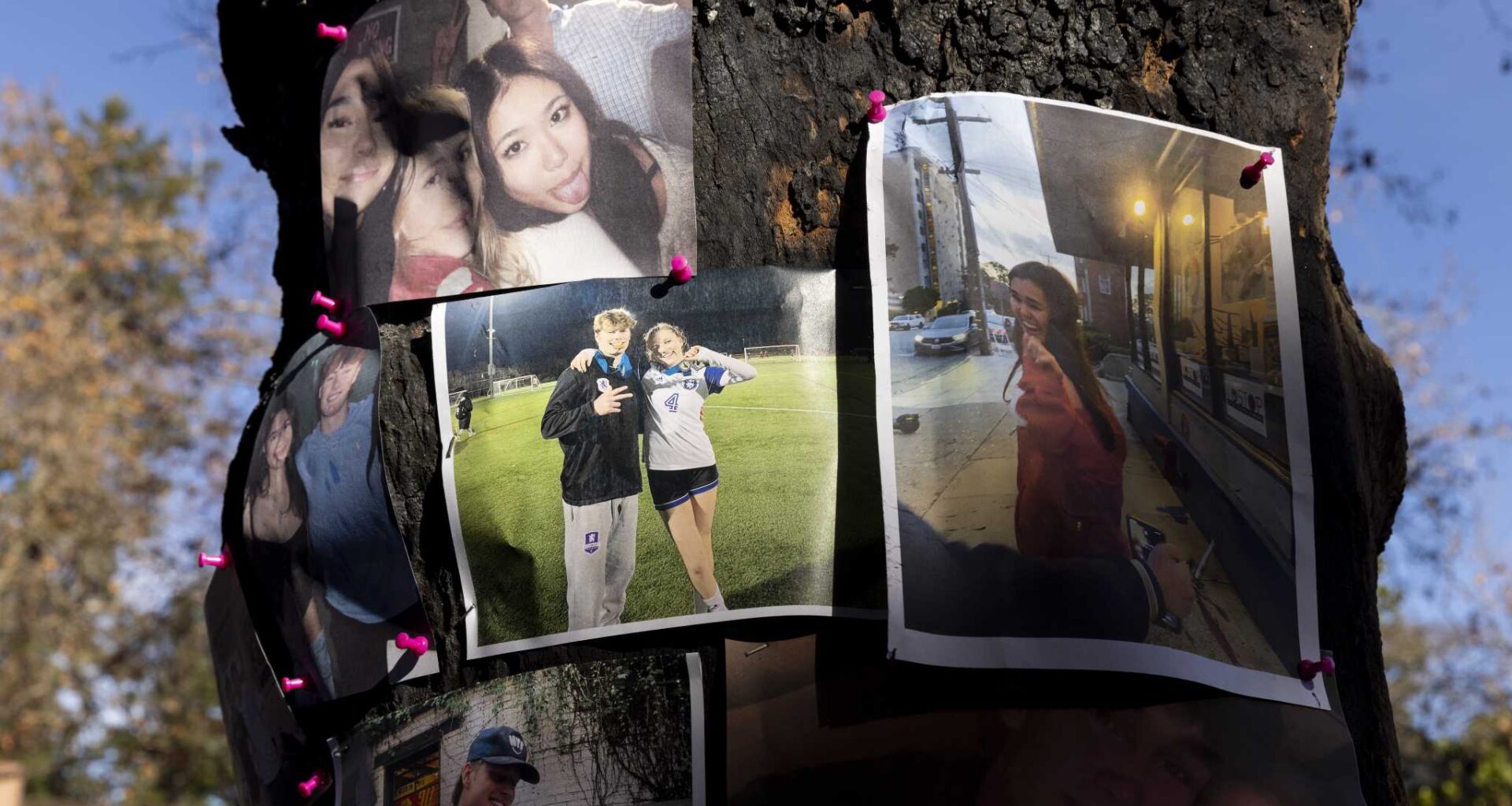
The sole survivor of a fiery Cybertruck crash in Piedmont sued Tesla on Tuesday, claiming that design flaws trapped him in a burning vehicle as a rescuer desperately pounded on the window.
Jordan Miller was riding shotgun in the electric pick-up that jumped a curb while speeding up a hilly road at 3 a.m. on Nov. 27, 2024. Driver Soren Dixon, 19, lost control of the truck and crashed into a tree at Hampton Road and King Avenue. Instantly, the Cybertruck erupted in flames.
Police, regulators and grieving family members have struggled to find accountability for the incident, which left three college students dead, including Dixon. Toxicology reports from the Alameda County Coroner showed he had a blood alcohol level of 0.195 %, nearly 2 ½ times the legal limit, and all three of the deceased had cocaine in their systems. Investigators from the California Highway Patrol consistently pointed to speed and impairment as factors that led to the wreck.
Miller named Dixon’s estate as a co-defendant in the lawsuit, along with the estate of Dixon’s grandfather, Charles Patterson, who, according to the court complaint, was the registered owner of the Cybertruck. The lawsuit alleges that Dixon drove negligently by traveling at dangerous speeds, and that the vehicle’s owner is also liable.
But Tesla’s Cybertruck is the main focus of the suit filed in Alameda County Superior Court, which accuses the company of selling vehicles with a dangerous, defective design while knowing the risk of serious injuries and death. In manufacturing its bulky, space-age pickup, Tesla flouted a basic principle of car safety: that people need a reasonable way to get out in an emergency. Drivers and passengers in Cybertrucks are at the mercy of electronic door handles that “could fail in the very circumstances — collision and fire — when escape is most urgent,” the lawsuit says.
Representatives of Tesla did not immediately respond to a request for comment.
Attorneys for Miller present a stark picture of what happened when the vehicle suddenly ignited.
According to their account, a friend who was driving behind the four college students approached the Cybertruck’s right-side doors but could not open them because there were no exterior handles. The electronic buttons to operate the doors from the inside were not working, the suit said. Frantically, the friend grabbed a tree branch and struck the Cybertruck’s front window “multiple times” until it broke and the rescuer was able to extricate Miller.
He spent five days on a ventilator in an induced coma, with significant burns to his airways and lungs. Additionally, Miller suffered third degree burns to his legs that required skin grafts and left permanent scars. He lost about a third of his intestines, broke four vertebrae and continues to suffer from “significant catastrophic injuries that he’ll deal with for life,” said his attorney Anthony Label, a partner at the Veen Firm.
“He just sat there in flames with a rescuer pounding on the window, trying to get him out,” Label said, contending that Miller’s injuries would not have been nearly as severe if Tesla had configured the Cybertruck “in a way that people could escape easily.”
Millers’ suit follows separate litigation from the parents of two passengers who died in the crash, Krysta Tsukahara, 19, and Jack Nelson, 20. They sued Tesla last October.