
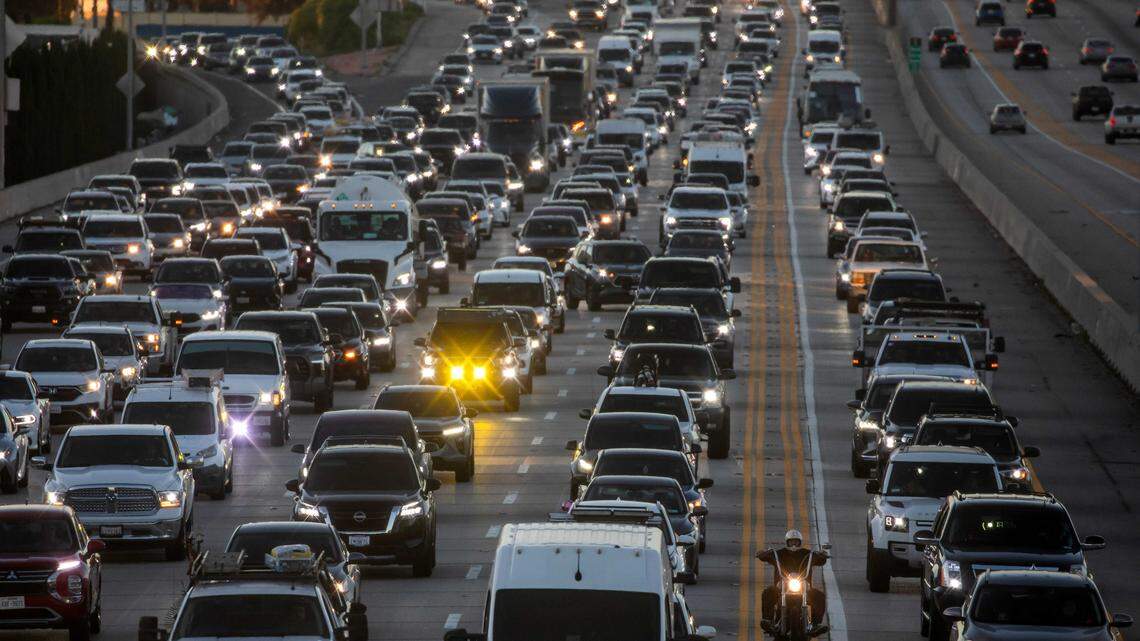
Traffic moves along the San Diego Freeway on Friday in west Los Angeles. The U.S. Department of Justice filed a lawsuit Thursday in Sacramento federal court challenging California’s greenhouse gas emissions and zero-emission vehicle regulations, marking the latest effort by the Trump administration to roll back the state’s vehicle standards.
Apu Gomes
Getty Images
The U.S. Department of Justice sued California on Thursday, challenging what it described as “illegal” regulations on greenhouse gas standards and zero-emission vehicles. The lawsuit was filed in Sacramento federal court against the California Air Resources Board — the agency responsible for implementing the regulations.
The Trump administration asked a federal judge to determine that California’s regulations related to CO2 emissions and zero-emission vehicle standards were “unlawful and unenforceable.” These rules, the complaint argues, relate to fuel economy, which falls under the purview of the National Highway Traffic Safety Administration under the Energy Policy and Conservation Act of 1975.
The complaint also asked a judge to permanently bar California from “adopting or enforcing new regulations” in these areas. The lawsuit marked the latest effort by the Trump administration to roll back California’s vehicle emissions policies.
Justice Department officials said blocking the rules would lower vehicle costs and expand consumer choice. Newsom’s office called the lawsuit “meritless” and said the state would continue defending its clean vehicle policies.
Here’s what you need to know:
How many zero-emission vehicles are made in California?
California is one of the largest markets for zero-emission vehicles, with more than 2.5 million cumulative ZEV sales as of 2025 and nearly 19% of all new vehicle sales in the fourth quarter of last year, according to the California Energy Commission.
New car dealers last year sold more than 378,000 electric vehicles, accounting for just under 21% of total new light-duty vehicles sold in the Golden State, more than twice the national rate, according to the California New Car Dealers Association.
Earlier challenge to California emissions authority
California has long held special authority under the federal Clean Air Act to set stricter vehicle emissions standards than the federal government because of the state’s historic smog problems.
In 2004, automakers sued California in Fresno federal court over vehicle emissions regulations, citing the same fuel economy rules referenced in the Trump administration’s lawsuit. California had become the first state in the U.S. to restrict emissions.
A district court ruled in California’s favor, rejecting the industry’s preemption arguments, according to the Harvard Law Review. The automakers appealed, but the case never reached the U.S. Supreme Court.
“There was no final (decision) by the Supreme Court on how the two — the Clean Air Act and the fuel economy under the transportation agency — mesh in terms of California’s authority,” said Mike Scheible, a former deputy executive director for the California Air Resources Board.
Scheible said this likely influenced the federal government’s decision to sue now, as the case could reach the U.S. Supreme Court.
Key rules at the center of the lawsuit
The latest lawsuit centers on California’s Advanced Clean Cars I regulations, which set greenhouse gas emission limits and require automakers to increase zero-emission vehicle sales.
A newer version, Advanced Clean Cars II, was adopted in 2022 and requires all new vehicle sales to be zero-emission by 2035. Under the Biden administration, the rules were supported, and California received a Clean Air Act waiver in 2024, allowing the state to continue pursuing its zero-emission vehicle goals.
In June, Trump signed congressional resolutions aimed at blocking the waiver and California’s rule phasing out new gas-powered cars. California responded by suing the feds, with California Attorney General Rob Bonta’s office calling the measure an “illegal resolution.” In response, Gov. Gavin Newsom signed an executive order reaffirming the state’s commitment to expanding zero-emission vehicle use.
How could this lawsuit affect current regulations?
Last fall, the California Air Resources Board proposed an emergency rule to maintain certain regulations as litigation moved through the courts. The rule was adopted late last year and re-adopted earlier this month.
The emergency rule ensures that low-emission vehicle standards adopted in 2012 remain in effect. It also allows the board to continue parts of the Advanced Clean Cars II program and Omnibus regulation, “to the extent permitted by law, in the event a court of law holds invalid the resolution purporting to disapprove that waiver,” according to the proposal.
Automakers can choose to follow either set of rules, though if courts determine the congressional resolutions are not valid, they will need to comply with the new regulations.
The resolutions created “uncertainty into the California market for new motor vehicles,” the proposal stated. The emergency rule aimed to preserve regulatory continuity.
How could this lawsuit affect California’s authority?
Interpretations of federal jurisdiction and terms such as fuel economy can shift between administrations, particularly when political control changes, Scheible said. A U.S. Supreme Court ruling, however, would be more definitive.
If the case reaches the high court and the conservative majority sides with the federal government, it could be difficult to reverse and may lead to changes in California law, Scheible said.
A ruling against California could limit the state’s ability to set greenhouse gas emissions standards for vehicles, with potential effects on states that follow its rules.
The California Air Resources Board did not respond to a request for comment. The agency previously said it would not comment on active litigation.
Related Stories from Sacramento Bee

The Sacramento Bee
Madison Smalstig covers transportation for The Sacramento Bee. Before joining The Bee, she reported on breaking news, focusing on crime and public safety, in the North Bay for three years. Smalstig is a born and raised Hoosier and earned degrees in journalism and Spanish at Indiana University.