
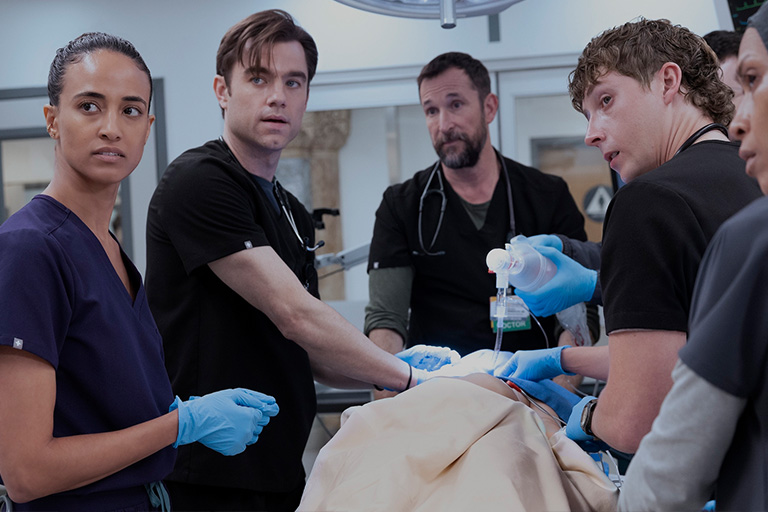
Production designer Nina Ruscio and casting director Cathy Sandrich Gelfond dish on designing “triggering” hospital sets, casting for raw authenticity and how their time at Berkeley taught them to watch life closely, turning every detail into material for an immersive narrative.
Ask people what they love most about The Pitt, the HBO Max medical drama that debuted in 2025 and went on to sweep the Emmys, and the answer is almost always the same: It feels so real.
The show’s pace appears just like an emergency room — lively and chaotic, always in motion. Its characters seem like real doctors and nurses you’d meet in an overcrowded urban ER: They’re highly competent and compassionate, sometimes curt and distracted, while bearing a mountain of responsibility and layers of trauma they absorb during their grueling 15-hour shift.
But what exactly goes into making the show, a massive hit with over 10 million viewers per episode, feel so real? How do you create an immersive, full-bodied world that pulls you in so far you forget that this place and these people don’t actually exist?
Turns out, two UC Berkeley alumni know all about it.
Nina Ruscio and Cathy Sandrich Gelfond both work on The Pitt — Ruscio as the production designer and Sandrich Gelfond as a casting director. They also both graduated from Berkeley in 1983 with degrees in English, widely regarded as one of the country’s leading programs. But the self-described “soul sisters” didn’t actually meet until they began pre-production and development for The Pitt in 2024.
“I always tell people who say that English is an impractical degree, ‘Are you kidding me?’” says Sandrich Gelfond. “It’s about storytelling. It’s about character and tone and human behavior. If you know how to write, if you know how to communicate your thoughts and ideas, you have the foundation to do just about anything.”
In this UC Berkeley News interview, Ruscio and Sandrich Gelfond talk about designing “triggering” hospital sets, casting for raw authenticity over Hollywood gloss and how their time at Berkeley taught them to watch life closely, turning every quirk and detail into material for an immersive narrative.