
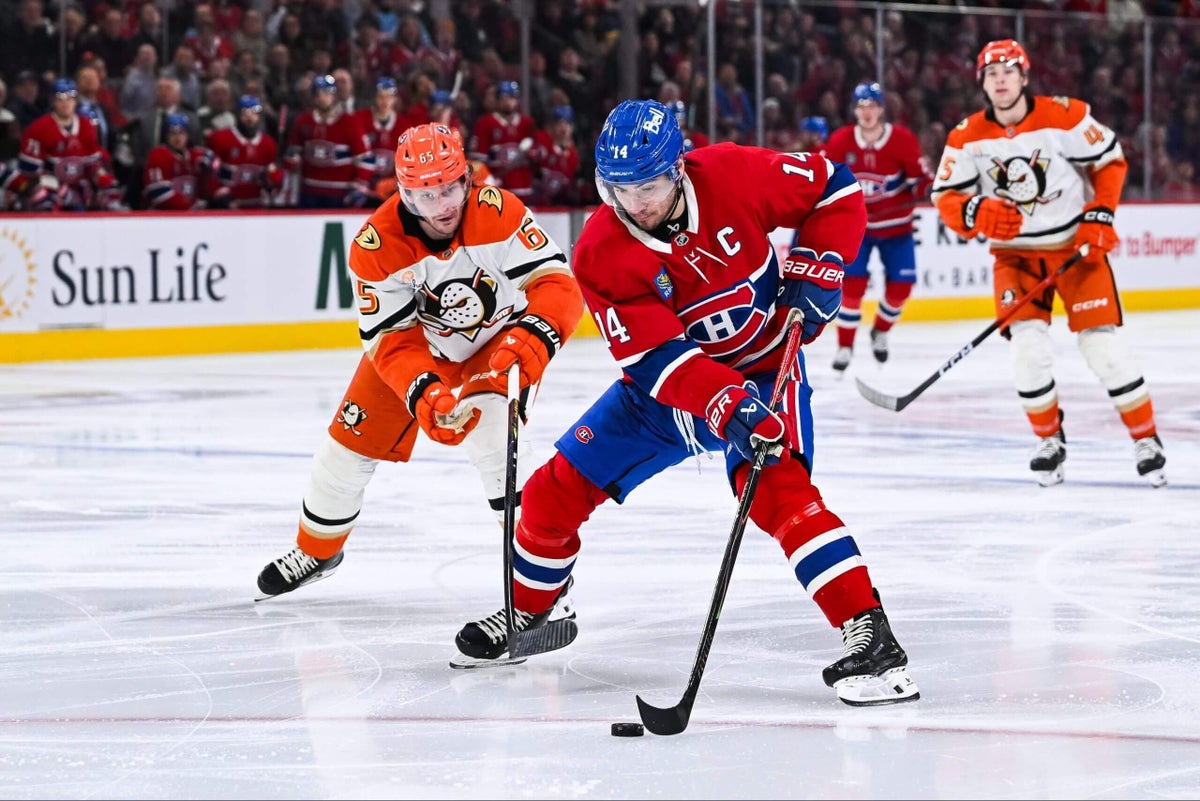
MONTREAL — Nick Suzuki did not seem to appreciate the question, and perhaps he was justified.
Over the past three seasons, Suzuki is tied for 11th in the NHL in points with 244. Over that same span, his linemate Cole Caufield is tied for 14th in goals with 104. And the third member of that line, Juraj Slafkovský, is a unique package of size and skill that is extremely rare in this league.
So, when Suzuki was asked whether his line had a difficult weekend producing offensively while also trying to contain Leo Carlsson in a 4-3 loss to the Anaheim Ducks on Sunday, and Macklin Celebrini in a 4-2 loss to the San Jose Sharks one night prior, he didn’t think it was a fair question.
BEAT OUR EXPERTS
Predict how you think the tournament will
play out. Can you beat one of our experts?
Carlsson had two goals and an assist Sunday while matched largely against Suzuki, and Celebrini had the same stat line against Suzuki on Saturday, so the question was not without merit. But Suzuki didn’t like it all the same.
“I mean, I would say we’re the better line of the three,” Suzuki said. “So no, I don’t think it was an issue. We didn’t play our best, so that’s something we need to do better going into next week.”
That is a healthy mentality you want your players to have — being competitive enough to believe they have the advantage to win any matchup. And it is inherently linked to talent.
The Canadiens have gathered a ton of that over the four years of this rebuild. Now that it has come to some degree of maturity, it is a difference-making element of this team. Caufield scored his 39th goal of the season against the Ducks; only Nathan MacKinnon has more. Suzuki had a goal and an assist, giving him 78 points this season, on pace to set a career high for the fifth straight year.
Talent is an attitude. It is swagger. And swagger wins.
Except when it doesn’t.
After the Canadiens’ loss to the Sharks on Saturday, Lane Hutson was somewhat exasperated that issues the Canadiens have talked about for months keep coming up. Primarily, he mentioned being stubborn with the puck, a talking point coach Martin St. Louis has been harping on that defined the 0-for-2 weekend.
“I feel like just a little bit of looseness in our game, and it’s so hard,” Hutson said. “Earlier in the year it’s fine because you think about how many games you have left, but now we’re getting down to every little thing within these games matters a lot.”
Where does the looseness show the most?
“Just in our coverage a little bit, myself included,” he said. “And then maybe stubbornness with the puck. We want to make plays on the rush, and that can burn us at times with a team this talented. … It’s easy things, honestly. It’s stuff we know, but we’re just reverting back to whatever we want to do, I guess.”
It’s a double-edged sword that comes with being talented. On the one hand, it gives you the swagger necessary to succeed in the best league in the world. On the other, it can sometimes make you forget you are playing in the best league in the world against players who are also extremely talented.
The Canadiens entered the third period tied at 3. The game was evenly matched, and the period was cautious for the most part, with playoff contender from each conference trying to make sure it secured the point available for reaching overtime. But as the minutes ticked down, the Canadiens seemed to want that regulation win a bit too much, to show that difference-making talent they have cultivated.
It produced the opposite of the desired result. The Ducks got several high-quality chances late in the third period before finally generating the winning goal with less than three minutes to play in regulation. But it also produced a fascinating examination from St. Louis of the balance between talent-based swagger and professional game management that winning in the NHL requires.
“It’s a fine line between being hungry to win and being afraid to lose,” he said. “… We’re a good enough team to put ourselves in situations where the player, especially the players we have, talented players, that they will be hungry to win. So we have the puck, and in those moments … that mentality also gives us a lot of success, the hunger to win. We’re dangerous and everything. But there are moments where we can be more, especially tied 3-3, end of the game. It would be OK to be a little afraid to lose. … So what hurts us sometimes is also a reason why we are where we are today.”
That is an interesting concept: The reason for your success is also why you struggle. The Canadiens are a poor defensive team — it has been a season-long focus and remains problematic — but they are an excellent offensive team. But what if the reason for their offensive excellence is the same reason they are defensively deficient? What if their swagger is as negative as it is positive?
That comes back to what Hutson was saying after the loss to the Sharks. Stubbornness with the puck only happens when you have an overwhelming belief in what you can do with the puck.
It only happens when you are talented and you have swagger.
Swagger leads to undue risk, and undue risk is something St. Louis has been fighting all season.
“I don’t tell the boys to take risk. Everything’s calculated,” St. Louis said. “Like, one of the chances (the Ducks) had late, we’re on a three-on-two, so you should have freedom to not dump a puck in, right? We just don’t execute, it’s turned over, and now it’s a footrace and they get a shot. So, to me, I don’t tell the guys to play with risk, I ask them to have calculated risk. When there’s no numerical advantage, there should be zero risk. It should be a deep game mentality, whether you can carry it in or you can chip it in.
“But when you have guys on three-on-twos, my guys know they have freedom to make plays. This is an opportunity. Do I know if we just dump the puck in, we’re not going to get scored on? Yes. But I know also that if we take advantage of a situation, we possibly score. So, of course you want to do that. But I feel at times, where the score is, we can manage the non-numerical situations better. We can probably wait until the puck leaves our zone before worrying about getting a rush scoring chance, not be in such a hurry to leave the zone.
“So it’s a balance, but to me, there’s moments in the game where you can totally play with zero risk, and I feel like sometimes we get in trouble because we don’t do that.”
As St. Louis completed that long answer, his voice was barely audible. It was a whisper as he said, “Because we don’t do that.”
This is a time of year when the Canadiens need to do that, because playoff-hardened, veteran teams do that, as Hutson mentioned Saturday night.
The winning goal Sunday, scored by Cutter Gauthier with 2:30 left in regulation, left Hutson enraged. There was a puck battle in the corner. Two Ducks players were there, along with the Canadiens’ Kaiden Guhle, and he fell. Hutson went into the battle knowing he had three forwards in the defensive zone in support. But they failed to recognize the situation.
There were more Ducks than Canadiens in that corner, but the Canadiens still had a numerical advantage because the Ducks were in the middle of a line change. Yet they still managed to get a scoring chance out of it.
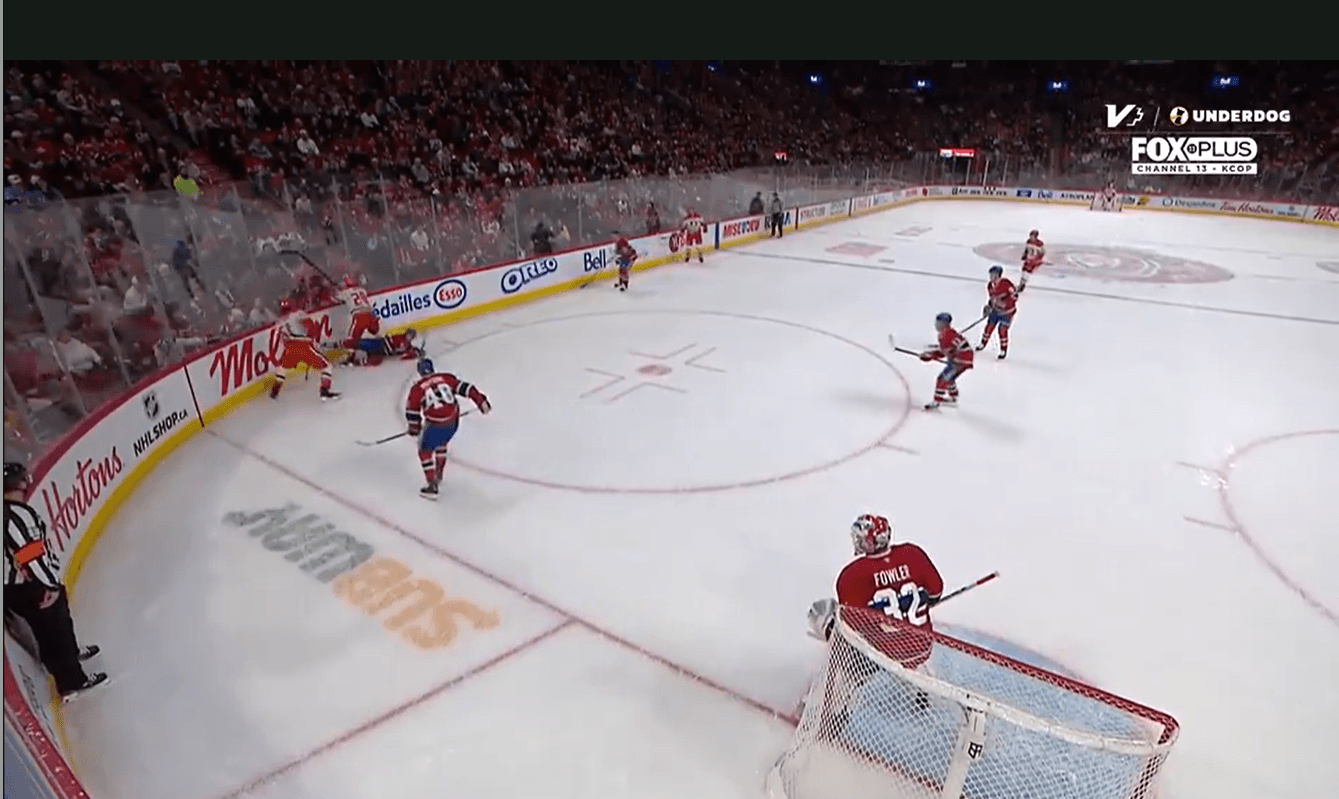
When Hutson entered the puck battle in that corner, the rest of the Canadiens on the ice did not react properly, and Gauthier sprang free to score the winner. The closest player to Gauthier was Caufield, but St. Louis chose not to call him out.
“We just didn’t get the job done,” he said.
The Canadiens have reached a time of year and a time in the evolution of their team when they need to get the job done in these situations.
They are young and talented and have swagger. They need to learn when to apply it.