
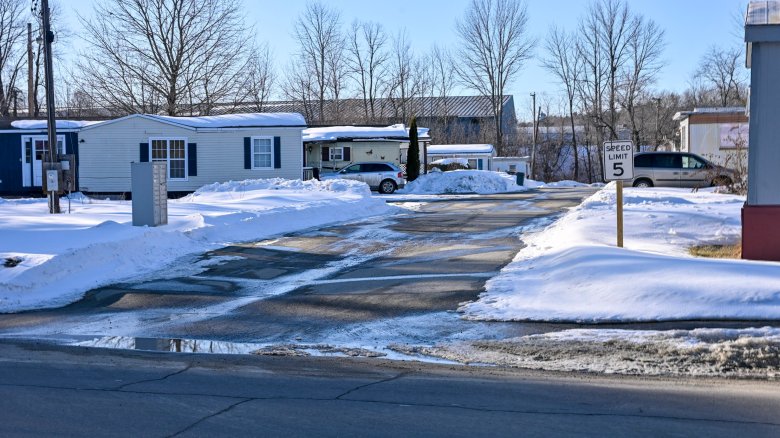
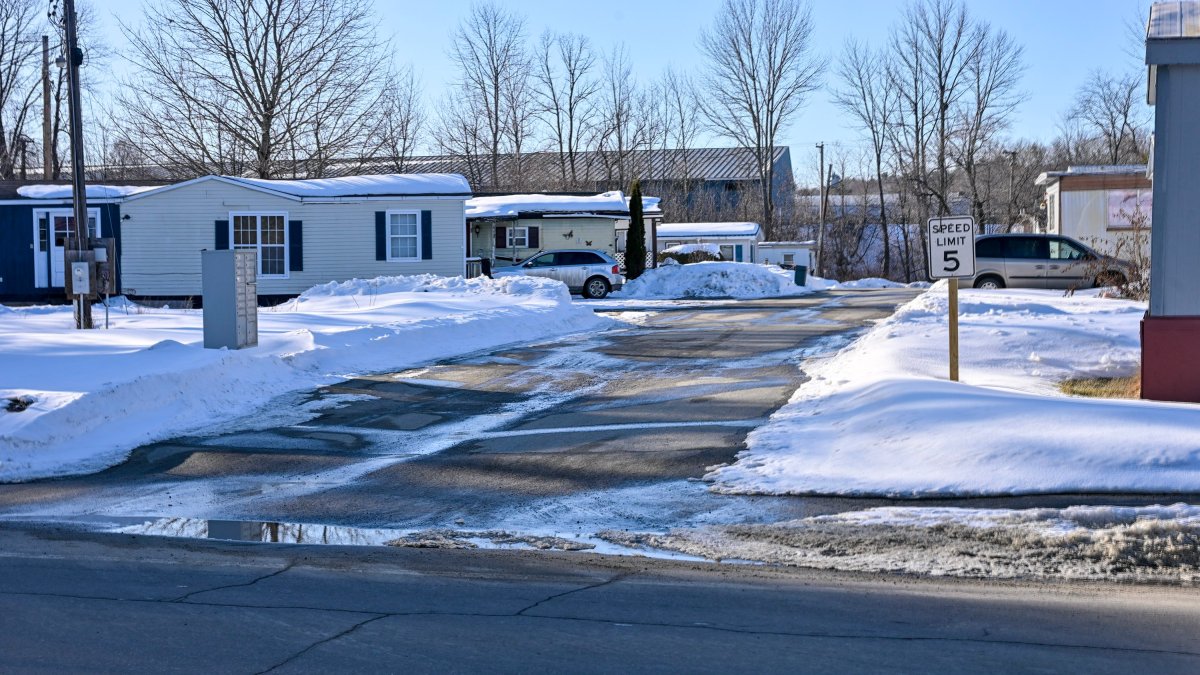
 Snow melts in late February in the driveway of Breens Mobile Home Park off Fairfield Street in Oakland. The town is considering a lot rent stabilization ordinance. (Joe Phelan/Staff Photographer)
Voters in the Kennebec County town of Oakland will soon be able to weigh in on a request to place a temporary ban on mobile home lot rent increases.
The proposed 90-day moratorium is intended to give town officials time to consider whether to enact a mobile home park lot rent stabilization ordinance.
As in several other Maine towns and cities, residents of mobile home parks say they can’t afford the lot rent increases that in some cases have caused the residents to choose between paying their rent or putting food on the table.
Many own their mobile homes but rent the lots they sit on.
Oakland residents havepleaded with officials at town council meetings to consider a moratorium, which other communities, including neighboring Waterville, have enacted.
The Waterville City Council last fall voted to approve a 180-day moratorium and a few weeks ago, voted to also approve a rent stabilization ordinance that mandates park owners not increase rents more than once in a year and notify residents and the city of upcoming rent increases about 90 days previous to an increase.
Also, if increases are above a certain (cost of living) amount, the park owners must go before the city’s newly formed mobile home park rent stabilization committee and consider both a park resident and park owner’s reasons for opposing or asking for the increase.
Oakland councilor Kelly Roderick at a March 11 meeting proposed the council approve a 180-day moratorium but, for lack of a second, her motion failed. Instead, the council approved considering a 90-day moratorium.
The Town Council will hold a public hearing on that proposal at 5:30 p.m. March 25 at the fire station on Fairfield Street where people can give input. Then at 6 p.m., the council will consider taking a first vote to approve or reject a moratorium. Typically, the council takes two votes on such a matter but can waive a second vote.
That will give town officials time to consider whether to draft and approve and ordinance while holding any changes at bay.
Across Maine, many communities are grappling with the same issue.
In Searsport, a coastal town of about 2,800 people, residents at the annual town meeting March 7 voted 67-12 to approve a mobile home park rent stabilization ordinance, according to Town Manager James Gillway.
Gillway said Tuesday town officials were able to bypass having to enact a moratorium first because the timing was such that residents could gather enough signatures on a petition in time to consider the stabilization ordinance at the annual town meeting.
Like in Oakland, Searsport mobile home park residents had been paying increased fees for lot rentals in one park in particular. At the town meeting, they said the cost for a lot rental was $350 when the original owners who developed it in the 1960s and ’70s had it. The park changed hands three times and during that time, lot rents increased twice, going to $450 and $500. The new third owner has not yet raised the rent but will likely do so to keep up with the cost of inflation, Gillway said.
“It’s a bad situation when everything goes up and they can’t afford to move, there’s no alternative and they get stuck,” Gillway said.
The rent stabilization ordinance allows the owner to raise the rent every year, but not above the consumer price index for the northeast region, plus 2%. Gillway said, however, that park owners would be given an exception ifextenuating circumstances such as broken pumps or major road issues happen. No more than one increase can be levied in a 12-month period and, as in Waterville, at least a 90-day notice must be given to residents.
Searsport has three mobile home parks with three different owners. The largest park has 61 lots and the other two, fewer than 10.
In 2024, Old Orchard Beach approved a mobile home rent stabilization ordinance that limits yearly increases to 5% for people who own their mobile homes and rent the lots they sit on.
The town of Jay also is pursuing enacting a mobile home rent stabilization ordinance.