
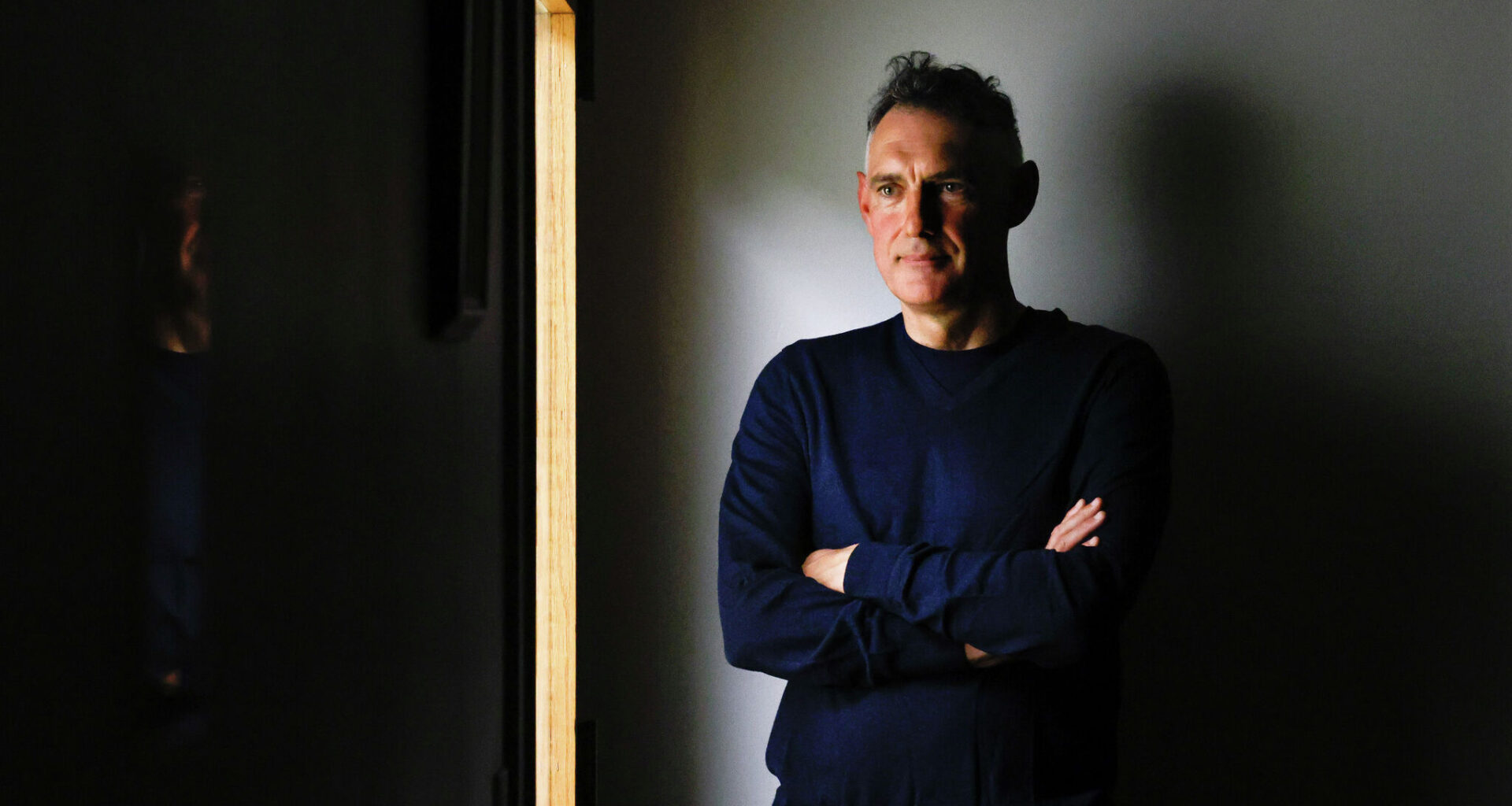
Emmanuel Saez, a professor of economics and director of the Stone Center on Wealth and Income Inequality at UC Berkeley, is one of of four co-authors of a controversial plan to tax California’s billionaires.
Lea Suzuki/S.F. Chronicle
Emmanuel Saez doesn’t look like a political provocateur. Tall and lean, with graying temples and rectangular eyeglasses, the UC Berkeley economics professor favors V-neck sweaters, drives a 2009 Honda Fit and speaks so softly in his French accent that colleagues lean in to hear him.
But in recent years, updating his most famous tax chart started making him angry. On his computer screen was what he saw as unmistakable proof of soaring inequality in the United States: a line that shot almost straight upward, showing the richest 1% capturing much of the nation’s economic gains.
“That chart kind of radicalized me,” Saez said.
Article continues below this ad
A leading scholar on taxation and inequality, Saez, 53, is a co-author of the boldest — and most viable — state-level wealth tax in U.S. history. California’s proposed billionaire tax, a one-time 5% levy on the net worth of the state’s richest residents, isn’t just dividing Democrats and causing some billionaires to flee the state. It thrust a self-described “bookworm” into the center of one of America’s most contentious economic arguments: Is inequality simply the outcome of capitalism, or a danger to democracy itself?
Saez’s research has long shaped the intellectual framework for the modern wealth-tax movement, a burgeoning effort to tax the assets of the super rich rather than their incomes. Now, after years of writing op-eds in The New York Times, debating wealth-tax opponents like Larry Summers, and advising Democratic presidential campaigns, he is completing his transformation from introverted academic to polarizing public figure.
San Francisco Chronicle Logo
Make us a Preferred Source to get more of our news when you search.
Add Preferred Source
Whether you view Saez as a champion of the oppressed or a risky zealot might depend on your tax bracket. Though some believe he’s orchestrating a campaign that threatens to ruin California’s economy, others laud the French American economist as the mastermind giving the billionaire tax a legitimate shot in November’s election.
Introduced by a health care union called SEIU-United Healthcare Workers West, and currently gathering signatures to qualify for the ballot, the billionaire tax packs several lofty ambitions into one straightforward proposal. If it overcomes intense opposition from the state’s wealthiest class, it could generate tens of billions of dollars for health care programming, validate the wealth-tax movement, and make the nation’s richest state less socioeconomically stratified.
Article continues below this ad
“This tax has the potential to change how people around the country — and even the world — handle matters of inequality,” said French economist Gabriel Zucman, one of Saez’s most frequent collaborators. “Emmanuel is as well-equipped as anyone to take on an assignment of that magnitude.”
Emmanuel Saez said he was in part inspired to coauthor a proposal to tax California billionaires by his experiences in the Bay Area, where inequality was jarring to him when he arrived from Europe.
Lea Suzuki/S.F. Chronicle
Once content to stick to analysis, Saez began to delve deeper into policy discussions about two decades ago. His work tracking how wealth and income are distributed convinced him that the U.S. is a plutocracy.
According to Federal Reserve data, the wealthiest 1% of Americans now hold as much money in stocks and mutual funds as the remaining 99% of the country. Saez fears that the longer money and power flow unchecked to a tiny fraction of the richest families, the more inequality will balloon, social mobility will erode and public trust will crumble.
“It really feels like everything has led up to this moment,” Saez said on a recent afternoon in his sixth-floor office at UC Berkeley’s Evans Hall, where posters of Spanish Renaissance painter El Greco and the Monterey Bay’s rugged coastline decorate the cinder-block walls. “We’re at a crossroads. Will we reverse the trend, or continue to stand by and watch our democracy give way to a full-blown oligarchy?”
Article continues below this ad
Taxation can be a useful tool in helping narrow the chasm separating the top 1% from everyone else. But to use it, policymakers must first understand why the rich keep getting richer.
The problem with taxing billionaires has long been that they don’t always report much income. Instead, their wealth tends to be tied up in assets like investments, which are taxed at lower rates than wages.
In 2019, when Saez co-authored “The Triumph of Injustice” with Zucman, the internet was abuzz with one of the book’s key findings: Billionaires had been paying lower effective tax rates than middle-class workers for decades. Saez’s chart — the one with that near-vertical line showing the wealthiest families’ ceaseless accumulation of wealth — went viral, amplifying calls to tax the rich.
In the afterglow of “The Triumph of Injustice,” Saez helped design federal wealth-tax proposals that Elizabeth Warren and Bernie Sanders promoted during the 2020 Democratic presidential primary. Then, in the early 2020s, state Assembly Member Alex Lee, D-San Jose, worked with Saez on several state tax proposals, but none came close to passing.
Article continues below this ad
The proposals were loaded with complex jargon about tax code and little-known loopholes, making it hard for them to gain traction with the general public. Saez kept all that in mind last summer. After coming across a 2019 New York Times article about his work, SEIU-UHW — a health care union known for backing pro-labor policies with ballot propositions — asked for Saez’s help crafting a wealth-tax proposal that would backfill some of the health care funding cut by the Trump administration.
Over frequent emails and Zoom conversations with the tax’s three other co-authors, all tax law experts, the group identified taxation thresholds and guarded against possible litigation. Saez also insisted on keeping the proposed ballot measure uncomplicated.
Emmanuel Saez believes that California can set a new national agenda with a proposal to tax the super rich. “It really feels like everything has led up to this moment,” he said on a recent afternoon.
Lea Suzuki/S.F. Chronicle
Since most billionaires keep their wealth in public companies, the proposal would simply tax their shares, which are easy to value based on stock price. To keep California billionaires from flocking to more tax-friendly places like Texas and Florida, Saez and his co-authors decided on a one-time tax on any billionaire who was living in the state on Jan. 1, 2026. That expedited timeline would ostensibly make it difficult to avoid.
“What makes the California billionaire tax different from previous proposals is that it really gets at the heart of the matter,” Lee said. “Nothing is easy when you’re going up against powerful billionaires, but I like our chances this time. And Emmanuel has a ton to do with that.”
Article continues below this ad
The youngest son of a high school Spanish teacher and a local phone company manager, Saez spent his formative years in the Basque region of southwestern France, where debates over Basque identity unfolded in the shadow of the ongoing Basque separatist conflict in neighboring Spain. A high-performing high school student, he moved nearly 500 miles away to study at École Normale Supérieure — a Paris university renowned for producing some of France’s top intellectuals.
After earning a math degree, Saez shifted his focus to economics and quickly became fascinated by taxation’s role in shaping inequality. That passion only grew when a 29-year-old Saez accepted a tenure track professorship with UC Berkeley’s economics department. Over his quarter-century there, he has cemented himself as one of the most revered — and divisive — economists of his generation.
Brian Galle, a UC Berkeley tax law professor and co-author of the billionaire tax, called Saez “one of the real geniuses of our time.” It’s not just that Saez has won a John Bates Clark Medal, the most prestigious economic laurel not named the Nobel Prize. Working with him, Galle said, “can sometimes feel like the tax-policy equivalent of a 10-day-contract guy trading passes with LeBron James.”
But his critics have a different take. Many view Saez, who holds dual French and American citizenship, as a radical leftist helping spearhead Americans’ misguided attack on the billionaire class.
Enrico Moretti, a prominent tax economist and UC Berkeley professor with an office just down the hall from Saez’s, takes issue with the billionaire tax. He called his colleague’s estimate it would yield roughly $100 billion in revenue “way overly optimistic.” According to a recent study from Stanford University’s conservative-leaning Hoover Institution, the tax could actually reduce state revenue by nearly $25 billion by triggering a mass exodus of billionaires.
Saez projects that only about 10% of the state’s 200 or so billionaires will find ways to avoid the tax. “That’s not right,” Moretti said. “When billionaires are faced with a tax like this, they’ll leave in droves.”
Emmanuel Saez, Professor of Economics, director, Stone Center on Wealth and Income Inequality, UC Berkeley; stands for a portrait at UC Berkeley on Monday, February 23, 2026, in Berkeley, Calif.
Lea Suzuki/S.F. Chronicle
Online vitriol has been far harsher. David Gamage, a University of Missouri tax law professor and co-author of the billionaire tax, said that one man was so incensed by the proposal that he created a website dedicated to harassing all four of the billionaire tax’s co-authors.
On it, the man posted each of the co-authors’ pictures, accompanied by their phone numbers and home addresses. The man also sent a barrage of emails Gamage characterized as “mildly threatening” to Saez and his fellow co-authors. The website has since been removed.
“I do find myself worrying about Emmanuel’s safety sometimes,” said Casey Gardner, Saez’s wife. “The stakes just feel really high right now.”
Saez agrees. In addition to a bid for much-needed revenue, the billionaire tax is an attempt to reconcile perhaps the state’s most confounding paradox.
Despite having the largest state economy in America, California remains one of the most unequal. Tech fortunes measured in the billions coexist with some of the country’s highest housing costs and poverty rates. On many workdays at UC Berkeley, Saez has walked past homeless encampments in People’s Park before stepping into class, where his students sometimes include the children of Fortune 500 founders.
“The inequality out here can be jarring,” Saez said.
He and his co-authors now hope to set an important precedent. If California becomes the first state to implement a true wealth tax on members of the three-comma club, other states could follow. Zucman described the billionaire tax as “a test of whether modern governments can reassert fiscal power over massive private fortunes.”
Asked on that recent afternoon about all that comes with trying to effect so much change, Saez leaned back in his chair, raised his arms and glanced around his dimly lit office with cinder-block walls.
On his MacBook screen were tabs of research. Just a few feet away, a bookshelf was filled with literature from some of history’s great economists, including his own friend and collaborator, Thomas Piketty.
“As you can see, I’m not one for the limelight,” Saez said. “I wasn’t even sure at first if I should do this interview. But I feel passionately about what I do, and it’s more important than ever to fight for equality.”
Less than eight months until November’s election, the billionaire tax faces crucial questions: Will the proposal attract the roughly 875,000 valid signatures it needs to qualify for the ballot? Could SEIU-UHW negotiate with billionaires and withdraw the measure? Will more billionaires bolt from California?
Reports suggest that at least a handful of California’s uber-wealthy residents — including Google founders Larry Page and Sergey Brin — began severing ties with the state before the proposed tax’s Jan. 1 move-out deadline. Gov. Gavin Newsom, who has pledged to fight the proposal, is just one of many critics who worry that the tax could hamper the state’s financial outlook.
“It has the potential to completely destroy California’s economy,” Moretti said. “It has become trendy to bash the rich, but those billionaires are owners of Silicon Valley’s biggest companies. California needs them.”
Saez remains adamant that concerns about a billionaire exodus are overblown. But regardless of what happens, he said, now is the time to take risks.
According to a recent New York Times analysis, the richest Americans have seen their net worth skyrocket 120% since President Trump first took office in 2017. The financial picture of lower- and middle-class people, meanwhile, has hardly changed.
Saez looked out his office window. There, in the distance, were the skyscrapers and high-rises of San Francisco’s financial district.
“The Bay Area has more billionaires than any other metro area in the world, yet many of the roads are littered with potholes,” Saez said. “Something has to change.”