
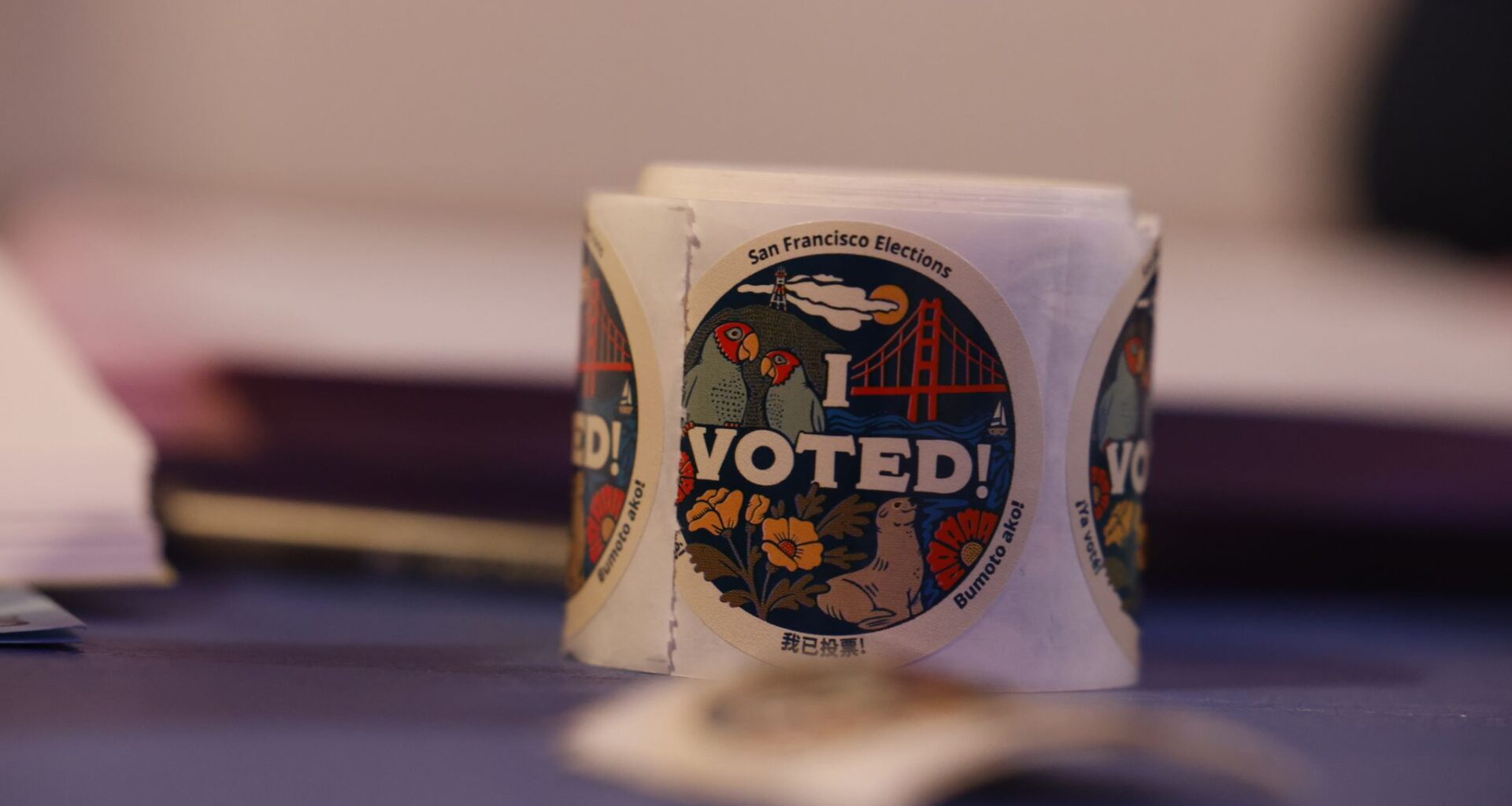
I Voted stickers are seen on a table at a Cafe International polling place on Election Day, Nov. 4, 2025, in San Francisco.
Lea Suzuki/S.F. Chronicle
WASHINGTON — New restrictions sought by President Donald Trump would upend voting in California, which significantly redesigned its elections over the past decade to boost participation.
Innovations such as automatic registration and providing mail ballots to every voter would become infeasible or even illegal under the SAVE America Act, the sweeping federal elections legislation that Trump has demanded Congress pass. The measure would impose stringent verification protocols for voters, following years of baseless claims by Trump that millions of noncitizens are casting ballots unlawfully to help Democrats steal elections.
Under immense pressure, the U.S. Senate opened debate Tuesday on the bill, even as its prospects appear exceedingly slim. Democrats have rallied against it, arguing that the voter identification requirements are so severe they would effectively disenfranchise tens of millions of Americans.
Article continues below this ad
Because the vast majority of Californians vote by mail, the state stands to be disproportionately affected.
“California has been just a real leader in the country in both modernizing, including the security, and expanding how people vote, and this would just kneecap it,” said Michael Waldman, CEO of the Brennan Center for Justice at New York University School of Law.
San Francisco Chronicle Logo
Make us a Preferred Source to get more of our news when you search.
Add Preferred Source
To verify their identity and eligibility to vote, Californians currently must provide a state ID or driver’s license number or the last four digits of their Social Security number when they register. Registration is available in person, by mail or online and, under a groundbreaking 2015 law, anyone who signs up for a state ID or driver’s license is automatically added to the voter rolls unless they opt out. Californians then do not generally have to show identification to cast a ballot.
As permanent absentee voter status gained overwhelming popularity in the state, California also began transitioning away from traditional neighborhood polling places in 2018. Every registered voter now receives a mail ballot for every election, and while more limited in-person options remain, vote-by-mail typically accounts for more than 80% of the California electorate.
Article continues below this ad
Mail voting predominates across the west, including in Republican states such as Utah and Montana. But California’s system — which has also long been criticized for its slow counts — particularly infuriates Trump, who has repeatedly claimed without evidence that he would have won the liberal state in his three presidential elections if not for mass voter fraud.
“You go to California, they send out like 38 million ballots. Some Democrats got seven, eight ballots,” Trump said Monday during an event in the Oval Office. “Republicans are a lot of times calling in, ‘Where’s my ballot? Where’s my ballot? ’ They’re lucky to get one.”
Nelson Tse processes ballots for counting at San Francisco City Hall on March 7, 2024.
Benjamin Fanjoy/The Chronicle
The SAVE America Act, a version of which passed the House last month, could not only undo the expansions to voting in California but erect new hurdles for huge swaths of the electorate.
To register for and participate in federal elections, voters would have to present a form of photo identification that aligns with REAL ID standards and indicates they are a citizen of the United States. Mail voters would need to submit a copy of the document with their ballot.
Article continues below this ad
That change would make online, mail and automatic voter registration impractical or impossible, and it would functionally preclude continuing all-mail elections.
Furthermore, California, like most states, does not issue REAL IDs with citizenship listed. The bill provides several alternatives, such as using a passport or supplementing a noncompliant photo ID with a birth certificate or naturalization certificate. But experts estimate that about 9% of eligible voters — more than 21 million nationwide — do not have ready access to any of those documents, which can cost hundreds of dollars and take weeks to obtain. It could be a substantial burden for married women and other people whose names no longer match their birth certificates.
Another provision would force states to share voter data with the Department of Homeland Security to verify citizenship. The Trump administration has unsuccessfully sued California for that information to bolster his allegations of widespread illegal voting.
Critics compare the voter identification requirements to the Jim Crow-era poll taxes designed to prevent Black people from casting ballots. At a news conference on Tuesday, Senate Minority Leader Chuck Schumer, D-N.Y., called it “one of the most pernicious pieces of legislation that I’ve ever seen” and accused Trump of trying to switch election rules to keep Republicans in power as their popularity plummets.
“It’s about coming for the power of we the people,” Maya Wiley, CEO of The Leadership Conference on Civil and Human Rights, said. “Earn our vote. Don’t block us from the ballot.”
Article continues below this ad
More changes could be coming. Trump has insisted on amendments to the bill to end nearly all mail voting and, unrelatedly, to ban transgender athletes from women’s sports and prohibit transgender medical care for minors.
Those are likely to be added this week as the Senate considers the SAVE America Act, though the bill itself appears doomed. Against unified Democratic opposition, there are not enough votes in the Republican-controlled Senate to overcome a filibuster, and even many GOP senators appear reluctant to change the rules to force the measure through.
Nevertheless, facing public threats from Trump and an organized campaign by conservative activists, Republicans took up the bill Tuesday. Debate could last for days or weeks, through marathon overnight sessions, with no clear path to a final vote.
“We’ll look forward to putting the Democrats on record and showing just the lack of common sense that they apply to some of these basic issues where the American people agree with us,” Senate Majority Leader John Thune, R-S.D., told reporters.
Article continues below this ad
Sen. Alex Padilla, who once oversaw California’s elections as secretary of state, said at a press conference that Democrats are prepared to “fight tooth and nail” for as long as it takes to “make sure the SAVE Act suffers the death that it deserves.” He said Trump and Republicans are trying to distract from a failed agenda that has raised costs for working families.
“They know they will suffer the consequences this November in the midterms as a result,” Padilla said. “They know that if they implement the SAVE Act, that’s their chance of holding on to power at the expense of our fundamental right to vote.”