
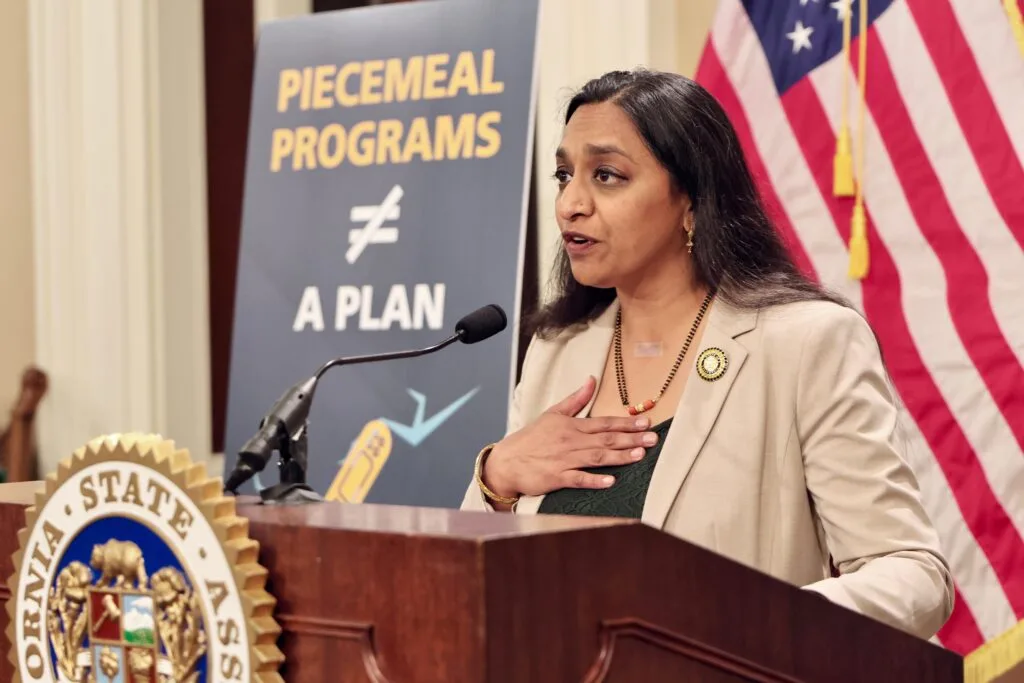

Courtesy of Alisha Kirby / CSBA
Package of bills would set goals and hold state agencies accountable for helping districts improve
Originally published by EdSource
Advocates and experts cite many factors behind a persistent student achievement gap: poverty, chronic absences and health challenges, poor instruction, a lack of teacher preparation, inadequate funding, bureaucratic intransigence and entrenched interests.
The California School Boards Association cited another factor on Tuesday — state government itself.
In announcing a new legislative initiative called SOS for Student Achievement to close “the state accountability gap,” the association faulted “fragmented” state policies, “diluted” resources, overlapping authorities and new programs with piles of regulations as obstacles to student success.
“School districts and county offices of education are expected to deliver results for students every day,” said CSBA President Debra Schade. “The SOS for Student Achievement legislative package recognizes that the state must also be accountable for ensuring its own policies, programs and funding are aligned to support local efforts.”
The disparities of students by race, ethnicity and family income in test scores and other indicators of student success, including meeting admission requirements for state universities, are collectively known as the achievement gap. It’s been vast for decades, and since Covid-19, it has widened as rates of recovery for the most vulnerable students have lagged.
On the 2025 state Smarter Balanced test in math, for example, 20% of Black students and 26% of Hispanic students were proficient in math, compared with 50% of White and 70% of Asian students – differences that remain essentially unchanged in a decade. On the 2024 National Assessment of Educational Progress (NAEP) 4th grade math test, the 39-point difference in scores between California’s income-disadvantaged and non-income-disadvantaged students was tied with Massachusetts for the widest gap in the nation.
What the bills would do
CSBA says its quartet of bills will force the state — the governor, legislators, county offices of education, the California Department of Education — to establish clear priorities, with annually measurable goals and to make it clear who, when and how districts will receive support. The purpose, the bills repeatedly say, is better “alignment” and “coherence,” partly by weeding out mandates superfluous to narrowing achievement gaps.
Two of the Assembly’s education leaders, the new chair of the Assembly Education Committee, Darshana Patel, D-San Diego, and her predecessor, Al Muratsuchi, D-Torrance, are introducing two of the four bills.
Assembly Bill 2225, Patel’s bill, would create a 15-member group, half from education groups like CSBA, employee unions and administrators, and half from legislative leaders and state departments, to write the state Closing the Achievement Gap Support and Operations Plan and submit it to the State Board of Education and Legislature by Dec. 1, 2027.
The plan would set metrics for agencies involved with student achievement — among them the State Board, the California Department of Education, the California Collaborative for Education Excellence — and determine how to respond when they come up short. It would also recommend how the governor and legislators can reduce unfunded mandates — requirements and regulations imposed on districts without accompanying resources — a measure that should especially please school board association members.
AB 2202, Muratsuchi’s bill, would create an independent body called Closing the Achievement Gap Commission, which would annually advise the State Board and Department of Education on what is and isn’t working in districts for improving student performance. Its members would be state agency heads, representatives of small and big districts and employee groups.
Another bill, AB 2149, would require the nonpartisan Legislative Analyst’s Office to annually recommend how the state could better meet the new closing-the-achievement-gap targets. The fourth would create a new State of the Achievement Gap Dashboard (AB 2514) to measure the state’s progress (presumably different from the multi-colored, often criticized California School Dashboard).
“As a school board trustee, my budget reflects the priorities of our district,” said Schade, who serves on the Solano Beach School District board. “We want the LAO to look at if closing the achievement gap is reflected in the state’s proposed and final budget.”
Deeply flawed school accountability system
In 2012, the Legislature and then-Gov. Jerry Brown made addressing the achievement gap the focus of redesigning the state’s funding and accountability system under the Local Control Funding Formula. It provides additional money for low-income students, English learners and other high-needs students and sets up a new system of support tied specifically to student groups with the lowest performance by a half-dozen measures.
But CSBA said the system of support is duplicative and disorganized, with widely varying effectiveness.
The current system imposes differentiated assistance on hundreds of school districts’ lowest-performing student groups, usually foster children and students with disabilities. In most districts, Latino, Black and low-income children, comprising most students, aren’t designated for assistance, although their performance in state math and English language arts is persistently well below proficient.
Districts’ complaints about creeping mandates under the funding formula have grown louder in recent years. Gov. Newsom and the Legislature have used unexpected state revenue to phase in new programs at the same time — transitional kindergarten, expanded after-school learning and community schools without detailed implementation plans.
CSBA said the new programs, like a requirement to buy electric buses, have diverted energy from focusing on addressing the achievement gap.
“We do have unfunded mandates and initiatives that are providing a tremendous amount of noise and barriers for our local school districts and county offices that really have caused some challenges,” said Schade.
Eric Premack, executive director of the Charter Schools Development Center in Sacramento, agrees with CSBA — to a point.
“I’m struck by the belief that reform is something that the state can impose on thousands of schools by edict and mandate. Thus, I’m a bit sympathetic with CSBA,” he said in an email. “Their bill, however, is more about preserving school districts’ and school boards’ autonomy and exclusivity than it is about changing the system to encourage or ensure improvement in services to students/families.”
Newsom’s office declined immediate comment on CSBA’s initiative, but earlier this year, the governor cited some of the same flaws in the structure of California’s oversight and support. He is proposing to shift school management from the State Superintendent of Public Instruction to a new Commissioner of Education under the governor’s and State Board’s control.
Also, the State Board is considering fully revising the system of differentiated support for low-performing districts and is expected to vote on it in May.
CSBA has joined many other advocacy and school management groups in endorsing Newsom’s proposal, which would go into effect after Newsom’s term ends. CSBA Chief of Communications Troy Flint said that the proposal complements CSBA’s initiative but doesn’t go far enough for “a complete reformation.”
“Beyond the first flurry of attention, we want continued involvement as partners, with ongoing evaluations, as systems are changed,” he said.
Follow the Vanguard on Social Media – X, Instagram and Facebook. Subscribe the Vanguard News letters. To make a tax-deductible donation, please visit davisvanguard.org/donate or give directly through ActBlue. Your support will ensure that the vital work of the Vanguard continues.
Categories: Breaking News Education State of California