
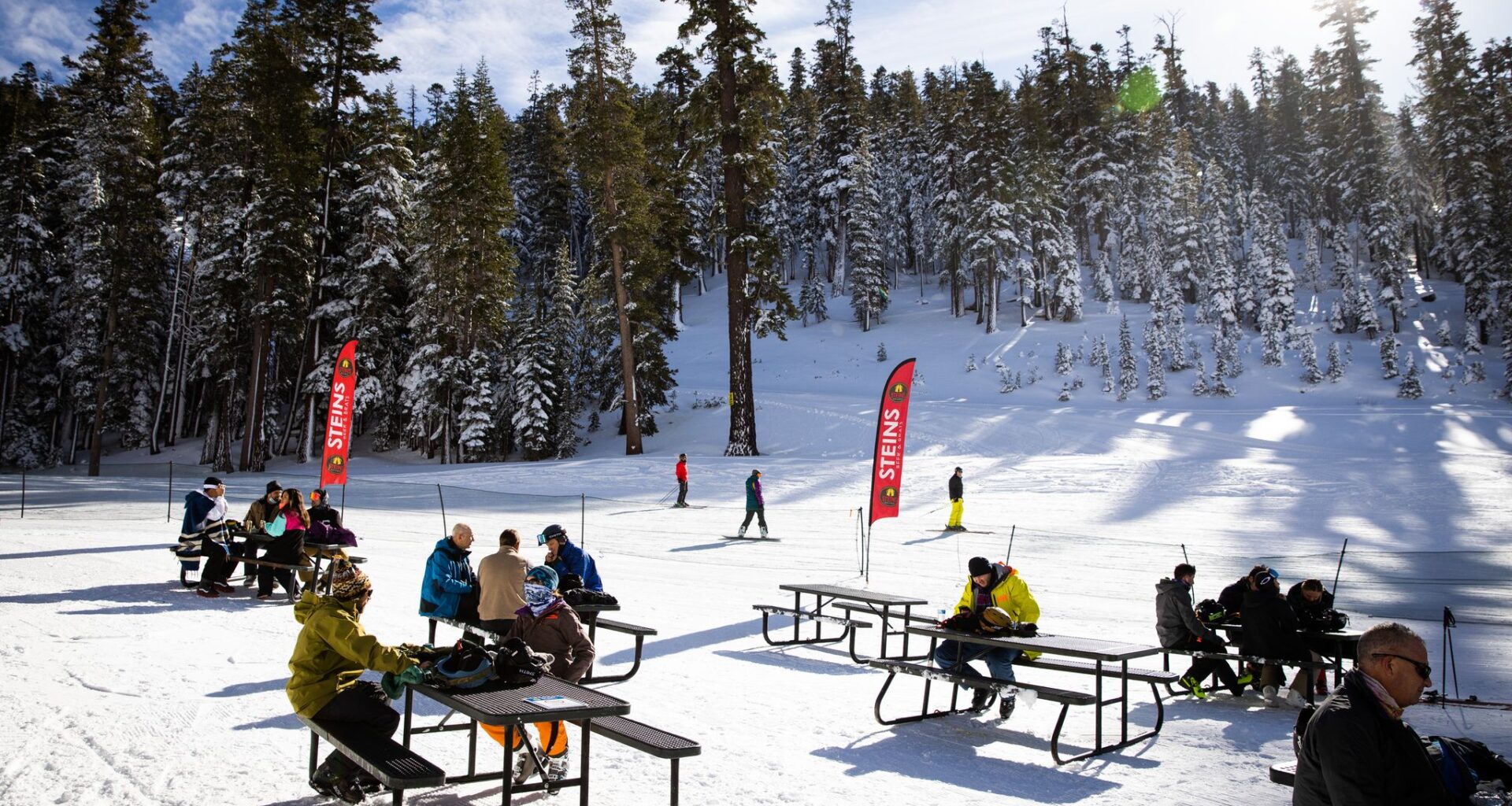
A 2020 file photo of skiers at a mid-mountain restaurant at Heavenly Mountain Resort in South Lake Tahoe.
Max Whittaker/SFC
A San Francisco family is suing one of Lake Tahoe’s premier ski areas over an incident stemming from a cup of hot chocolate.
Two winters ago, Brittany Burns and Joshua Moran Burns brought their 5-year-old daughter to Heavenly Mountain Resort in South Lake Tahoe for a day of skiing, according to a lawsuit filed in El Dorado County Superior Court. During a break at the resort’s mid-mountain Sky Deck cafe, an outdoor patio where skiers pick up snacks and drinks from a take-out window, Brittany Burns ordered her child a hot chocolate.
After filling a to-go cup with the beverage, the cashier sprayed whip cream on top and slid the drink, without a lid, across the window counter “directly to the minor,” the lawsuit alleges. The young girl picked it up and “attempted to drink it” but it was too hot and she ended up “spilling the hot chocolate beverage inside her ski suit” which trapped the liquid against her body and scalded her, according to the complaint.
Article continues below this ad
“She suffered bad burns down her chest and abdomen,” said Roger Dreyer, a personal injury attorney in Sacramento representing the Burns family. “Now she has permanent scars.”
The Burnses claim the drink was served at an “excessively and unnecessarily hot temperature.” While the complaint doesn’t speculate on the degree of temperature, it characterizes it as “far too hot for consumption and dangerous, especially to minors.”
San Francisco Chronicle Logo
Make us a Preferred Source to get more of our news when you search.
Add Preferred Source
In their complaint, the family seeks to demonstrate that Heavenly and its service workers were negligent and “knew and should have known that such hot beverages posed a great hazard of causing just this type of incident and injuries, including burns and/or other related injuries.” Serving such a hot beverage to a child constitutes conduct that was “known, intentional, malicious, and without due care for the likelihood of injury,” according to the lawsuit.
The family is seeking recompense for a host of damages, including medical expenses, “past and future income and/or earning capacity loss,” “past and future physical and mental suffering,” and “loss of enjoyment in life.”
Article continues below this ad
Vail Resorts, which owns Heavenly, declined to comment for this article, saying it doesn’t discuss pending litigation.
Ski areas are often targets for personal injury lawsuits, but those claims typically stem from incidents in which guests get hurt while actively skiing or snowboarding — colliding with a chairlift tower or falling while loading onto a chairlift or being pummeled by an inbounds avalanche. In pursuing those claims, the aggrieved generally try to prove a resort demonstrated gross negligence by contributing in some significant way to their mishap.
In California, attorneys say, those cases often aren’t successful because ski areas warn people about inherent risks in their liability waivers.
This case is different, Dreyer said.
“You’re assuming the risk of skiing — okay,” he said. “But you’re not assuming they’ll cook the hot chocolate to a temperature that’s not consumable to a human being.”
Article continues below this ad
The Heavenly hot chocolate claim echoes other hot beverage lawsuits in California and elsewhere, some of which were successful.
Last year, a jury ordered Starbucks to pay $50 million in damages after a delivery driver in Los Angeles sustained severe burns from a cup of hot coffee passed to him through a drive-thru window. It was determined that a Starbucks worker failed to properly secure its lid.
Then there is the infamous 1994 McDonald’s hot coffee lawsuit in which an older woman in Albuquerque suffered third-degree burns after spilling a cup of scalding-hot coffee in her lap. A jury awarded her $2.86 million in damages, a sum that was later reduced by a judge to $640,000.
“The Starbucks and McDonald’s cases share a concerning theme — preventable accidents caused by inadequate safety measures,” a Midwestern personal injury law office wrote in an analysis of the hot beverage claims. “Both lawsuits emphasize the responsibility companies have in ensuring their products and services don’t harm customers.”
Article continues below this ad
Dreyer said that, in addition to pursuing damages for the Burnses, he hopes the case causes ski areas to improve their service standards.
The case is set to go to a trial next winter.