

San Diego County military veterans are split over President Donald Trump’s decision to go to war with Iran, expressing mixed views about whether the fight was necessary and concerns that it could lead to a long ground war that could kill many Americans and compel Iranian terrorists to attack U.S. cities.
The schism surfaced in interviews the Union-Tribune did with nearly 30 veterans representing the Navy, Marines, Army and Air Force, men and women whose ages ranged from the early 30s to early 80s. Many had served in major conflicts, mostly between the latter years of the Vietnam War and the end of the war in Afghanistan.
The discussions were done in person, by phone and through email exchanges in a county that is home to roughly 115,000 active-duty service members and 230,000 veterans.
It is a deeply local moment for many. The San Diego-based USS Abraham Lincoln carrier strike group has been launching air attacks against Iran since the war began on Feb. 28. Marines at Camp Pendleton are preparing for the possibility of being sent to the Middle East.
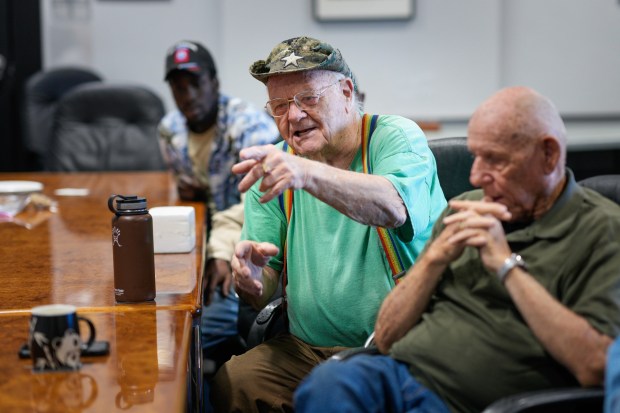 Jerry Smith of San Diego served in the U.S. Navy. Smith was among the military veterans who met at the San Diego Air & Space Museum for a discussion on the war unfolding in Iran. (Nelvin C. Cepeda / The San Diego Union-Tribune)
“The attack needed to be done,” said Jerry Kidrick, a retired Army aviator from El Cajon who served in the war against Iraq. “Since 1979, when the American hostages were taken and the death-to-America campaign started, Iran was essentially at war with the U.S.
“If it comes to a time when U.S. forces are needed to assist Iranians who want a different regime, there will need to be boots on the ground,” he said. “And those boots will be filled by the U.S. Army.”
Phil Kendro, a retired Marine fighter pilot from Rancho Bernardo, said, “For those of us who served in Iraq and across the Middle East, this is not just policy debate, it is personal. Many American service members were killed or wounded by weapons supplied by Iranian forces and their proxies.
“For Iraq War veterans and the families of those who never came home, holding those responsible accountable may finally offer a measure of closure for our brothers and sisters we lost.”
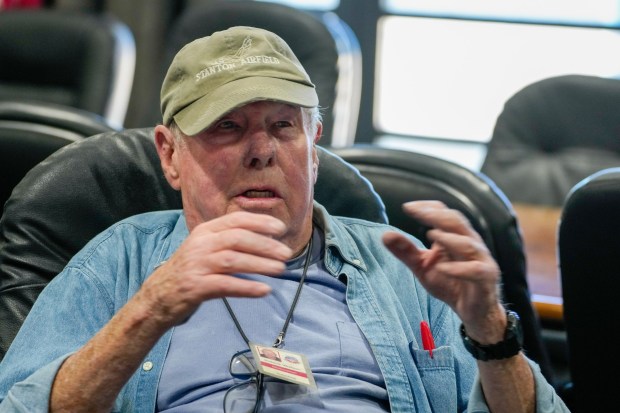 Patrick Watson of San Diego served in the U.S. Air Force. Watson was among the military veterans who met at the San Diego Air & Space Museum for a discussion on the war unfolding in Iran. (Nelvin C. Cepeda / The San Diego Union-Tribune)
His view is shared by Pat O’Donohoe of San Diego, a retired Navy flight officer whose son, Army Spc. Justin O’Donohoe, was killed during the war in Afghanistan in 2006.
“The fact that Iranians brag that they have enough (uranium) for 11 atomic bombs is enough for me to say, ‘You are not a stable regime,”’ O’Donohoe said. “You are not anybody’s friend.”
That viewpoint doesn’t sit well with Dan Jackson, a retired Marine fighter pilot from Escondido.
“This ‘war’ with Iran is a monumental mistake, and it reeks of distraction from the Epstein files and a disastrous domestic policy,” Jackson said.
“The war was decided unilaterally by Trump without congressional approval or advance notice,” he added. “It is an affront to our Constitution.”
 Stephan Puryear, of Bonita, served in the U.S. Marines. Puryear was one of the military veterans who gathered at the San Diego Air & Space Museum to discuss the ongoing war in Iran. (Nelvin C. Cepeda / The San Diego Union-Tribune)
San Diego’s Gary Gutterfield, an Army infantryman during the Vietnam War, said, “Once again our politicians want us to engage in a war with unclear goals brought about by under-qualified diplomats who seem to have their own selfish goals in mind.”
Faith Klinger sees hypocrisy in the decision to go to war.
“What right do we have to tell Iran to rid themselves of weapons we will not rid ourselves of …” said Klinger, a San Diego veteran who handled ordnance for a Marine air attack squadron. “Better yet, have we asked our people if we should maintain a presence in the sovereign territory of a country who is not even our geographical neighbor?”
There is also disagreement among veterans over Trump’s evolving war plan for Iran. Some think the plan is clear and well thought out. Others think it is fuzzy and hard to follow.
“We like to know everything, and this suppression of Iran’s effort is no different,” said Jim Kidrick, a retired Navy fighter pilot from San Diego and brother of Jerry Kidrick.
“Unfortunately, because of confidentiality associated with sensitive operations and targeting/tactics, not everything can be revealed, especially when information could endanger our forces,” he said. “And, we fully expect things to change; it’s the unpredictability of combat.”
O’Donohoe said, “We don’t need the secret details,” but added, “We do have to articulate a consistent and coherent plan. And that is the job of the president. … He’s saying something different every day. It tells me that someone didn’t sit down with him and say, ‘This is the message.’”
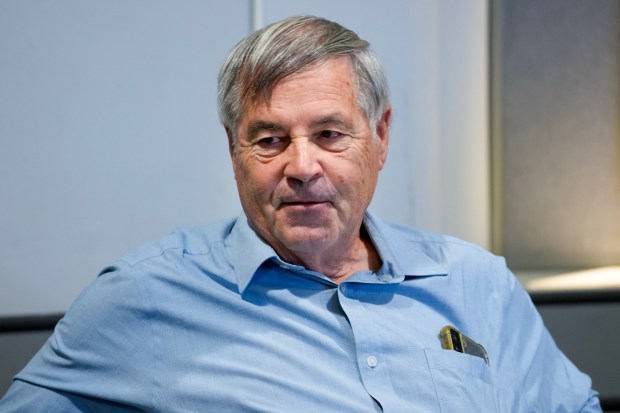 Roger Bisson of El Cajon served in the U.S. Air Force as a pilot and a physician. Bisson was among the military veterans who met at the San Diego Air & Space Museum for a discussion on the war unfolding in Iran. (Nelvin C. Cepeda / The San Diego Union-Tribune)
Roger Bisson, a retired Air Force pilot and flight surgeon, is also frustrated.
“The plan was we’re going to have a three- or four-week war,” Bisson said. “Maybe it’s going to be 10 or 12 weeks. Maybe it’s going to be two years. … We went in there without a plan of what the end game is going to be.”
The possibility that the U.S. will send ground troops into Iran stirs even more concern.
Trump has said he doesn’t want to pursue that option. But last week, he approved sending the amphibious assault ship USS Tripoli, which was based in San Diego until last year, to the Middle East, possibly accompanied by two other warships. They would deliver about 2,500 U.S. Marines who are based in Japan.
The order came about a month after San Diego’s USS Boxer Amphibious Ready Group, which is composed of three ships, finished key training that will enable it to deploy Camp Pendleton Marines to the Middle East, if they are needed.
“It’s going to be a long, drawn-out (war),” said Harold Lamb, a retired Navy flight officer from San Diego. “And in the meantime, a lot of people are going to die. Not just Americans, but the entire area is going to be in a real war. I’m worried about World War III.”
There are also worries that Iran or its sympathizers could launch terrorist attacks in the U.S. The FBI recently notified law enforcement agencies in California, as well as military bases that included Camp Pendleton, that Iran “aspired” to fire ship-borne drones at the West Coast.
“Before you know it, there’s going to be, I believe, a 9/11-style attack (on the U.S.) that’s going to draw us even further into this mess,” said Seke Snoh of San Diego, who worked on electronic warfare when he was in the Army.
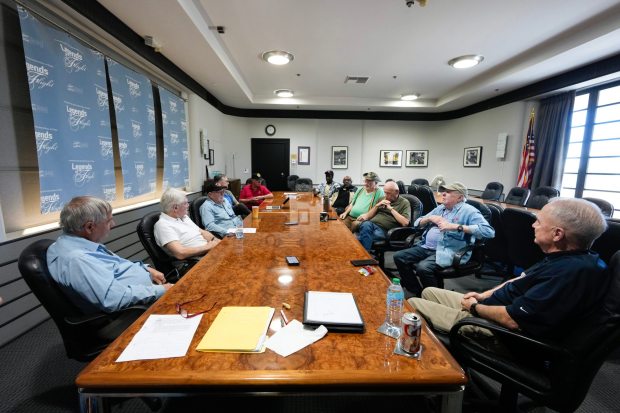 A small group of military veterans gathered at the San Diego Air & Space Museum for a discussion on the war unfolding in Iran. (Nelvin C. Cepeda / The San Diego Union-Tribune)
Jody Hansen, a retired Marine helicopter pilot from Valley Center, said, “Will the war continue? I say it won’t because there’s no reason for the war and there’s certainly no end-game … I believe someone in the White House will simply say we won at some point when the economic pressures get (to be) too much. I hope that it does not turn out that way.”
Lamb isn’t so sure of this.
“We could declare victory, but Iran has said they want to stay in,” Lamb said. “It takes two sides to stop a war.”