
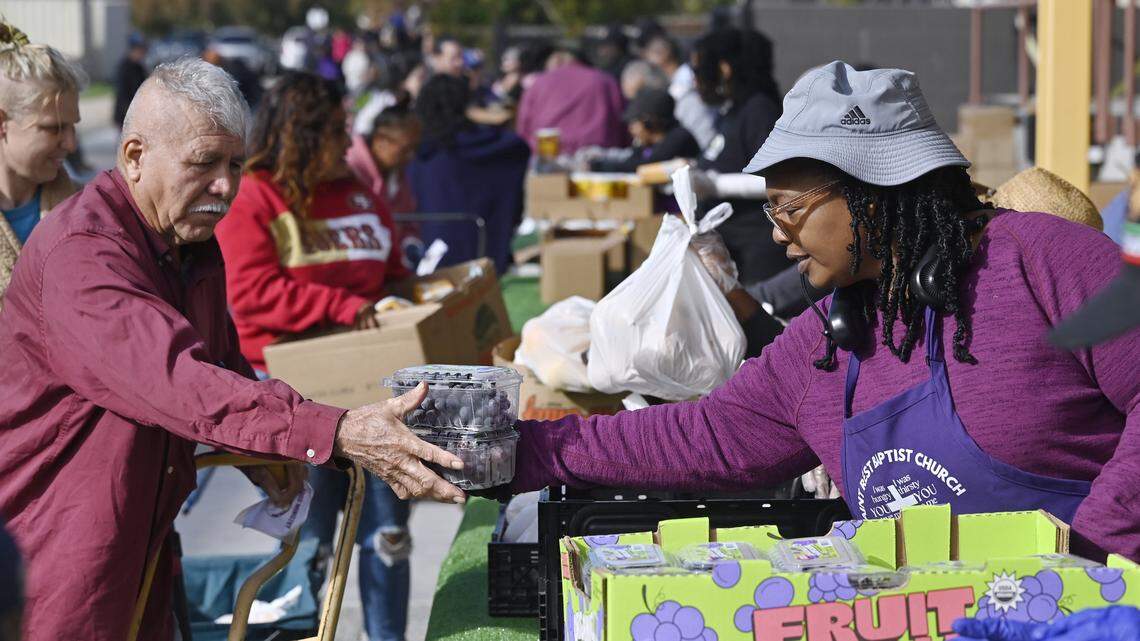
Food provided by the Central California Food Bank is distributed at Saint Rest Baptist Church Thursday, Nov. 6, 2025 in West Fresno, as federal benefits were limited due to an ongoing government shutdown. Cuts to this federal program will stress the safety net system.
ERIC PAUL ZAMORA
ezamora@fresnobee.com
The 43-day federal shutdown in late 2025 showed potential weaknesses in the food safety net in Sacramento and throughout the state as more residents here and throughout the nation will soon lose access to a key federal program.
For a state that produces nearly half the nation’s fruits and vegetables, more than one in five California households face food insecurity. Even more alarming, among households with children, it’s one in four.
The federal shutdown last year impacted funds flowing into the Supplemental Nutrition Assistance Program (SNAP), program, resulting in a loss of benefits for low-income residents throughout the country. Data collected during last fall’s federal government shutdown and resulting SNAP benefits delay provided a glimpse into this dramatic surge in need.
In California, our SNAP program is known as CalFresh. Weekly calls to California’s 2-1-1 hotline from people seeking emergency food increased five-fold. Food banks across the state reported serving record numbers of households — often higher than during the peak of the COVID pandemic. And the millions of households on SNAP grappled with the uncertainty of when — if ever — they would receive their food benefits.
Food banks serve as the hands behind the SNAP safety net. The banks are there to catch people who fall through the cracks of the government-led service systems. For every meal a food bank provides, SNAP provides nine, supporting nearly 5.3 million Californians each month.
The California Association of Food Banks represents 43 food banks and nearly 6,000 partner agencies that help millions of Californians put food on the table every month. Looking ahead, 2026 promises a perfect storm of increasing food costs paired with severe cuts in federal funding. To ensure food banks can continue to meet the growing need, the state needs to learn from the recent past and prioritize bold solutions.
In the state capital, traffic to Sacramento Food Bank & Family Services’ online food locator rose by 330% during the shutdown. And, in October, the Sacramento Food Bank & Family Services and their countywide network served 372,728 individuals, a 12% increase over September and the largest month ever in the organization’s 50-year history.
Researchers from the University of California visited food distribution sites throughout California around this time and reported long lines, often forming before 6 a.m., along with a sense of heightened anxiety resulting from weeks of shutdown disruptions, rising food costs and, for some, recent activities targeting immigrants.
Yet everybody was served with compassion — nobody was turned away.
The charitable food system rose to meet this most recent short-term crisis, with food banks on the front lines supplying food, volunteers stepping in to serve their neighbors, state leaders acting decisively to provide additional funding to meet the need, and the governor moving swiftly to minimize the impact. It was a story of California at its best, taking care of its own.
California has yet to see full impact of food cuts
Unfortunately, we know there are even more rocky times ahead. H.R. 1 (the Big Beautiful Bill), which President Donald Trump signed into law on July 4, has slashed funding for SNAP. We have yet to see the full impact of these cuts, but we will soon.
Beginning April 1, 72,000 humanitarian immigrants in California will become ineligible for SNAP. Two months later, nearly 950,000 people aged 18-64 without dependent children will be subject to strict time limits, subject to losing basic food assistance if they do not meet the exemption criteria or cannot prove they are working or volunteering 20 hours every week. Many of these households will go hungry, making the process of finding work harder, not easier.
Together, these harmful policy changes represent the largest cut to SNAP in the program’s history. Food banks won’t be able to solve this alone, but they can help communities weather the storm.
The state must bolster the emergency food system by adequately funding the CalFood program, which food banks use to purchase California grown foods for pennies on the pound. The state should guarantee baseline funding of $60 million per year, over multiple years. This will allow food banks to better budget for anticipated spikes in need. An additional $50 million in one-time funding would help those cut off SNAP due to H.R. 1.
The SNAP delay in November was a stress test for our state’s emergency food system. Food banks, state leaders, and communities stood together and held strong. In 2026, we need to carry forward that spirit of Californians taking care of each other. No one should go hungry in the great state we all call home.
Stacia Hill Levenfeld is CEO of the California Association of Food Banks, which represents 43 food banks serving communities across California. Blake Young is president and CEO of Sacramento Food Bank & Family Services.
Related Stories from Sacramento Bee