
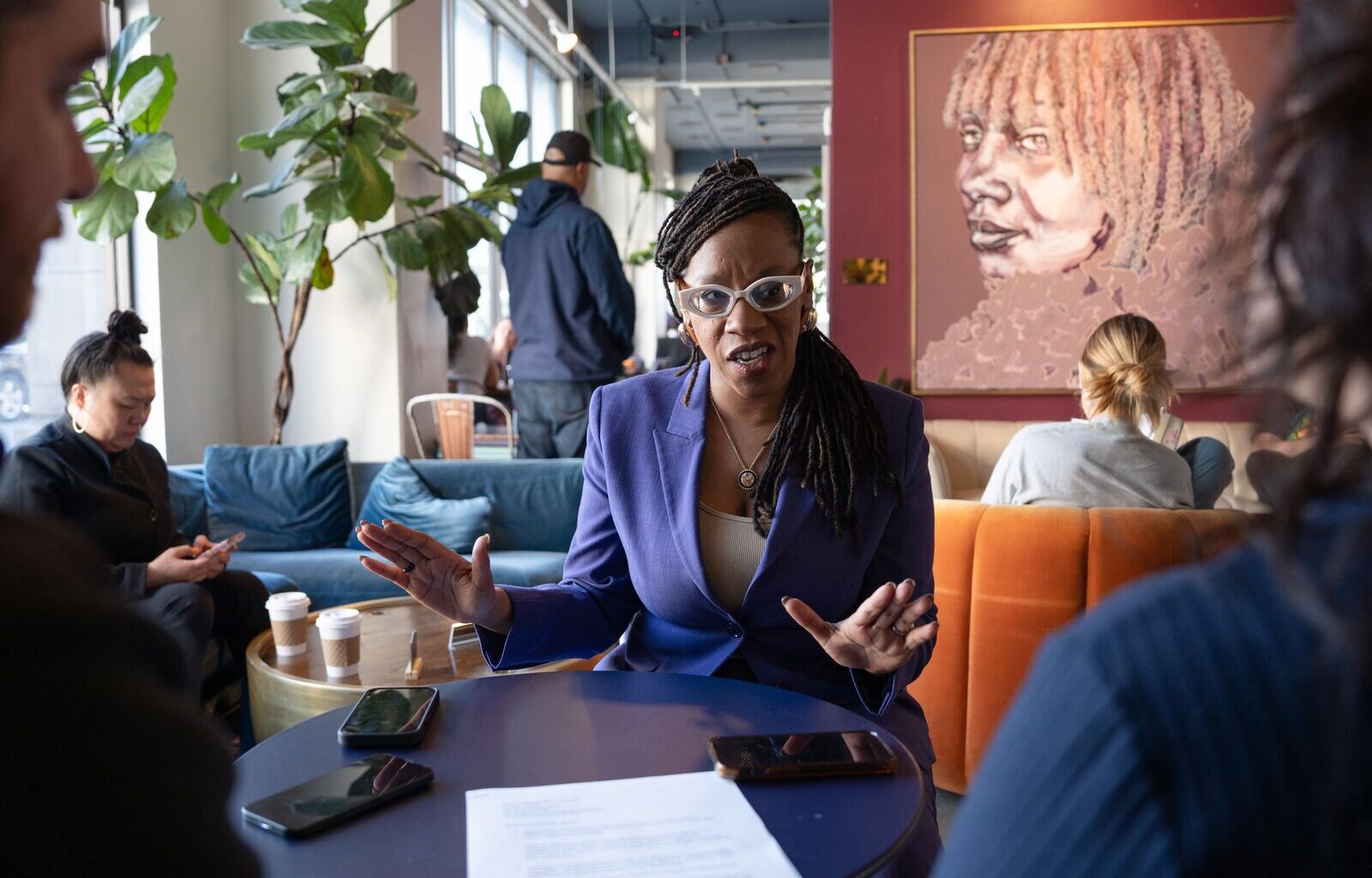
When Lateefah Simon was sworn in to represent the East Bay in Congress last year, she entered a political maelstrom that hasn’t stopped for a second.
Simon was inaugurated the same month as Donald Trump, who marked his return to power by embarking on a massive deportation campaign targeting Democratic strongholds, and alienating the country’s allies with stiff tariffs. Trump slashed funding for critical food and healthcare services in California, attacked universities, launched military strikes, and, most recently, embarked on a war against Iran. Democratic Party leadership has been criticized by some as ineffective in the face of this radical agenda.
Simon is part of a small but vocal coalition in Congress that has spent more than a year pushing the Democrats to take bigger, bolder stances against Trump. She told The Oaklandside that, unlike some of her colleagues, she’s not chasing TV appearances. Rather, Simon said she is focused on passing legislation to advance the health and well-being of her constituents in Oakland, Berkeley, San Leandro, Emeryville, and Albany.
To learn more, The Oaklandside sat down with Simon last week at Kinfolx. The following interview has been edited for clarity and length.
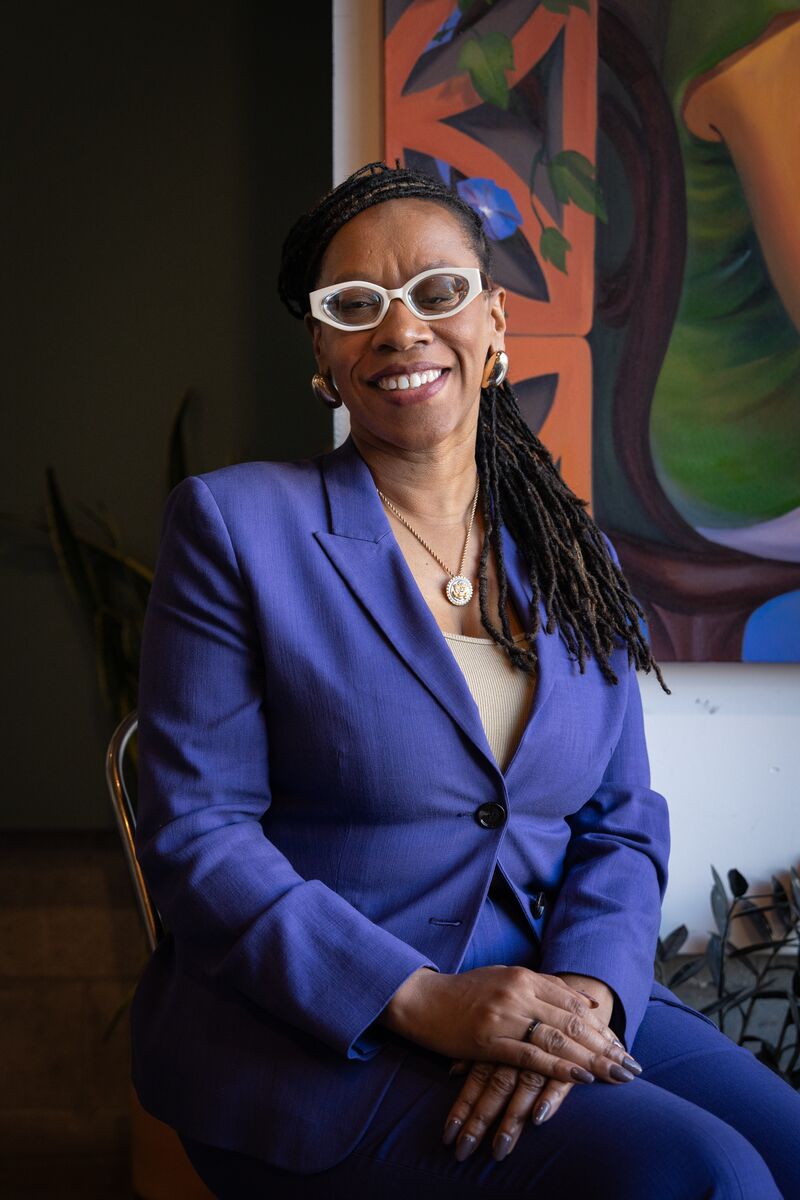 Rep. Lateefah Simon at Kinfolx in Oakland on March 11, 2026. Credit: Sarahbeth Maney for The Oaklandside
Rep. Lateefah Simon on the issues
Democrats are widely expected to take back the House in the midterm elections. Assuming that you do, what should the House accomplish over the next two years? What will your priorities be?
Lateefah Simon: Well, we’ve got to get there. I don’t think it should be a foregone conclusion.
I’m actually spending most of the summer campaigning for candidates all over California and other parts of the country.
I’ve been in Congress for almost a year and a half. Every day that we’re on the floor, there’s some crazy legislation that is in front of us, and we typically lose by four to five votes. When the first iteration of the “big, ugly bill” came to the floor, we lost by one vote before it went to the Senate. It was at that point that I really understood that I am serving in one of the most consequential times in American history.
When we take back the House, leadership needs to make a commitment to be as audacious as our foes and begin to redirect the shame and the sham brought forth by the Trump administration.
We’re not going to get presidential approval, but we’re going to have to challenge this Medicaid and Medicare disaster. That, to me, is one of the largest crises. During the shutdown, second-stage clinical trials were canceled all over the country. So you’re talking about children with lymphoma and leukemia, and a second-stage trial, being sent home to die. The healthcare justice framework that I’ve been obsessed with, it’s both personal and very political to me.
We’re going to have to really be on a road to committing to the American people that when they need a doctor, they will get one. I am very much a proponent of Medicare for all. I understand from all pragmatic sensibilities that may not happen in our lifetime, but courageous Democrats need to be pushing towards care for all, for every single person in this country, regardless of their status. If you step on U.S. soil and you are ill, you should be able to see someone who is going to make you better.
Should we win — which we will win — election protection is also on my mind.
It’s extremely important that we are setting up the framework for 2028 to rebuild government institutions that have been torn down to their studs.
When I was an 18-year-old activist, I wasn’t necessarily thinking about what would happen if we lost the Department of Education. I wouldn’t think about that, and I shouldn’t have to as somebody who was in high school, legally blind. I always had a vision aid in high school, middle school, and elementary school. Those were standards that K-12 in California didn’t create, those were federal standards.
When I worked on the issue of sexual assault and young women, from those who are working on the streets to those who are working and studying at Berkeley, I knew who I could call to investigate their trafficking or their assaults. For college students, that is the Office of Civil Rights under the Department of Education.
We do need institutions that put in place safeguards. The last 62 years of civil rights, Title IX, desegregation, within a year and a half, the institutions upholding these hard-won fights are almost dead.
Unfortunately, I don’t see this in the next two years, or even the next four, when we win the presidency back. We’re not going to be able to radically change the living conditions or the material conditions of people because they ripped things down so quickly. What we will have to do is audaciously govern. What that means is, don’t worry about poll numbers. It means asking, what’s right? What’s the right thing to do? How do we protect our young people, our elders, and our sick?
I’m excited to be a very new member of Congress when we take back the House, but I’ve been pretty loud on the floor, hoping to be a part of that change.
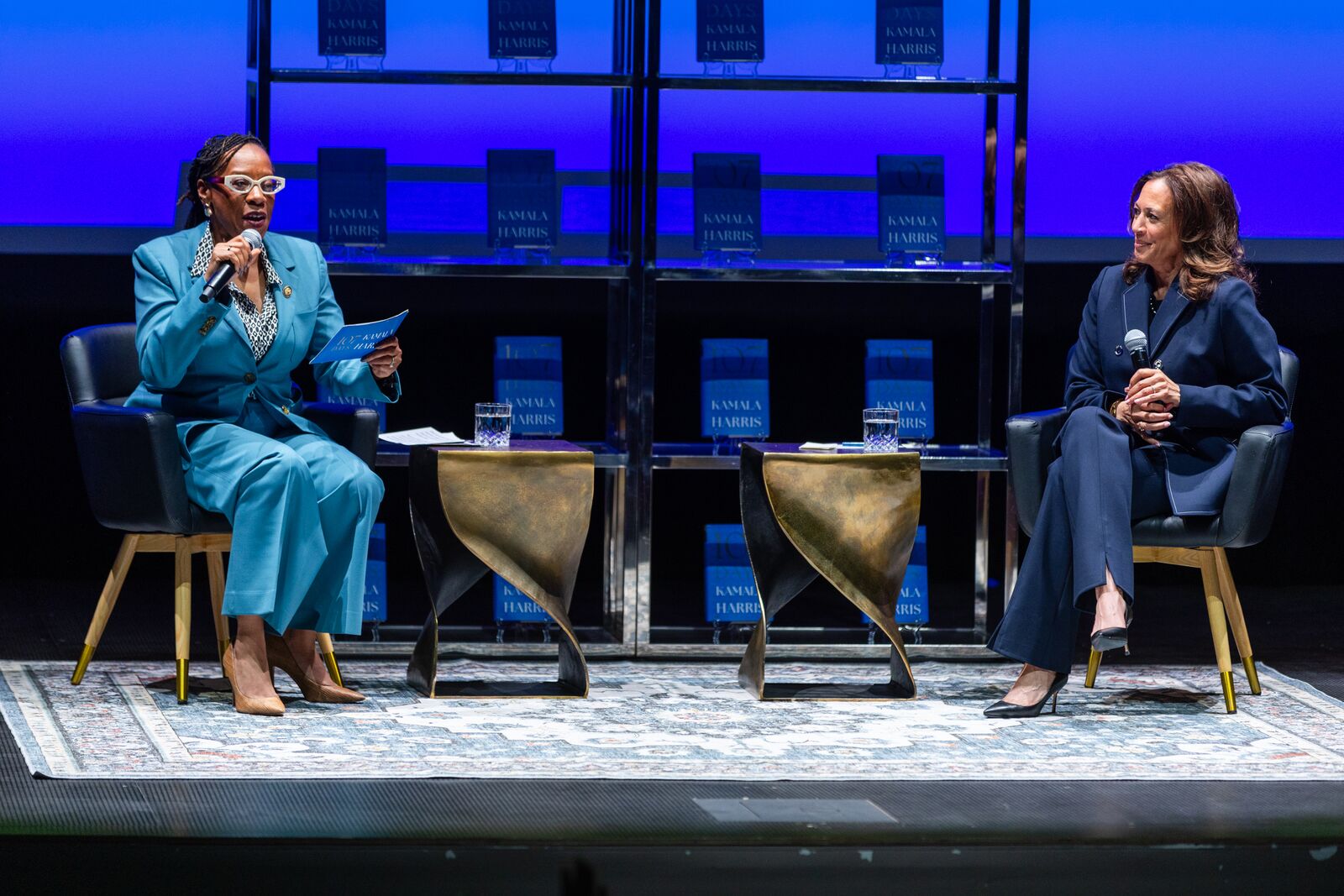 Rep. Lateefah Simon talking with former vice president Kamala Harris on March 3, 2026. Credit: Estefany Gonzalez for The Oaklandside
There have been many cuts to SNAP funding, reproductive health, Medicare, homelessness, and medical research. Do you have a priority list for what you would like to see restored?
LS: Everybody has a priority list in Congress. I was taught by very smart politicians to be myopic and do more. Health care justice is really important to me, and being an ally for disabled people, for elderly folks, for folks who are sick. That’s really a space where I’m carving out who I am in Congress.
Children’s Hospital, we just got them a million dollars for their sickle cell lab. There was a threat of that being taken away. We helped to get $40 million back to the CRISPR lab over at UC Berkeley.
I thought I was going to be on the Transportation and Infrastructure Committee. I’m BART, all day, all the time. I didn’t get on that committee. And yet, I’m still moving legislation in that space.
I would like to leave Congress in a decade or so, knowing that I was a part of creating a United States where we actually took care seriously. My husband [Kevin Weston] died of a very rare disease, and it’s been 11 years, and I still sometimes wake up in tears, not just from watching him die and raising his child and being bankrupt after — literally bankrupt — we had nothing left. I had insurance, and we still ended up with nothing. I just got off the bankruptcy rolls a year and a half ago.
I have an amazing community. My eldest daughter went to law school, and my little one is a super smart theater kid. We survived because of community, not the social structures that were supposed to keep us strong, but that is a disaster. And the people that I’ve met along the way, other cancer moms and cancer-wise folks who survived.
I want little kids to grow old. And I want old people to be able to live with dignity. And I also want to be an effective legislator. That is the gig, to be a part of the body to move important work forward.
Being on that floor and watching the OGs, like Nancy Pelosi — I used to consider her a super centrist, but I see her working with those five-inch heels every single day, moving people to push a discharge position or fighting. You can see her yelling on the floor on the other side; she’s not even the minority leader, and she understands that the work is really about organizing folks. I’m fascinated by what that kind of governance looks like. It’s not just voting. It’s not just organizing back at home, not just setting up world-class constituency services. To me, it’s moving a party forward that is in desperate need of folks who know how to manage and organize and who want to see people live longer and live better.
Polls show that on a lot of major issues like abolishing ICE, and opposing military aid to Israel, the Democratic base is to the left of the party leadership. How will you and other progressives push party leadership leading up to the midterms and after, to get ahead on these issues and get where the base is?
LS: My training and my experience tells me members of Congress won’t do that. The people will — and they have.
Within the last six months, we’ve seen members of Congress who were very supportive in their careers of military action by Israel, supportive of Israel’s military ecosystem that we fund, folks are walking that back. That’s because real people in real communities are connecting the dots every minute, every hour, on what is not happening, and where we are prioritizing our dollars and our time. In my district, 8,000 people still sleep on the streets every single night, and for every 2,000-pound bomb, we are making a choice.
I believe that there is a huge shift happening. I really want to start a human rights caucus. We don’t have one in Congress.
There is no facilitated anti-war flank. There’s “The Squad” and other progressive members. (I’m not a squad member. I am a little older than those sisters. I’m a grandmother, but I sit with them. Those are my very close friends, and we pretty much vote consistently together.) But Democrats haven’t yet created a formal institution inside Congress that says we will hold the Pentagon accountable. The Pentagon has, by the way, failed its last eight audits. There’s a trillion dollars unaccounted for. There are multi-millionaires and billionaires who are contractors, who have gotten rich off the complacency of both parties in our addiction to the war economy.
I think the people — not just groups like the Indivisible Movement or ACLU — it’s the grandmas on Saturday by the lake with those little signs and their Birkenstocks, it’s that kind of movement that is shifting and facilitating to demand something different.
Folks will lose elections if they are war mongers. Folks will lose elections if they don’t stand up for queer children.
Remember, the polling said at the beginning of this Congress, don’t talk about immigration. Now, every single Democrat is talking about this administration’s vile betrayal of our Constitution and centering the rights of immigrant folks.
Our biblical principles — your Torah, Bible, Quran — are all intricately linked in how they talk about the foreigner. The faith community is holding it down. White Midwesterners are emerging as a force: they’re going to demand more of Democrats, not just the Republicans we’ve given up on.
Democrats, as with Republicans, have a long way to go, and it has everything to do with money in politics. But also, they have to, like a snake, shed their addiction to the old ways of doing things. We do not have to govern an empire that is addicted to the loss of lives all over the country to show our might.
What’s your position on the war against Iran that the Trump administration and Israel have launched?
LS: What you’ll hear from any Democrat at this point — well, except for four — is that this is a war that we should not have gone into with Israel. That’s the party line.
For me, as with any situation where we are choosing bombs over full bellies, it’s been important for me to understand from a very deep place the Iranian diaspora. Because it’s not simple.
War, to me, is simple. Absolutely no war. We should not be going into World War Three, particularly over oil. We’ve always been clear that the lies that we talk about liberating countries, we don’t really care about that. We care about the resource. We care about our relationship to Israel and its vengeance on Iran. And we also do care about nuclear weapons.
I don’t know if this administration cared at all about the Ayatollah and the Iranian government’s real devastation to protesters in the streets. While there haven’t been thousands dead here, we have jailed and deported folks here who have lifted their voices for protesting in our streets, we too, have a lot to atone for.
I don’t believe that this war has been about liberating folks in Tehran. It’s not about that. In Venezuela, it wasn’t about a liberation from a horrible leader. It’s been about land. That’s not conspiratorial, that’s a fact. It’s about oil and resources. So I am against this war.
We get hundreds of calls a day in my office. Iranian folks have asked to speak with me in terms of their understanding and their support and or condemnation. And I have been, night and day. So I represent people, not just an ideology.
To achieve a free Iran, a free Cuba, a free Venezuela, for Sudan, a Free Gaza: diplomacy should be our best tool. We are not using it. We also need to understand that Iran has been under siege by a horrible, horrible regime for too long.
That being said, you can’t have the United States enter into any kind of relationship where our service members will die, where we’re spending a billion dollars a day, and not consult a dual level of government. That is why we’re there. I’m gonna say and vote no to war. The disrespect, the violation of the Constitution, that’s why I voted no on the resolution saying that Iran is the worst terrorist state in the world. It’s kind of already U.S. policy. We’ve already said that as the three equal bodies, I think we can all agree, Iran has done horrible things to its citizens and its neighbors.
I learned about the U.S. and Israel’s strikes in the same morning when you all did. The briefings that we get are theater.
I have tried to do the very hard work of being a real listener to folks who do not have my politics in this district. As a legislator, I’m learning more and more that it’s about listening and seeing and trying to deeply understand. So I’ve gone to Shabbat dinners with folks who have said, “Lateefah, we believed in you until you came out against Israel’s position on this war.” I may never get their trust back, but I sure as hell I’m going to listen.
But I’m not going to abandon who I am and why folks sent me to Congress to be an extension of what this seat has always stood for. That means understanding the Constitution and understanding our place in the human rights community, believing in the United Nations, and that rules and processes are there for a reason.
Being a bully will not serve us well. It won’t in the long run. What’s happening is creating an anti-Western sentiment far beyond what I think this administration understands, and that’s not good for us. It’s not good for the folks who are dying overseas either.
Oakland has been bracing for a major federal immigration operation since Trump took office again. What are you doing to fend that off, or to help local leaders prepare?
LS: I’m so proud of what’s happened in the last year and a half in terms of how our local electeds have come together. I’d particularly like to lift up Nikki Bas, who’s just been such a cornerstone leader on developing a coalition with NGOs. My office is on the ground level, we’re communicating with organizations, with families, and with our local electeds, around what we hear.
ICE has to talk to members of Congress. We ask them questions. They will let us know if there is an operation. They don’t give us a heads up, but they’ll certainly confirm, yes, we are in East Oakland. So we’re in consistent conversations with the federal government so that we can get information to our folks.
Has that helped? There are other communities across California that don’t have the same kind of ecosystem of legal support, like legal aid, advocacy, and mutual aid support that we’ve developed. I’m proud of the coalition here.
We’ve been working very closely with Children’s Hospital. We recently spoke with trauma surgeons about immigration issues and patient care and have me directly calling, talking and convincing parents to get their children’s medical needs taken care of. And that we will protect them, if they are facing these horrific challenges.
I’m one of the first African Americans in Congress to say there’s no reforming ICE. Unfortunately, most Democrats still believe we can reform tyranny. You have to tear it down. I said at a recent Oversight Committee hearing that it’s unfortunate now that some folks have had to die. There have been death camps in this country, ICE-facilitated camps. But 22 years ago, it was Democrats who created the agency because we wanted to appear tough on crime post 9-11. We didn’t do an autopsy of what happened and why 9-11 happened.
[Editor’s Note: Congress created the Department of Homeland Security and ICE in 2002 during the administration of Republican President George W. Bush.]
We wanted to appear tough, but communities across the country have been saying ICE was bad news since the very beginning: immigrant justice scholars have been saying that it was government overreach and there were already structures to deal with the fact that our immigration justice system was broken.
What makes me excited about this movement moving forward is if you look at the polling for how folks in this country thought about immigration and deportation at the beginning of the Trump administration, that has drastically changed, and not just in blue states. Folks are seeing their family members, their in-laws, and coworkers taken away.
This isn’t new. We have an amnesia problem in this country. What is happening now also happened when the Democrats were in power. We own that too. That’s our fault too. What are we doing? How are we implicating ourselves in other countries? I think that we have a lot to atone for as Democrats. Good governance is different than just having good ideological standpoints.
My hope is that when we take back the presidency, we end the operation once and for all of ICE.
I’m also not stupid. Every country has to have an immigration system that is efficacious. You do have to have a border policy. But how do you create the conditions where you don’t have hundreds of thousands of people escaping countries where we’re implicated? I mean, with USAID dismantled, can you imagine how much more forced migration is going to happen in the next 10 years because we have all but cut off foreign aid? We keep setting ourselves up.
We have to fix our immigration system here first. I think it’s really focusing on asylum, what that looks like, and how to protect the folks who are here who don’t have papers, moving them through a process.
Have you had any conversations with other members of Congress about immigration reform? And on the same topic, we’ve seen that other members of Congress have gotten the chance to visit detention centers. Have you visited any?
LS: The Northern California delegation, we will be visiting detention centers this summer. There are four that we’re thinking of going to.
The Dems have tried to put forth legislation. I think it should and will be stronger moving forward when hopefully we have some power.
In recent votes around reforming ICE to reopen the government, I voted no.
Body cameras? I think we’re way past that. We’re way past having conversations about how to improve ICE when its agents only have 47 days of training. The police department here they have 27 weeks of training. And even then, we’re still trying to get our police departments to do the right thing.
When we get some power, I’m going to advocate defunding ICE. There are about 10 of us in Congress who are very clear that this department is not worth the money that we’re spending on it.
Here’s the deal in Congress that I want you all to understand about what I’m trying to do. If I put a bill in the hopper, and it doesn’t have cosponsors, and it doesn’t have sign-offs from the ranking member for that committee on the Dem side, it doesn’t move. So you’ll find a lot of Reps, they’re just throwing bills in the hopper for messaging. You’re paying me to be in Congress. So every bill that I put out, they’re strong, and they have strong sponsorships. That’s because I take this obligation very seriously. I’m a legislator, not a messenger.
I’m hoping to be a champion for immigration reform in my time in Congress. And it will look different. Our systems will look different in the next decade.
In the meantime, we just have to look after our folks and be real and not gaslight them. It’s dangerous out here. I went to Minnesota, and I went up to a regular residential street where Ms. Good was murdered. We brought flowers to pay respect. There were about 150 white Christians, and it was hella cold. I’m from here, so it was like eight degrees. They were reciting the Lord’s Prayer over and over, and it shook me to my soul, because right is right and wrong is wrong.
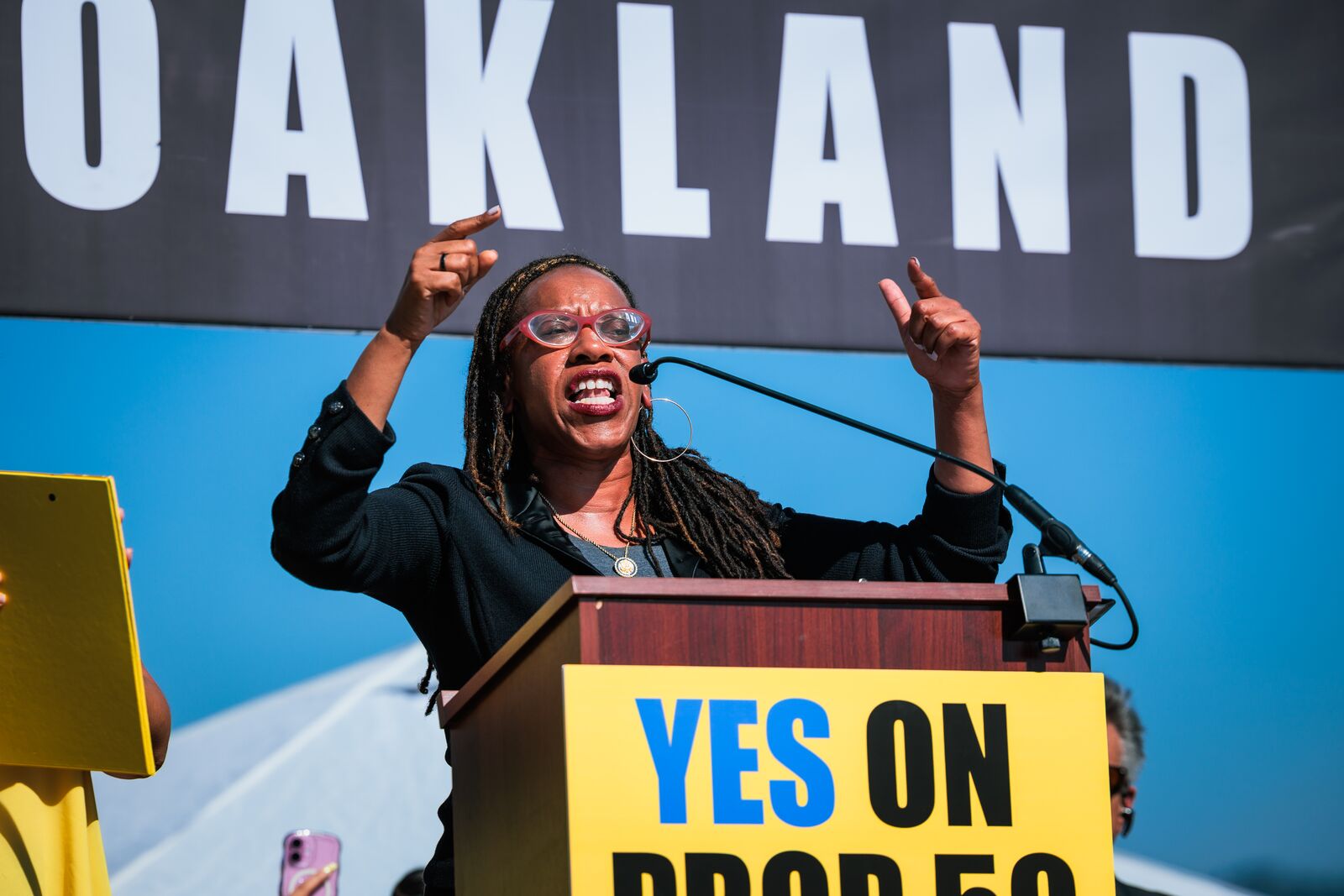 Oakland Congresswoman Lateefah Simon spoke at Oakland’s “No Kings Day” protest on Oct. 18, 2025. Credit: Richard. H. Grant for The Oaklandside
LS: I’m going to stand up for young people every opportunity I get. I walk around with Black skin. People have scapegoated Black people for years. People have scapegoated queer kids and queer people for years. People believe that folks with HIV should just die. It took courageous legislators to stand in the center of that to do the right thing. I have worked with so many transgender young people, particularly in the foster care and juvenile justice systems. I know how much resilience they have.
How dare Democrats or Republicans degrade children. But I think that that is just a consistent dehumanization of our children, of our young people, folks in our communities. I’ll never have polls or sentiment dictate how I communicate based on basic values, loving our folks.
Big tech, which includes the AI industry, has a huge influence on many Democratic leaders in the Bay Area. Do you see big tech as too powerful? Does it need to be reined in? If so, how do you see that happening? Do you support the California billionaires’ tax?
LS: I haven’t taken a position on the billionaire’s tax because I actually support a taxation system that is long-term with folks paying their fair share. I worry about the five-year cap, and I worry about the unrealized gains component of the billionaires’ tax proposal. I worry about it because oftentimes that money isn’t even there, and it’s not even real yet.
I think it’s important, if you have resources, you need to pay your fair share. And I want both the state and the feds to have a taxation system where poor people don’t pay a percentage higher than their millionaire and billionaire counterparts. I would love to see a long-term solution around tax equity. What the billionaire’s tax purports to do is to provide the state with a cushion, given the Medicare and Medicaid debacle. It’s federal and it’s short term.
My focus, as I talked about earlier, is going to be reversing this crazy “big, beautiful bill” that tears almost 17 million people away from Medicare and Medicaid.
Regarding tech being too powerful: every good sector needs a little regulation. There is a place in California for the best and the brightest in technology. That’s who we’ve been, and I feel like it’s where we need the axis of this industry to stay. Regulatory opportunities exist, particularly around child safety and war. For me, deep fakes in porn and trafficking, all connected to AI, are very scary.
I spent time at OpenAI and with the folks at Andreessen Horowitz and Anthropic. I’m very proud of Anthropic for taking the stand it did, to say we’re not going to create bots that just kill babies. We’re not going to do that.
I don’t think a smart politician in California, particularly in the Bay Area, can ignore tech. A smart politician also needs to be very honest. I’m on the Oversight Committee. I will be right there, calling into question how dangerous this technology can be and ensuring that there’s not only conversations but action protecting people.
We have to create safeguards. We know that China is not. So I understand the conundrum facing these tech providers. I think it’s important for the United States to set the standard across the world. And I do think that in our bodies, like the United Nations, which typically focuses on food and hunger, we need to be more focused on the fear we all have about an automated world.
You boycotted Trump’s State of the Union speech and gave your seat to Nola Brantley from MISSSEY, which is an anti-human trafficking group in Oakland. Can you talk a little bit about what you’re doing to prevent sex trafficking in the city? Are you in touch with federal agencies on enforcement efforts
LS: Some of the first work I ever did was in San Francisco with Kamala Harris, before she became DA. I was on a task force to stop the pattern and practice of arresting, charging, and incarcerating girls under the age of 18 who are being trafficked on the streets. We don’t really have a track or a blade in San Francisco to this day because of that work that we did. The Young Women’s Freedom Center that I helped create is still there. We provided a political home for young women who’ve been trafficked, not just to get straight and get out of the system and get off the streets, but to ask “who are we politically and how can we exert our power?”
I’ve been working very closely with the Epstein survivors. If we can’t get justice for those women, how are we going to get justice for those sisters on the track, on East 14th? To this day, it shocks me that folks will literally ride through that community and see girls as young as 12, and just keep riding and shake their heads, because they’re little Black and brown girls. Who are we? I’ve tried to address this problem from my work on BART, to my work in philanthropy, of funding movement groups who were not just trying to get girls out, but addressing some of the structural issues, like jobs, opportunities, and diversion programs for folks on both sides.
I’m working with Rep. Sydney Kamlager-Dove on this issue. She and I represent the two districts with the largest, what we call “blades” or “tracks,” in the country. She’s got the Figueroa Corridor, and my district includes E. 14th Street. Both our cities need more resources.
In Oakland, I’m working with Charlene Wang’s office. I’ve been really supportive of her work. I don’t want to touch anything where our girls are pathologized. I’ll support efforts where you can really shine a light on the johns who are selling these young sisters and also folks who are pimping them out.
I want to be clear: I’ve worked with enough girls to know that there are some young women who are using survival sex to live. We failed them because we have very few economic opportunities for girls who are surviving on the streets. I’ve never been convinced that just a complete abstinence-only model works. I don’t want girls to be out there on the streets. But I also know that you could have a girl who’s filled out 30 applications for jobs and she’s not going to get hired. We have to figure out real economic opportunities for our girls. But we also need to be very clear that folks who are plying and selling them need to be held to account. I’m going to continue doing the work here, working and organizing with young women.
Kamlager-Dove and I will be figuring out how to bring some more DOJ resources to district attorney offices all over the country for victim advocates to be able to support young women getting places to live and leaving their pimps. You can’t just arrest the pimp. So lots to do there.
UC Berkeley is in your district. While some other universities, like Harvard, have more aggressively defended themselves against Trump’s attacks on higher education, the UC has sought to negotiate with Trump. Do you think the UC’s strategy is working? How should academic freedom and research be protected?
LS: I am of the mindset that if we capitulate with the administration, you’ll find out really quickly that they’re not acting in good faith.
My hope is that UC will be the beacon of light in this country, and go hard and stand up. Their endowments are large. They have some of the best legal minds. I think that there were universities like the UC system that tried, in good faith, to negotiate. My hope is that they go harder. I was disappointed when names were provided to the federal government of protesters.
I feel like our students are at risk, our Jewish students, our Muslim students, and our intellectual freedoms. While we have to fight true antisemitism and Islamophobia, it’s extremely important for universities to be the sites of anti-war deliberation and conversation. The sort of the provocative nature of this war changed how protests happen in this country. I think we have to applaud young people for being very concerned about their neighbors.
So, yeah, UC needs to go harder.
Ok, lightning round. Name your three favorite spots in Oakland and Berkeley
LS: I don’t really have a lot of hobbies. I’ve always had two or three jobs. This is the first time I’ve only had one job. So I spend time with friends when I can. And of course, my kids. We like to go out to eat.
I really like Jaji, which is an Afghan restaurant. The other place I take friends a lot is Cafe Eritrea on 40th and Telegraph.
I was going to say Lake Temescal, but that’s not Berkeley. I want to say, because I like to cook, the Berkeley Bowl.
You know why? Because in DC, tomatoes don’t taste the same. Food doesn’t taste the same. The food is better here. The culture is better here. I know what taco trucks to go to and the ones not to go to here.
So I spend most of my time with friends around food. I’m a Bay Area girl, so I like it all. The pupuserias, the amazing dim sum in Chinatown. I don’t have three favorite spots.
Any food trucks? Or taco trucks?
LS: I don’t even know the name of it, but I’ve been going to it for 15 years. It’s the taco truck by the flower shop, right by the BART headquarters. It’s so delicious. And it’s a red truck. They have a corn tortilla that is so good.
Editor’s note: The truck she is talking about is Tacos La San Marqueña Taco Truck at 1975 Webster St. We can confirm, it’s good.
I love Lake Merritt. I love it so much. I mean, it’s majestic, it’s beautiful.
Mills College. I was just up there the other day. It’s so beautiful.
Oakland really raised me and made me the person that I am. I’m lucky to be able to do this job. And I do think I’m going to continue to learn. This interview next year will be different than this interview.
“*” indicates required fields