
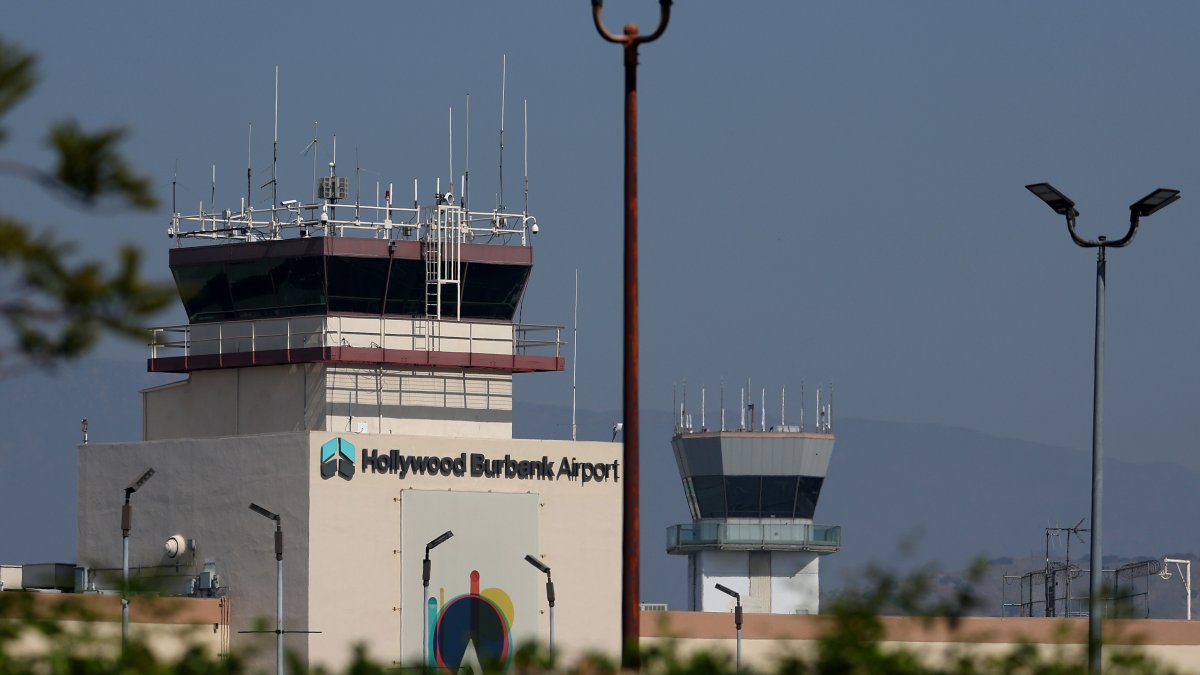
A close call earlier this month between a twin-engine Beechcraft 99 and helicopter at Hollywood Burbank Airport was cited by federal authorities Wednesday as a key factor behind a new airport safety measure.
The new order designed to improve safety near airports where helicopters cross both arrival and departure paths suspends use of visual separation between airplanes and helicopters and requires air traffic controllers to use radar to manage lateral and vertical separation between aircraft.
Among recent examples cited by the FAA as examples of the need for the order was a March 2 close call at Hollywood Burbank Airport.
A Beechcraft 99 was cleared to land at the San Fernando Valley airport when in “conflicted” with a helicopter on final approach. The plane and helicopter were on converging courses when the helicopter pilot turned to avoid the plane, the FAA said.
In another example, the agency said American Airlines Flight 1657 was cleared to land at San Antonio International Airport when a police helicopter was on its final approach path. The helicopter turned to avoid the American Airlines plane, the FAA said.
The new requirement applies to more than 150 of the nation’s busiest airports and extends a restriction already in place at Ronald Reagan Washington National Airport.
The upgraded safety measure was rolled out after a year-long FAA safety team review. In a news release, the FAA also referenced the Jan. 29 American Airlines jet and Army Black Hawk crash that killed 67 people. A key factor in the crash was the placement of a helicopter route in the approach path of Reagan National Airport’s secondary runway, the NTSB board said, also identifying air traffic controllers’ over reliance on asking helicopter pilots to avoid other aircraft as a factor.
“The tragedy over the Potomac one year ago revealed a startling truth: years of warning signs were missed, and the FAA needed dire reform,” U.S. Transportation Secretary Sean P. Duffy said. “Since then, we’ve implemented numerous changes to protect the skies over our capital and keep the traveling public safe.
“But the job isn’t done. Using innovative data analysis, the safety team at the FAA has identified the need for enhanced protocols at all airports across the National Airspace System. The Trump Administration will continue to act decisively to keep you and your family safe when you fly.”
In January, the chair of the National Transportation Safety Board expressed concerns over the possibility of a mid-air collision at Southern California’s Hollywood Burbank Airport. The comments from NTSB Chair Jennifer Homendy came at a news conference during a hearing about the investigation into the deadly mid-air crash last year near Washington, D.C. between an Army helicopter and an American Airlines plane.
Located in Los Angeles’ San Fernando Valley, the 555-acre Hollywood Burbank Airport about 12 miles north of downtown Los Angeles has two intersecting runways and handles about 6.5 million passengers each year and 74.8 million pounds of cargo.
Van Nuys Airport, about 9 miles to the west of Hollywood Burbank Airport, serves noncommercial air travel, such as private, corporate, and government aviation.