
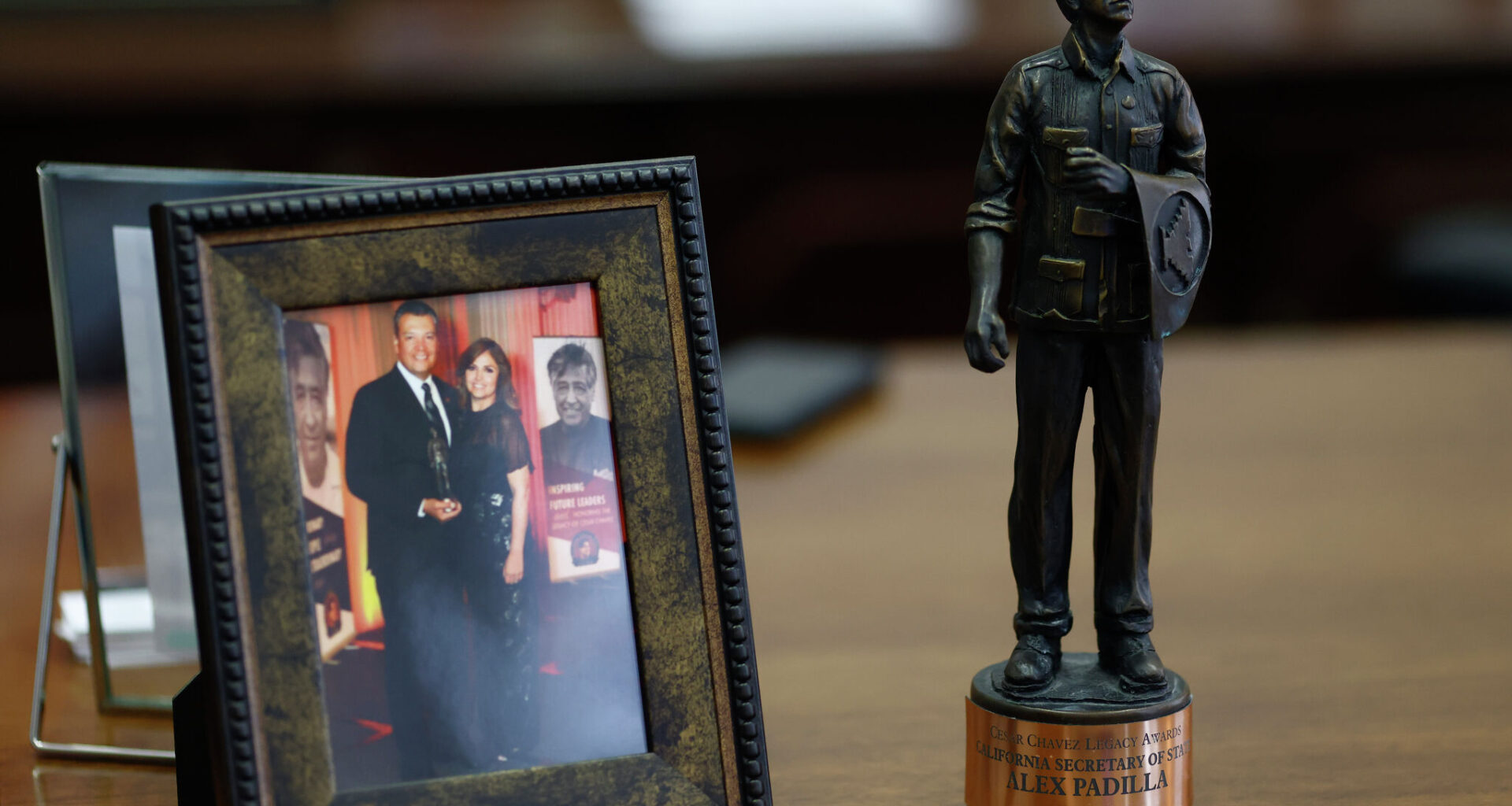
A statue of Cesar Chavez stands on the desk of Sen. Alex Padilla, D-Calif., in his office in the Hart Senate office building on Capitol Hill, in Washington, D.C., on May. 3, 2022.
Ting Shen/For the S.F. Chronicle
Former Los Angeles Mayor Antonio Villaraigosa, who’s running for governor, remembered meeting César Chávez at 15 and being inspired by the farm labor activist’s “seeming selflessness.”
California Attorney General Rob Bonta’s mother worked alongside — and lived near — the late United Farmworkers leader after fleeing the Ferdinand Marcos dictatorship in the Philippines and becoming involved in the Filipino-led Delano Grape Strike that brought Chávez national attention.
Sen. Alex Padilla, the son of Mexican immigrants and the first Latino to represent California in the U.S. Senate, once considered himself an inheritor of Chávez’s legacy.
Article continues below this ad
But around the state and across the country Wednesday, Latino leaders reeled from a report in the New York Times that the almost mythological figure had sexually abused girls for years, expressing shock, offering sympathy for the victims and calling for reconsidering the legacy of Chávez, who died in 1993 at age 66. Some immediately called to wipe away the many monuments to the man, arguing that the movement he led was always bigger than one person.
Padilla, who has carried bills to turn the former United Farm Workers headquarters and Chávez home in Keene into a national park, said he supported removing the labor leader’s name from landmarks and would rework his own legislation in honor of farmworkers.
San Francisco Chronicle Logo
Make us a Preferred Source to get more of our news when you search.
Add Preferred Source
“There must be zero tolerance for abuse, exploitation, and the silencing of victims, no matter who is involved,” he said in a statement. “Confronting painful truths and ensuring accountability is essential to honoring the very values the greater farm worker movement stands for — values rooted in dignity and justice for all.”
The most pressing challenge now facing California leaders is what to do about Cesar Chávez Day, an annual state holiday coming up quickly on March 31. Assembly Member Alexandra Macedo, R-Tulare, said she would introduce legislation to rename it to Farmworker Day to “honor the movement” and “the hands that feed us all,” though no Democrats in the state Legislature immediately jumped to support her proposal.
Article continues below this ad
A giant in California politics, where the United Farm Workers continue to carry outsized influence, Chávez’s name dots memorials and institutions across the state.
Organizers behind the upcoming Cesar Chávez Day breakfast and parade in San Francisco announced they would change the name to instead honor his longtime associate Dolores Huerta, who revealed in the Times story that Chávez raped her in 1966.
In the state capital, Sacramento Mayor Kevin McCarty announced the creation of a subcommittee to rename the city’s Cesar Chávez Plaza, which prominently features a statue of the man looking across the street at City Hall.
In Los Angeles, where Chávez moved in 1959 to lead a grassroots civil rights organization and where he attended the California presidential primary victory celebration at which Sen. Robert Kennedy was assassinated, the progressive nonprofit California Rising called for César Chávez Avenue to be renamed to Dolores Huerta Avenue.
“These allegations are not minor. They are deeply serious and deserve to be treated as such by every institution connected to his name and legacy,” state Sen. Suzette Martinez Valladares, R-Santa Clarita, and Assembly Member Kate Sanchez, R-Temecula, co-chairs of the California Hispanic Legislative Caucus, said in a statement. “Accountability cannot be set aside in deference to legacy; no historical significance exempts any individual from that standard.”
Article continues below this ad
Huerta, a Stockton native who co-founded the United Farm Workers union with Chávez in 1962, said in a statement after the Times report was published that Chávez impregnated her twice: during the rape and in an incident when he pressured her into having sex with him six years earlier. At 99, Huerta remains a flagbearer for the worker and immigrant rights causes that were nearly synonymous with Chávez.
On Wednesday, some Democratic leaders suggested that Huerta was always a truer representative of that work while noting that she now is taking on another difficult mantle, as a voice for sexual assault survivors.
“I thank Dolores Huerta for her strength and courage in coming forward,” Assembly Member Dawn Addis, D-Morro Bay, said in a statement. “I am also grateful to United Farm Workers for believing survivors and taking appropriate action in this moment. Across our state and nation, too many survivors have been forced to carry their experiences in silence: ignored when they try to speak, dismissed, or even attacked by those in power. Survivors must be believed.”
The revelations about Chávez also intersected with California’s crowded governor’s race.
Former U.S. Health and Human Services Secretary Xavier Becerra, another candidate for governor, said the allegations against Chávez had to be confronted.
Article continues below this ad
“The United Farm Workers movement was historic, and it is real. The fight for justice for America’s farmworkers was life-changing and real,” he said in a statement. “Clearly, there is a painful side to this story and Cesar Chavez that we must face. Iconic labor leader Dolores Huerta has come forward to tell her story and use her voice to empower other survivors to tell their story. We must stand behind the truth and those who live it.”
Villaraigosa, also a Democrat, wrestled with the rupture between myth and reality when it came to Chávez, once a personal inspiration.
Reflecting on his meeting with Chávez as a teen at the Joaquín Murrieta Center in East Los Angeles, Villaraigosa said he listened to Chávez speak about the Grape Boycott movement and felt inspired by “his quiet dignity.”
“These revelations are a punch in the gut for me and for so many who believed deeply in the cause of social justice,” Villaraigosa said in his statement. “Chávez’s legacy has long been defined by the fight for dignity and justice. That legacy helped transform our country and uplift farmworkers and Latino communities. But moral clarity demands that we hold two truths at once.”
Article continues below this ad