
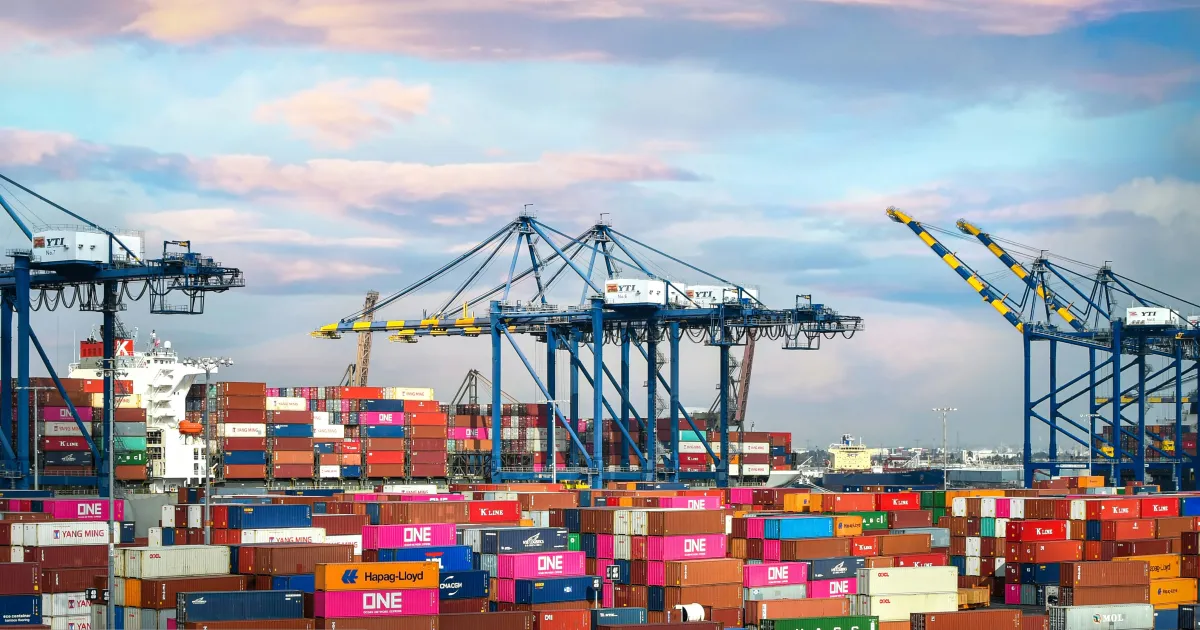
Shipping containers at the Port of Los Angeles. Changes in trade policy can quickly affect market access for farm products. Photo by Barrett Ward on UnsplashStudy finds a 64% drop in value of California agricultural exports to China
California agriculture has spent decades building export markets around the world, particularly in Asia. But new research published by the University of California Giannini Foundation of Agricultural Economics shows how quickly changes in trade policy can destroy market access critical to the success of some agricultural sectors. Agricultural economists Colin Carter, Sandro Steinbach and Yasin Yildirim found that in aggregate the top 13 California agricultural commodities exported to China fell from an average total annual value of around $1.55 billion in 2024 to $554 million in 2025 – a 64% decline in a single year.
After joining the World Trade Organization in 2001, China became one of California agriculture’s fastest-growing export markets, with exports of key crops (e.g., almonds, pistachios, dairy and cotton) to China expanding over the next two decades. But that trajectory changed in 2018-19 with the first U.S.-China trade war. Then, in 2025, while California farmers were still recovering from the effects of the 2018-19 trade war, the United States imposed tariffs on Chinese imports under the International Emergency Economic Powers Act. China responded with effective retaliatory tariffs on U.S. goods – including many California-grown agricultural products.
A cluster of pistachios grow on a tree. From 2024 to 2025, California pistachio shipments to China declined roughly 84%.
The authors found some of the largest losses in California’s tree nut industry. The value of annual pistachio exports to China declined by about $478 million, while almond exports fell by roughly $228 million. Export volumes dropped just as significantly: Almond shipments to China fell about 77%, while pistachio shipments declined roughly 84%. For these crops, and many others that saw export values decrease by 30% to 80% from their previous averages, the changes reflected just how quickly tariffs shift global demand toward competing suppliers, which is called trade diversion.
When trade barriers suddenly close a major export market, the effects are felt throughout the agricultural economy. The authors showed how the effects of this loss of market access affected several California counties. Counties with large agricultural sectors experienced some of the largest estimated annual export losses, including roughly $246 million in Fresno County and $238 million in Kern County. These losses can ripple through the processors, trucking companies, warehouses, and port facilities that support agricultural exports.
“Long-term trade relationships are fragile,” said Steinbach, professor of agribusiness and applied economics at North Dakota State University. “Trade policy shifts can easily destroy more than they protect.”
For farmers, the consequences of the current trade barriers will have both immediate and long-lasting effects. In the short term, reduced exports can put downward pressure on prices and limit marketing opportunities for crops that rely heavily on global demand. Over time, trade disruptions allow competing exporters to strengthen relationships with international buyers, making it harder for California producers to regain lost market share, even if tariffs are later reduced, as we saw in 2018-19.
Carter, professor emeritus in the Department of Agricultural and Resource Economics at UC Davis, emphasized that even the temporary exclusion from markets during the first trade war continues to harm farmers today, adding that “Rebuilding lost trust and market share will take years, if not decades, and would likely require hundreds of millions of dollars in market development efforts.”
To learn more about the implications of the current trade war with China on California agriculture, read the full article by Colin A. Carter, Sandro Steinbach and Yasin Yildirim: “2025 U.S.-China Trade Conflict Harms California Agriculture,” ARE Update 29(3): 1–5. UC Giannini Foundation of Agricultural Economics, online at https://giannini.ucop.edu/filer/file/1772215182/21582/.
ARE Update is a bimonthly magazine published by the Giannini Foundation of Agricultural Economics to educate policymakers and agribusiness professionals about new research or analysis of important topics in agricultural and resource economics. Articles are written by Giannini Foundation members, including University of California faculty and Cooperative Extension specialists in agricultural and resource economics, and university graduate students. Learn more about the Giannini Foundation and its publications at https://giannini.ucop.edu/.