
Read Mission Local often?
Help grow our newsroom, joining the 3,250 readers who support us by giving below.
In 1995, then-District 9 Supervisor Tom Ammiano cried, standing beside Eva Royale, the San Francisco regional manager for the United Farm Workers from 1900 to 2002, as the city unveiled the new signs renaming Army Street to Cesar Chavez Street.
Ammiano and Royale had embarked on an initiative seeking to pay tribute to the former United Farm Workers founder, who had died two years earlier.
Ammiano feels very differently today. “It’s very shattering to hear these revelations,” said Ammiano, who faced strong opposition when he sought to rename Army Street. Opposition, he said, that led to death threats, name-calling, bigotry and even a failed ballot proposition by Noe Valley residents.

Want the latest on the Mission and San Francisco? Sign up for our free daily newsletter below.
On Wednesday morning, the New York Times published a bombshell report five years in the making that Chavez had sexually abused at least two underaged girls between 1972 and 1977. Labor icon Dolores Huerta, 95, also told the Times on the record that Chavez sexually assaulted her twice — and that two of her children were, secretly, his.
“I just hate it for Dolores,” Ammiano said. “I hate it for the survivors. I hate it for all of us who really believed in him, and to hear this is very unsettling.”
Ammiano is one of many Mission residents and Latino leaders reached by Mission Local who reacted strongly to the allegations. They called the news highly disappointing, shattering and deeply sad, and reiterated their support for Huerta.
Most importantly, they said, Chavez’s alleged actions should not undermine the farmworker movement and the ongoing fight for labor rights.
Olga Miranda, president of SEIU Local 87, said local organizers are still processing the news.
“I love Dolores Huerta. We’ve grown up with these names in our households — Dolores Huerta and Cesar Chavez,” Miranda said. “It pains me to know that she’s endured this.”
Chavez’s presence in San Francisco is widespread. The student center at San Francisco State University and an elementary school in the Mission District are named after him.
The street named after him runs three miles through Districts 8, 9 and 10, and bisects the Mission. District 8 Supervisor Rafael Mandelman said he would defer to his Latina colleagues — Jackie Fielder and Myrna Melgar — when it comes to stripping Chavez’s name off the street. But, he said, “the current name’s days are numbered.”
District 9 Supervisor Jackie Fielder said in a statement that her “office will support community efforts to remove Cesar Chavez’s name from any District 9 institution.”
Melgar said talk of renaming would come later. “My heart is aching and crying…For all the folks calling for renaming things and cancelling things: let’s center those who are harmed FIRST,” she posted.
Changing the name of a street in San Francisco is typically a deeply arduous process. City policy on street name changes typically requires input from up to five departments — the Department of Public Works, the Planning Department, the Police Department, the Fire Department, and the Department of Building Inspection — and multiple actions from the Board of Supervisors.
Even after that, it may be difficult to truly erase Chavez’s name, as city rules typically require a street’s former name to also be featured on street signs for a period of five years. Army Street, incidentally, is still featured on Cesar Chavez Street signs.
The last major street name change undertaken in San Francisco came in 2014. After former Polish president Lech Walesa made deeply homophobic statements, the small street near City Hall bearing his name was changed to honor Gay Games founder Dr. Tom Waddell.
On smaller-scale changes, a student at San Francisco State who works at the student center’s front desk told Mission Local that they were instructed to obscure Cesar Chavez’s name on the front desk.
As for changing the name of the elementary school in the Mission, a spokesperson for the San Francisco Unified School District said “the district is closely monitoring the situation” and “shares the community’s concerns regarding the recent allegations involving Cesar Chavez.”
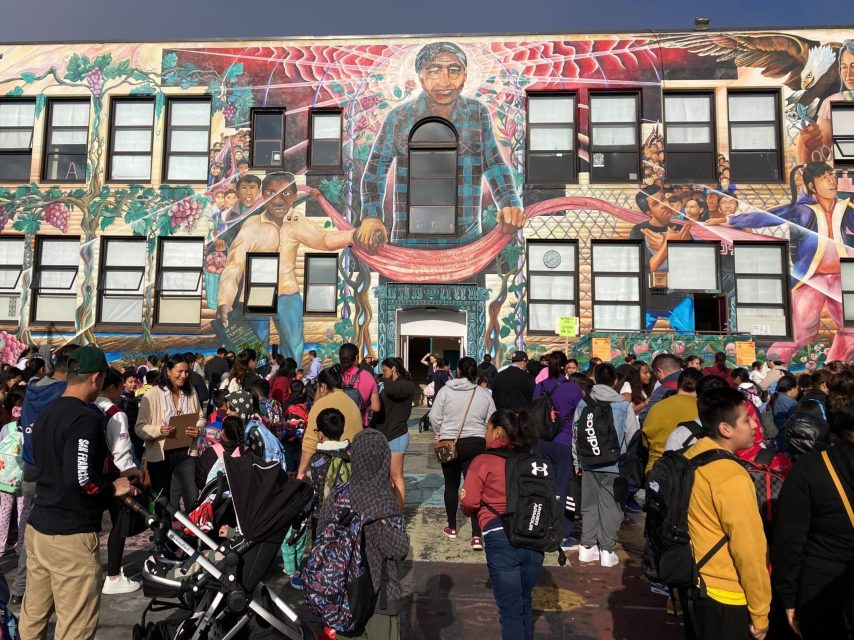 The back to school crowds on the blacktop at Cesar Chavez Elementary on Aug. 19, 2024. Photo by Anne Li.
Miranda of SEIU Local 87, for her part, said the revelations shouldn’t overshadow the importance of the United Farm Workers’ mission: to improve labor conditions for people who put food on our tables.
“This is not an opportunity to whitewash murals and rename streets,” she said. “This is a time to take accountability and recognize that there’s still a lot to work for.”
Ani Rivera, executive director of Galeria de la Raza, called today’s news devastating, but celebrated Huerta’s bravery.
“This didn’t happen in isolation,” said Rivera. “This is why we need a women’s agenda. I always say believe women. We have to believe women.”
Spokespeople for Huerta said she is not granting interviews at this time.
Former District 9 Supervisor David Campos, who met Chavez during Campos’ undergraduate days at Stanford University, echoed Rivera. Especially wrenching, he said, is the loss of what Chavez had represented for the Latino community: a symbol of empowerment and community organizing.
He was “very sad to see what has come out, especially because he’s the only figure who’s represented us,” Campos said. “The allegations are very serious and are very credible.”
Knowing that Huerta “suffered in silence for decades,” he said, was wrenching. “I’m very proud of her courage to come forward and to talk about something that is so painful.”
Additional reporting by Joe Eskenazi.
Join the 3,300 readers who keep Mission Local free for all!
Because of you, Mission Local reached and surpassed our $300,000 year-end fundraising goal. All we can say is thank you.
Thank you for choosing to invest in a local newsroom rooted in San Francisco’s communities — one that listens first and reports deeply.
If you haven’t yet had a chance to give, it’s not too late to be part of this community. Your contribution today helps sustain the reporting our city relies on all year long.
We’re grateful you’re here — and we’d be honored to have you join our donors.