
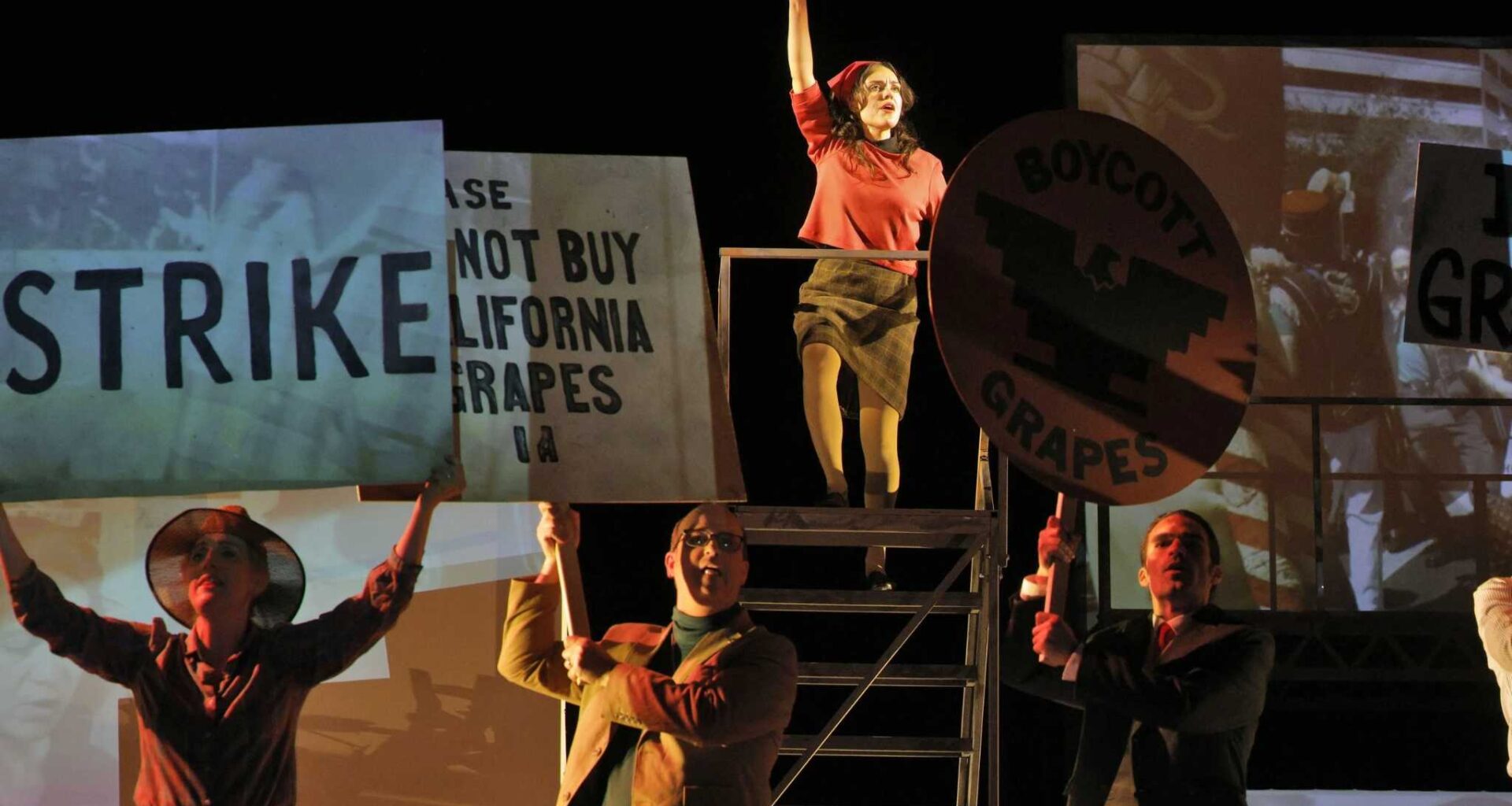
Kelly Guerra portrays Dolores Huerta, the labor leader who fought for civil rights during the 1968 Delano Grape Strike, in West Edge Opera’s “Dolores” in Oakland in August 2025.
West Edge Opera
Last year, when Dolores Huerta’s third cousin, composer Nicolás Lell Benavides, premiered an opera called “Dolores,” it was an unalloyed triumph at West Edge Opera.
“The show is dramatically tight and musically transporting,” correspondent Michael Zwiebach wrote in his Chronicle review of the production that focuses on one tumultuous year of the five-year Delano grape strike.
He concluded, “‘Dolores’ is guaranteed to have further performances after this run. It deserves them.”
Article continues below this ad
Now, with the devastating news that United Farm Workers co-founder Cesar Chavez preyed on young girls and repeatedly raped Huerta, his co-leader, the long-held narrative about the movement’s most revered figures is no longer so clear. That means the task of their storytellers becomes much more complex too.
Composer Nicolás Lell Benavides, left, and librettist Marella Martin Koch, speaking at a 2022 event for Seattle’s Music of Remembrance, are the creators of “Dolores.”
Ben VanHouten/VanHouten Photography
Benavides and librettist Marella Martin Koch aren’t the only ones facing difficult artistic choices as a result of the news.
San Francisco Chronicle Logo
Make us a Preferred Source to get more of our news when you search.
Add Preferred Source
Oakland Theater Project recently announced that its 2026 season will conclude in November with the world premiere of “She Se Puede (A Chorus of Huertas).” Lisa Ramirez’s play, to be directed by Karina Gutiérrez, is also about the life and work of the labor leader.
Article continues below this ad
In a joint statement to the Chronicle, Benavides and Martin Koch were clear that focus should be on the survivors.
“We are deeply dismayed by the news of the indefensible and predatory behavior of the late Cesar Chavez,” they wrote of the revelations, which the New York Times first reported Tuesday, March 17. “Our hearts, first and foremost, are with Dolores Huerta and the other survivors, some of whom were children when they were sexually assaulted. It must have been horrible to carry that burden, unable to speak the truth because of Cesar’s sway and power.”
They also stood by their work, which West Edge Opera commissioned.
Dolores Huerta, left, and mezzo-soprano Kelly Guerra at a 2023 preview performance of “Dolores” in San Francisco.
West Edge Opera
“Our opera centers Dolores: her leadership, her resilience, and the many personal sacrifices she made on behalf of the union and the farm workers,” the statement reads. “That has not changed.”
Article continues below this ad
West Edge Opera General Director Mark Streshinsky reiterated the company’s commitment to Huerta, Benavides and Martin Koch.
“The revelations of today are a reminder that no story is ever fully told and that we don’t know the weight people carry with them daily,” he said in a statement. “We rally around Dolores, her community, Nicolás, and Marella and will always support the need to express complex stories through art.”
After the opera’s August world premiere at Oakland’s Scottish Rite Center, it had a run at Opera Southwest in Albuquerque, N.M., in October. San Diego Opera and BroadStage in Santa Monica (Los Angeles County) have both expressed interest in mounting the title in future seasons, but no dates have been announced. Neither organization’s representative immediately responded to the Chronicle’s query.
Meanwhile, Benavides and Martin Koch did not directly address whether they would revise the libretto for “Dolores” or whether future productions would be affected. They said only, “The release of this disturbing information about Cesar Chavez brings new context that will take us time to process.”
Playwright Lisa Ramirez, left, and labor leader Dolores Huerta. This week Huerta revealed that United Farm Workers co-founder Cesar Chavez repeatedly raped her and preyed on young girls.
Courtesy of Michele Noble
By contrast, Ramirez’s play, which features six versions of Huerta at different phases in her life, is in an early draft. “This is going to be a part of the piece,” she told the Chronicle of the news. “It has to be.”
Article continues below this ad
Ramirez, who said she’s also a survivor of rape, empathized with Huerta’s decades of silence on multiple levels. “I blacked out the memory for 20 years after, so I understand not coming out about something like this,” she said.
But Huerta, Ramirez continued, put the affected children and the movement first.
“In the same way that she fought for farmworkers male and female, she’s not going to let these women now — that were young women — stand alone,” she said.
In an interview leading up to the West Edge production, Benavides, a New Mexico native, recalled fond childhood memories of Huerta. “She would frequently be at big family reunions we’d have in El Paso. She was present and attentive, particularly to children,” he said at the time.
The cast of West Edge Opera performs the world premiere of “Dolores” in Oakland in August 2025.
West Edge Opera
He chose to focus his opera on 1968, when the assassination of Robert F. Kennedy lost Huerta and Chavez a key ally and the grueling strike had already been going on for three years. “I wanted to show what it felt like to deal with such high stakes, to go through such immense loss and to discover the light on the other side,” he said. “A lot of ancient mythological stories are built that way — where heroes go through trials, emerge victorious and teach us something about resolve.”
Article continues below this ad
Inevitably, many past reflections on Huerta and Chavez now sound rife with dramatic irony or hidden double meanings. The opera imagined heated conversations between the two leaders, and last year Benavides said his goal was to show that neither historical movements nor their torchbearers are preordained. “Leadership isn’t this unified, dreamy state where everyone knows what to do and how to do it,” he said.
Now the storytellers might be less unified too in how they approach that history, as the revelations complicate both the movement and its leaders.
For her part, Ramirez predicted that Huerta won’t recede into the shadows — and neither will Ramirez or her play. When asked if she considered abandoning the project, Ramirez said, “Hell no.”