
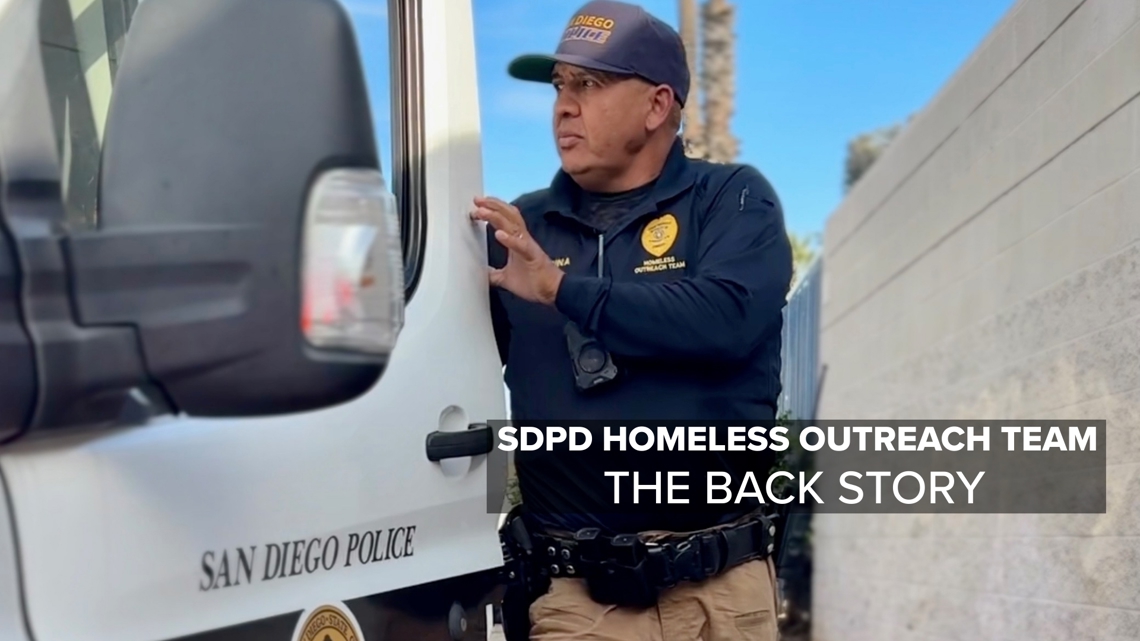
San Diego’s Homeless Outreach Team redefines policing by building rapport with unsheltered residents. Success stories highlight its impact on reducing homelessness.
SAN DIEGO — People in San Diego are often just a few missed paychecks away from homelessness.
Veterans, corporate workers, mothers and father — people who once has stable lives — are now sleeping on the streets, in cars, in parks. Job loss, mental health, domestic violence or substance abuse can be the catalyst that pushes someone out from under shelter.
Homelessness is decreasing in the city of San Diego according to last year’s “Point in Time Count,” the annual survey conducted each year to act as a snapshot for the region’s homelessness trends. City officials credit the Safe Sleeping Program and the Unsafe Camping Ordinance, among other programs, for the reduction.
But San Diego police officers are often the ones who make first contact with unsheltered San Diegans. In 2018, the San Diego Police department decided to try something unorthodox. Members of the new unit, called the Homeless Outreach Team, wore different clothes than the average police officer. They drove different cars. They had specialized training. The goal was to build relationships, to get to know people, to unsheltered San Diego residents where they were at.
The data shows it’s worked. So do the success stories.
News 8 sat down with San Diego Police’s Lieutenant Matthew Botkin and Sergeant Kayla Evans to learn how one unit within the department is addressing homelessness through consistent outreach and rapport.
“One thing that we’ve learned over the course of our careers, and really in the heavy amount of interactions that we have, when it comes to dealing and interacting with people who are experiencing homelessness, is that rapport is everything. If we don’t have rapport, we really don’t have anything. We have lots of resources. We have lots of services, community partners. But if we don’t have the cooperation of someone, then we’re not going to get a lot accomplished. And so the rapport building is really where those [plain clothes] uniforms come in. Homeless Outreach wear something similar to what I have on, which is a polo shirt and khaki pants with the regular duty belt. They still have a law enforcement function to perform, but that, just by itself, is helpful in gaining rapport. They drive vehicles that are just all white with San Diego police markings on them, but not the traditional black and white vehicles that you normally you see. And then Intervention Services Team, they take that one step further. They wear regular clothing like anybody else wears to the office, and they drive plain-marked cars. That really is the first step in reducing barriers, which is what we’re all about. We don’t want someone to not speak with us because they have a prior bad event or preconceived notion about who we are and what law enforcement is.”
“We had an individual who has had substance abuse issues for years. He’s a well-known individual in Downtown area. Everyone knows who he is. He’s been arrested, he’s been transported. He kind of came on our radar, and we reached out to him and just said, ‘Hey, when you’re ready, we’ll help you.’ There was a lot of resistance in beginning, a lot of, you know, building that trust, lot of contacts with him. Eventually he realized that, ‘Hey, we’re not here to get you in trouble. We’re here to help you. We’re not judging you.’ And it worked. He started trusting them. I think he reached his breaking point, and he was ready for help, and got to the point where he would relapse, and he would call my guys and say, ‘Hey, I started drinking again. This is where I’m at. Can you come help me?’ And we’ll be there, and we drive, go find him. Sometimes it was ordering medics for him because he was very intoxicated. And sometimes it’s like, ‘Hey, let’s go to detox and sober up and we’ll meet you tomorrow, and we’ll start again.’ It’s been a couple months, been almost a year now, and he’s sober, he’s thriving. He actually moved to be closer to family in a different state, and every once in a while, he’ll check up on us and just reach out and say, ‘Hey, I’m still sober. I’m still doing good.’ It’s just a really happy ending. Seeing someone that was so rock bottom and just at their most vulnerable, and to see them thriving. Now, it’s really rewarding.”